

12.5.2.5 Nanofiltration Membranes
Nanofiltration membranes have the pore size of 1 Â 10
À9 m i.e., 1 nm). Their size is
formed by comparing the size of the sodium ion (0.97 nm i.e. 0.97 Â 10
À9 ) and
chlorine ion (1.8 nm i.e., 1.8 Â 10
À9 m). Therefore, they have the capacity to remove
the contaminants to a very small size range. These membranes work under the
influence of the two processes i.e., ultrafiltration and osmosis. That’s why this
process is called as the hybrid process which acts as a bridge between the ultrafiltration and the osmotic membrane. But these membranes are sensitive to some physical
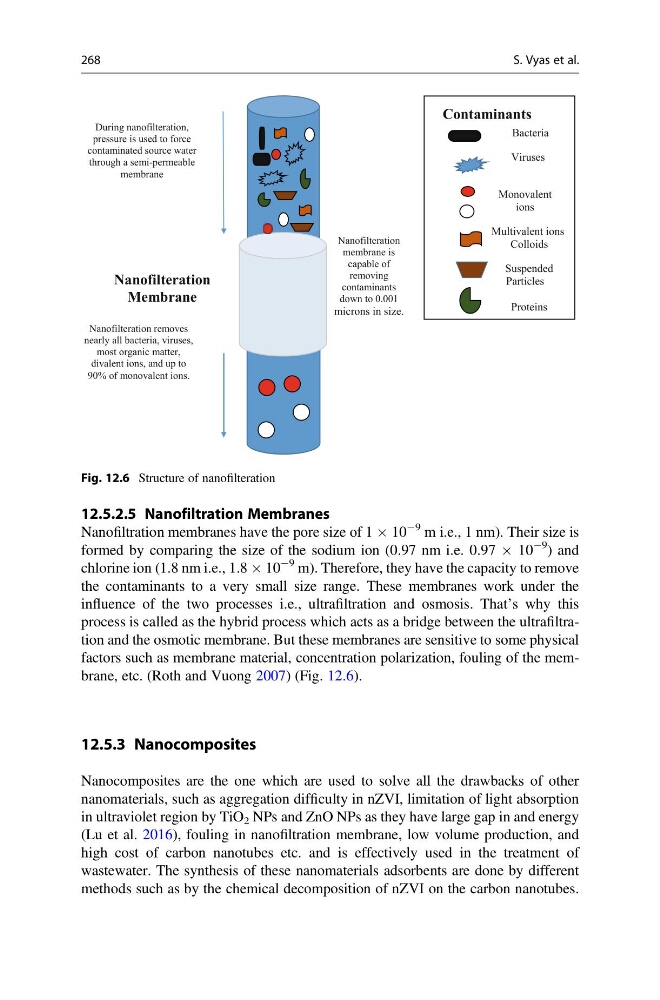
factors such as membrane material, concentration polarization, fouling of the membrane, etc. (Roth and Vuong 2007) (Fig. 12.6).
12.5.3 Nanocomposites
Nanocomposites are the one which are used to solve all the drawbacks of other
nanomaterials, such as aggregation difficulty in nZVI, limitation of light absorption
in ultraviolet region by TiO 2 NPs and ZnO NPs as they have large gap in and energy
(Lu et al. 2016), fouling in nanofiltration membrane, low volume production, and
high cost of carbon nanotubes etc. and is effectively used in the treatment of
wastewater. The synthesis of these nanomaterials adsorbents are done by different
methods such as by the chemical decomposition of nZVI on the carbon nanotubes.
Bacteria
Viruses
Monovalent
ions
Multivalent ions
Colloids
Suspended
Particles
Proteins
Contaminants
During nanofilteration,
pressure is used to force
contaminated source water
through a semi-permeable
membrane
Nanofilteration
Membrane
Nanofilteration removes
nearly all bacteria, viruses,
most organic matter,
divalent ions, and up to
90% of monovalent ions.
Nanofilteration
membrane is
capable of
removing
contaminants
down to 0.001
microns in size.
Fig. 12.6 Structure of nanofilteration
268
S. Vyas et al.
Nanofiltration membranes have the pore size of 1 Â 10
À9 m i.e., 1 nm). Their size is
formed by comparing the size of the sodium ion (0.97 nm i.e. 0.97 Â 10
À9 ) and
chlorine ion (1.8 nm i.e., 1.8 Â 10
À9 m). Therefore, they have the capacity to remove
the contaminants to a very small size range. These membranes work under the
influence of the two processes i.e., ultrafiltration and osmosis. That’s why this
process is called as the hybrid process which acts as a bridge between the ultrafiltration and the osmotic membrane. But these membranes are sensitive to some physical
factors such as membrane material, concentration polarization, fouling of the membrane, etc. (Roth and Vuong 2007) (Fig. 12.6).
12.5.3 Nanocomposites
Nanocomposites are the one which are used to solve all the drawbacks of other
nanomaterials, such as aggregation difficulty in nZVI, limitation of light absorption
in ultraviolet region by TiO 2 NPs and ZnO NPs as they have large gap in and energy
(Lu et al. 2016), fouling in nanofiltration membrane, low volume production, and
high cost of carbon nanotubes etc. and is effectively used in the treatment of
wastewater. The synthesis of these nanomaterials adsorbents are done by different
methods such as by the chemical decomposition of nZVI on the carbon nanotubes.
Bacteria
Viruses
Monovalent
ions
Multivalent ions
Colloids
Suspended
Particles
Proteins
Contaminants
During nanofilteration,
pressure is used to force
contaminated source water
through a semi-permeable
membrane
Nanofilteration
Membrane
Nanofilteration removes
nearly all bacteria, viruses,
most organic matter,
divalent ions, and up to
90% of monovalent ions.
Nanofilteration
membrane is
capable of
removing
contaminants
down to 0.001
microns in size.
Fig. 12.6 Structure of nanofilteration
268
S. Vyas et al.