

Alkenes and alkynes are known as unsaturated hydrocarbons because some of the
carbons are connected to fewer than four neighboring atoms. Alkenes contain at least
one double bond, while alkynes contain at least one triple bond. Alkenes are
characterized by the general molecular formula C n H 2n , alkynes by C n H 2n À 2 . Ethene
(C 2 H 4 ) is the simplest alkene and ethyne (C 2 H 2 ) is the simplest alkyne.
9.2.2 Aromatic Hydrocarbons
Aromatic hydrocarbons contain at least one benzene ring. These are also called as
arenes. These compounds possess special properties due to the delocalized electron
density in benzene, including additional stabilization. Aromatic hydrocarbons can be
classified into two types: monoaromatic hydrocarbons and polyaromatic
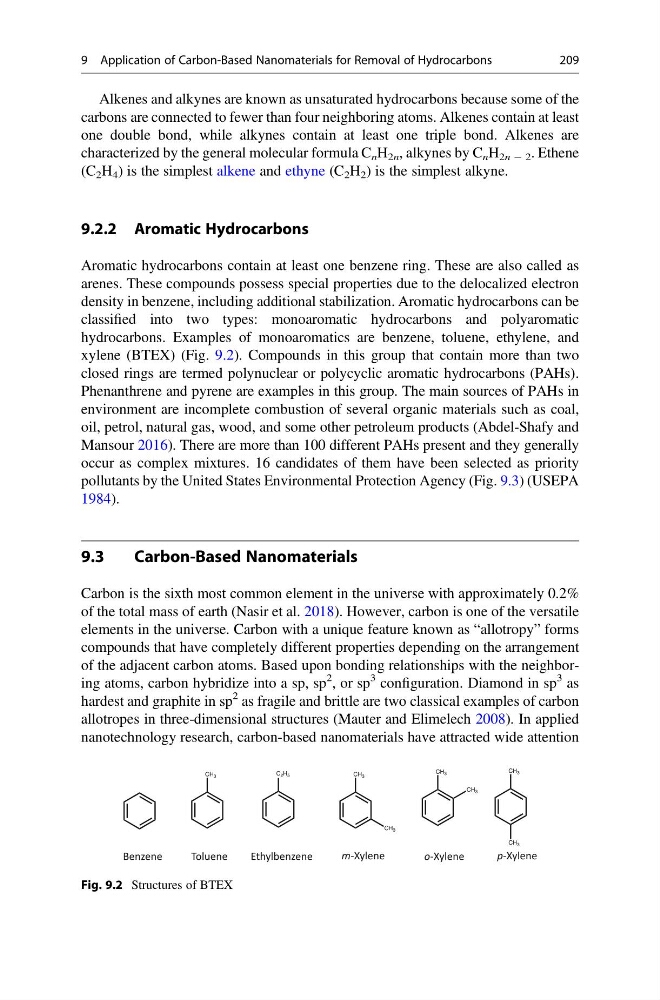
hydrocarbons. Examples of monoaromatics are benzene, toluene, ethylene, and
xylene (BTEX) (Fig. 9.2). Compounds in this group that contain more than two
closed rings are termed polynuclear or polycyclic aromatic hydrocarbons (PAHs).
Phenanthrene and pyrene are examples in this group. The main sources of PAHs in
environment are incomplete combustion of several organic materials such as coal,
oil, petrol, natural gas, wood, and some other petroleum products (Abdel-Shafy and
Mansour 2016). There are more than 100 different PAHs present and they generally
occur as complex mixtures. 16 candidates of them have been selected as priority
pollutants by the United States Environmental Protection Agency (Fig. 9.3) (USEPA
1984).
9.3
Carbon-Based Nanomaterials
Carbon is the sixth most common element in the universe with approximately 0.2%
of the total mass of earth (Nasir et al. 2018). However, carbon is one of the versatile
elements in the universe. Carbon with a unique feature known as “allotropy” forms
compounds that have completely different properties depending on the arrangement
of the adjacent carbon atoms. Based upon bonding relationships with the neighboring atoms, carbon hybridize into a sp, sp
2 , or sp
3 configuration. Diamond in sp
3 as
hardest and graphite in sp
2 as fragile and brittle are two classical examples of carbon
allotropes in three-dimensional structures (Mauter and Elimelech 2008). In applied
nanotechnology research, carbon-based nanomaterials have attracted wide attention
Fig. 9.2 Structures of BTEX
9 Application of Carbon-Based Nanomaterials for Removal of Hydrocarbons
209
carbons are connected to fewer than four neighboring atoms. Alkenes contain at least
one double bond, while alkynes contain at least one triple bond. Alkenes are
characterized by the general molecular formula C n H 2n , alkynes by C n H 2n À 2 . Ethene
(C 2 H 4 ) is the simplest alkene and ethyne (C 2 H 2 ) is the simplest alkyne.
9.2.2 Aromatic Hydrocarbons
Aromatic hydrocarbons contain at least one benzene ring. These are also called as
arenes. These compounds possess special properties due to the delocalized electron
density in benzene, including additional stabilization. Aromatic hydrocarbons can be
classified into two types: monoaromatic hydrocarbons and polyaromatic
hydrocarbons. Examples of monoaromatics are benzene, toluene, ethylene, and
xylene (BTEX) (Fig. 9.2). Compounds in this group that contain more than two
closed rings are termed polynuclear or polycyclic aromatic hydrocarbons (PAHs).
Phenanthrene and pyrene are examples in this group. The main sources of PAHs in
environment are incomplete combustion of several organic materials such as coal,
oil, petrol, natural gas, wood, and some other petroleum products (Abdel-Shafy and
Mansour 2016). There are more than 100 different PAHs present and they generally
occur as complex mixtures. 16 candidates of them have been selected as priority
pollutants by the United States Environmental Protection Agency (Fig. 9.3) (USEPA
1984).
9.3
Carbon-Based Nanomaterials
Carbon is the sixth most common element in the universe with approximately 0.2%
of the total mass of earth (Nasir et al. 2018). However, carbon is one of the versatile
elements in the universe. Carbon with a unique feature known as “allotropy” forms
compounds that have completely different properties depending on the arrangement
of the adjacent carbon atoms. Based upon bonding relationships with the neighboring atoms, carbon hybridize into a sp, sp
2 , or sp
3 configuration. Diamond in sp
3 as
hardest and graphite in sp
2 as fragile and brittle are two classical examples of carbon
allotropes in three-dimensional structures (Mauter and Elimelech 2008). In applied
nanotechnology research, carbon-based nanomaterials have attracted wide attention
Fig. 9.2 Structures of BTEX
9 Application of Carbon-Based Nanomaterials for Removal of Hydrocarbons
209