

biocompatible and less toxic particles. Therefore, it is not wrong in saying that
transformation of waste biomass to useful C-dots has made a significant impact in
finding new technologies for handling environmental concerns.
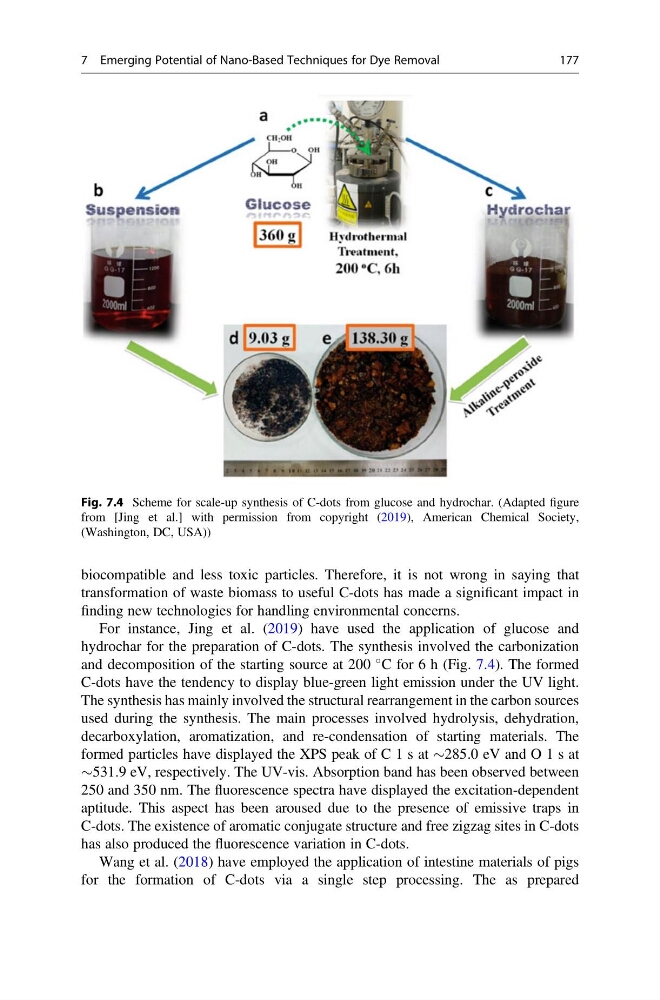
For instance, Jing et al. (2019) have used the application of glucose and
hydrochar for the preparation of C-dots. The synthesis involved the carbonization
and decomposition of the starting source at 200
C for 6 h (Fig. 7.4). The formed
C-dots have the tendency to display blue-green light emission under the UV light.
The synthesis has mainly involved the structural rearrangement in the carbon sources
used during the synthesis. The main processes involved hydrolysis, dehydration,
decarboxylation, aromatization, and re-condensation of starting materials. The
formed particles have displayed the XPS peak of C 1 s at $285.0 eV and O 1 s at
$531.9 eV, respectively. The UV-vis. Absorption band has been observed between
250 and 350 nm. The fluorescence spectra have displayed the excitation-dependent
aptitude. This aspect has been aroused due to the presence of emissive traps in
C-dots. The existence of aromatic conjugate structure and free zigzag sites in C-dots
has also produced the fluorescence variation in C-dots.
Wang et al. (2018) have employed the application of intestine materials of pigs
for the formation of C-dots via a single step processing. The as prepared
Fig. 7.4 Scheme for scale-up synthesis of C-dots from glucose and hydrochar. (Adapted figure
from [Jing et al.] with permission from copyright (2019), American Chemical Society,
(Washington, DC, USA))
7 Emerging Potential of Nano-Based Techniques for Dye Removal
177
transformation of waste biomass to useful C-dots has made a significant impact in
finding new technologies for handling environmental concerns.
For instance, Jing et al. (2019) have used the application of glucose and
hydrochar for the preparation of C-dots. The synthesis involved the carbonization
and decomposition of the starting source at 200
C for 6 h (Fig. 7.4). The formed
C-dots have the tendency to display blue-green light emission under the UV light.
The synthesis has mainly involved the structural rearrangement in the carbon sources
used during the synthesis. The main processes involved hydrolysis, dehydration,
decarboxylation, aromatization, and re-condensation of starting materials. The
formed particles have displayed the XPS peak of C 1 s at $285.0 eV and O 1 s at
$531.9 eV, respectively. The UV-vis. Absorption band has been observed between
250 and 350 nm. The fluorescence spectra have displayed the excitation-dependent
aptitude. This aspect has been aroused due to the presence of emissive traps in
C-dots. The existence of aromatic conjugate structure and free zigzag sites in C-dots
has also produced the fluorescence variation in C-dots.
Wang et al. (2018) have employed the application of intestine materials of pigs
for the formation of C-dots via a single step processing. The as prepared
Fig. 7.4 Scheme for scale-up synthesis of C-dots from glucose and hydrochar. (Adapted figure
from [Jing et al.] with permission from copyright (2019), American Chemical Society,
(Washington, DC, USA))
7 Emerging Potential of Nano-Based Techniques for Dye Removal
177