

removal of contaminants (Fu et al. 2014). Iron nanoparticles can also be modified
into various forms. The most extensively used nanomaterial is bimetallic nano-sacle
zero valent iron (nZVI). This bimetallic nanomaterial shows very high reactivity
towards vast varieties of pollutants. For example surface modified nZVI for better
distribution, carbon supported nZnVI for stability, and emulsified nZnVI for better
miscibility. Their large surface and high reduction capacity makes them beneficial
adsorbent for the future use (Luo et al. 2012; Dave and Chopda 2014).
6.6.3 Silver Nanoparticles
Silver nanoparticles are considered as viable adsorbents because of their chemical
and physical properties. They are biocompatible, highly catalytic active and easily
seperable. They can be modified by mixing with different metal oxides like ZnO,
SiO 2 , TiO 2 which makes them efficent tool for environmental remediation. Silver
nanoparticles can be also transformed by adding different stabilizers like surfactants,
CMC and polymers which alter their properties like lower reduction potential, more
stability and less aggregation, which make them highly effective. Also Silver
nanoparticles when coordinated with mercaptosuccinic acid used for the removal of
broad group of heavy metals (Theron et al. 2008; Sun et al. 2007).
6.7
Metal-Based Nanomaterials
Iron oxide-based nanomaterials are considered to be the finest method in the removal
of the metal contamination (Saharan et al. 2014). Iron oxide considered to be one of
fourth most abundant heavy element in the earth’s crust because of its abundance in
nature and its oxides have wide utilization in remediation of pollutants. One of the
most investigated iron oxides is goethite, magnetite, maghemite, and hydrous
oxides.
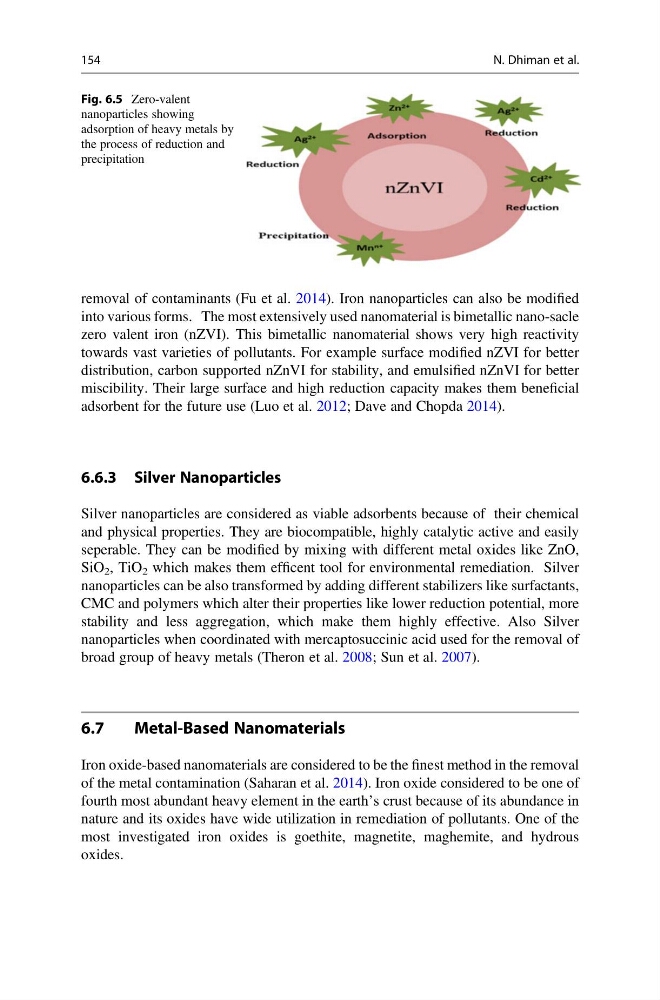
Fig. 6.5 Zero-valent
nanoparticles showing
adsorption of heavy metals by
the process of reduction and
precipitation
154
N. Dhiman et al.
into various forms. The most extensively used nanomaterial is bimetallic nano-sacle
zero valent iron (nZVI). This bimetallic nanomaterial shows very high reactivity
towards vast varieties of pollutants. For example surface modified nZVI for better
distribution, carbon supported nZnVI for stability, and emulsified nZnVI for better
miscibility. Their large surface and high reduction capacity makes them beneficial
adsorbent for the future use (Luo et al. 2012; Dave and Chopda 2014).
6.6.3 Silver Nanoparticles
Silver nanoparticles are considered as viable adsorbents because of their chemical
and physical properties. They are biocompatible, highly catalytic active and easily
seperable. They can be modified by mixing with different metal oxides like ZnO,
SiO 2 , TiO 2 which makes them efficent tool for environmental remediation. Silver
nanoparticles can be also transformed by adding different stabilizers like surfactants,
CMC and polymers which alter their properties like lower reduction potential, more
stability and less aggregation, which make them highly effective. Also Silver
nanoparticles when coordinated with mercaptosuccinic acid used for the removal of
broad group of heavy metals (Theron et al. 2008; Sun et al. 2007).
6.7
Metal-Based Nanomaterials
Iron oxide-based nanomaterials are considered to be the finest method in the removal
of the metal contamination (Saharan et al. 2014). Iron oxide considered to be one of
fourth most abundant heavy element in the earth’s crust because of its abundance in
nature and its oxides have wide utilization in remediation of pollutants. One of the
most investigated iron oxides is goethite, magnetite, maghemite, and hydrous
oxides.
Fig. 6.5 Zero-valent
nanoparticles showing
adsorption of heavy metals by
the process of reduction and
precipitation
154
N. Dhiman et al.