

6.1
Introduction
Heavy metals are the metallic compounds having relative densities higher than that
of water (Paul et al. 2012). They are naturally occurring metal/metalloids found in
earth crust. Heavy metal pollution is caused by both natural (weathering, volcanic
activities, natural calamities, etc.) and anthropogenic activities like mining, smelting,
industrial, and agricultural. Apart from natural sources anthropogenic activities are
considered to be the major contributor of heavy metal pollution. Usage of heavy
metals like cadmium, arsenic, selenium, lead, and mercury in such a large extent
affects lithosphere, hydrosphere, atmosphere, and biosphere. Due to industrialization
and urbanization, effluent from industries has become the main source of water and
soil pollution (Hillie and Hlophe 2007; Sheet et al. 2014). Agriculture sector
includes chemical fertilizers containing heavy metals used in crop fields also affect
the overall structure of soil, and rest of the water seeps down, contaminates the
ground water as well as the nearest water bodies (ponds, streams, and rivers). By the
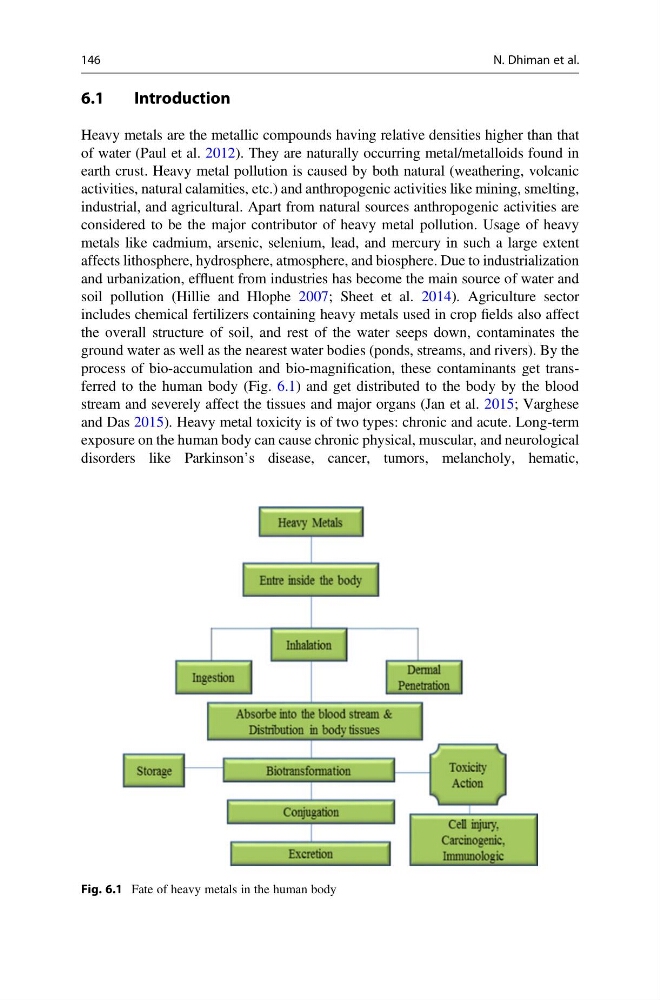
process of bio-accumulation and bio-magnification, these contaminants get transferred to the human body (Fig. 6.1) and get distributed to the body by the blood
stream and severely affect the tissues and major organs (Jan et al. 2015; Varghese
and Das 2015). Heavy metal toxicity is of two types: chronic and acute. Long-term
exposure on the human body can cause chronic physical, muscular, and neurological
disorders like Parkinson’s disease, cancer, tumors, melancholy, hematic,
Fig. 6.1 Fate of heavy metals in the human body
146
N. Dhiman et al.
Introduction
Heavy metals are the metallic compounds having relative densities higher than that
of water (Paul et al. 2012). They are naturally occurring metal/metalloids found in
earth crust. Heavy metal pollution is caused by both natural (weathering, volcanic
activities, natural calamities, etc.) and anthropogenic activities like mining, smelting,
industrial, and agricultural. Apart from natural sources anthropogenic activities are
considered to be the major contributor of heavy metal pollution. Usage of heavy
metals like cadmium, arsenic, selenium, lead, and mercury in such a large extent
affects lithosphere, hydrosphere, atmosphere, and biosphere. Due to industrialization
and urbanization, effluent from industries has become the main source of water and
soil pollution (Hillie and Hlophe 2007; Sheet et al. 2014). Agriculture sector
includes chemical fertilizers containing heavy metals used in crop fields also affect
the overall structure of soil, and rest of the water seeps down, contaminates the
ground water as well as the nearest water bodies (ponds, streams, and rivers). By the
process of bio-accumulation and bio-magnification, these contaminants get transferred to the human body (Fig. 6.1) and get distributed to the body by the blood
stream and severely affect the tissues and major organs (Jan et al. 2015; Varghese
and Das 2015). Heavy metal toxicity is of two types: chronic and acute. Long-term
exposure on the human body can cause chronic physical, muscular, and neurological
disorders like Parkinson’s disease, cancer, tumors, melancholy, hematic,
Fig. 6.1 Fate of heavy metals in the human body
146
N. Dhiman et al.