

Detection of water-borne pathogens like Escherichia coli (E. coli), Vibrio
cholerae, Legionella pneumophila, Staphylococcus aureus (S. aureus), hepatitis B
virus (HBV), etc., is necessary as these pathogens are the source of several serious
water-borne ailments like cholera (by bacterium Vibrio cholerae). For e.g., between
2011 and 2012, Legionella pneumophila was responsible for outbreak of more than
50% water-borne diseases (Willner and Vikesland 2018). Melaine et al. (2017)
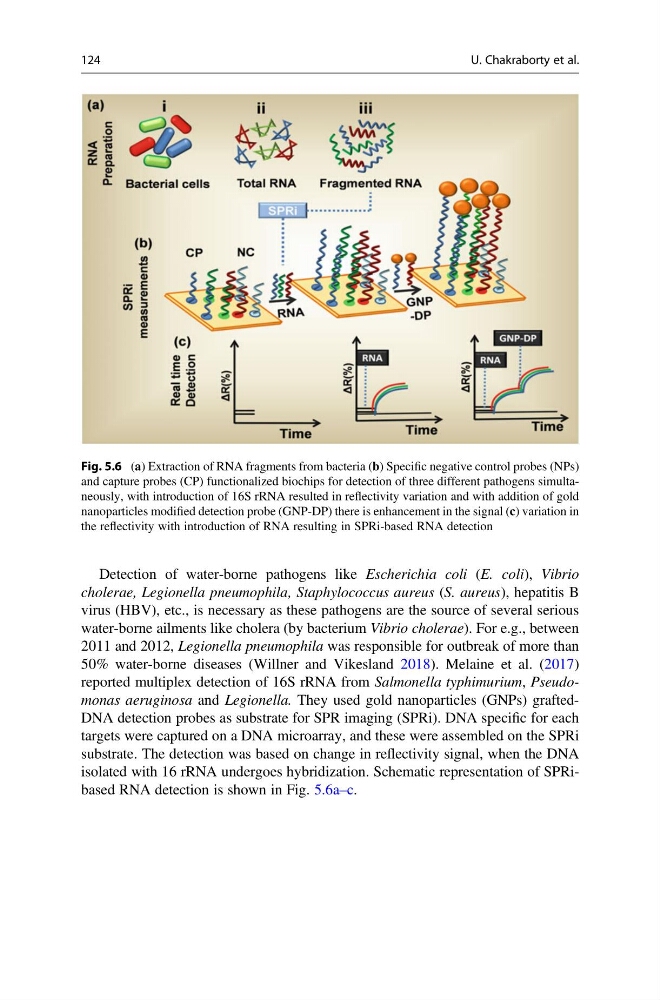
reported multiplex detection of 16S rRNA from Salmonella typhimurium, Pseudomonas aeruginosa and Legionella. They used gold nanoparticles (GNPs) graftedDNA detection probes as substrate for SPR imaging (SPRi). DNA specific for each
targets were captured on a DNA microarray, and these were assembled on the SPRi
substrate. The detection was based on change in reflectivity signal, when the DNA
isolated with 16 rRNA undergoes hybridization. Schematic representation of SPRibased RNA detection is shown in Fig. 5.6a–c.
Fig. 5.6 (a) Extraction of RNA fragments from bacteria (b) Specific negative control probes (NPs)
and capture probes (CP) functionalized biochips for detection of three different pathogens simultaneously, with introduction of 16S rRNA resulted in reflectivity variation and with addition of gold
nanoparticles modified detection probe (GNP-DP) there is enhancement in the signal (c) variation in
the reflectivity with introduction of RNA resulting in SPRi-based RNA detection
124
U. Chakraborty et al.
cholerae, Legionella pneumophila, Staphylococcus aureus (S. aureus), hepatitis B
virus (HBV), etc., is necessary as these pathogens are the source of several serious
water-borne ailments like cholera (by bacterium Vibrio cholerae). For e.g., between
2011 and 2012, Legionella pneumophila was responsible for outbreak of more than
50% water-borne diseases (Willner and Vikesland 2018). Melaine et al. (2017)
reported multiplex detection of 16S rRNA from Salmonella typhimurium, Pseudomonas aeruginosa and Legionella. They used gold nanoparticles (GNPs) graftedDNA detection probes as substrate for SPR imaging (SPRi). DNA specific for each
targets were captured on a DNA microarray, and these were assembled on the SPRi
substrate. The detection was based on change in reflectivity signal, when the DNA
isolated with 16 rRNA undergoes hybridization. Schematic representation of SPRibased RNA detection is shown in Fig. 5.6a–c.
Fig. 5.6 (a) Extraction of RNA fragments from bacteria (b) Specific negative control probes (NPs)
and capture probes (CP) functionalized biochips for detection of three different pathogens simultaneously, with introduction of 16S rRNA resulted in reflectivity variation and with addition of gold
nanoparticles modified detection probe (GNP-DP) there is enhancement in the signal (c) variation in
the reflectivity with introduction of RNA resulting in SPRi-based RNA detection
124
U. Chakraborty et al.