

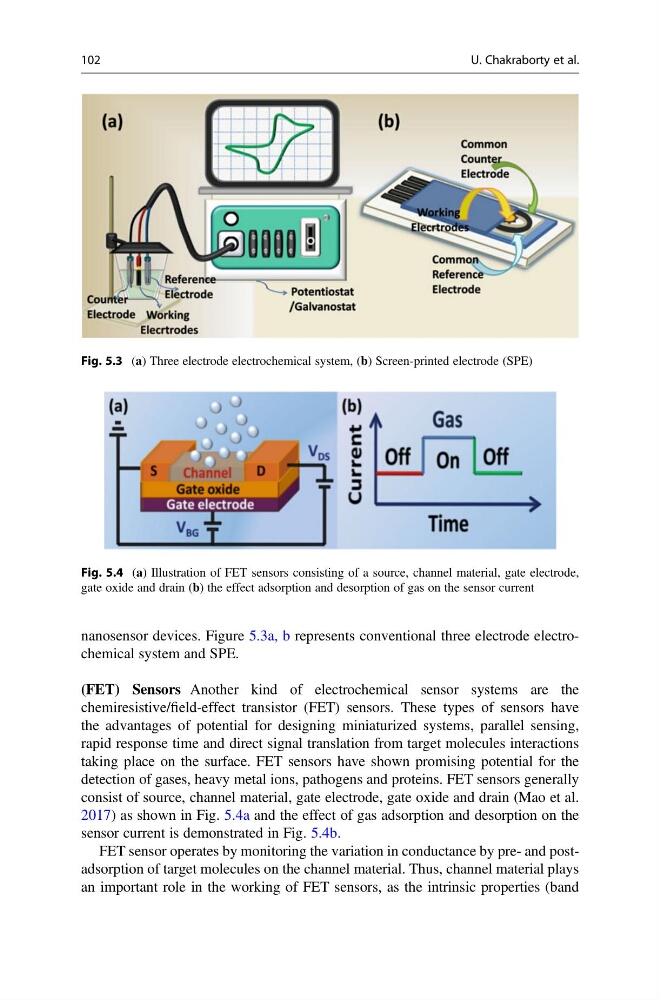
nanosensor devices. Figure 5.3a, b represents conventional three electrode electrochemical system and SPE.
(FET) Sensors Another kind of electrochemical sensor systems are the
chemiresistive/field-effect transistor (FET) sensors. These types of sensors have
the advantages of potential for designing miniaturized systems, parallel sensing,
rapid response time and direct signal translation from target molecules interactions
taking place on the surface. FET sensors have shown promising potential for the
detection of gases, heavy metal ions, pathogens and proteins. FET sensors generally
consist of source, channel material, gate electrode, gate oxide and drain (Mao et al.
2017) as shown in Fig. 5.4a and the effect of gas adsorption and desorption on the
sensor current is demonstrated in Fig. 5.4b.
FET sensor operates by monitoring the variation in conductance by pre- and postadsorption of target molecules on the channel material. Thus, channel material plays
an important role in the working of FET sensors, as the intrinsic properties (band
Fig. 5.3 (a) Three electrode electrochemical system, (b) Screen-printed electrode (SPE)
Fig. 5.4 (a) Illustration of FET sensors consisting of a source, channel material, gate electrode,
gate oxide and drain (b) the effect adsorption and desorption of gas on the sensor current
102
U. Chakraborty et al.
(FET) Sensors Another kind of electrochemical sensor systems are the
chemiresistive/field-effect transistor (FET) sensors. These types of sensors have
the advantages of potential for designing miniaturized systems, parallel sensing,
rapid response time and direct signal translation from target molecules interactions
taking place on the surface. FET sensors have shown promising potential for the
detection of gases, heavy metal ions, pathogens and proteins. FET sensors generally
consist of source, channel material, gate electrode, gate oxide and drain (Mao et al.
2017) as shown in Fig. 5.4a and the effect of gas adsorption and desorption on the
sensor current is demonstrated in Fig. 5.4b.
FET sensor operates by monitoring the variation in conductance by pre- and postadsorption of target molecules on the channel material. Thus, channel material plays
an important role in the working of FET sensors, as the intrinsic properties (band
Fig. 5.3 (a) Three electrode electrochemical system, (b) Screen-printed electrode (SPE)
Fig. 5.4 (a) Illustration of FET sensors consisting of a source, channel material, gate electrode,
gate oxide and drain (b) the effect adsorption and desorption of gas on the sensor current
102
U. Chakraborty et al.