

72
J. L. Shamshina and R. D. Rogers
in only a few high-end applications, such as biomaterials (e.g., tissue engineering,
plastic surgery, and drug delivery devices), will the relatively high costs of biopolymer precursors likely not interfere with market growth. In low-end and medium-end
applications, it is hard to predict whether economy-of-scale manufacturing will be
able to bring down the current high production costs.
Technical barriers are the same as for all new technologies, such as product design
and long development periods, even more so taking into consideration a need for
‘bench-to-scale’ prototyping. Besides, any new process also requires development
(or at least adaptation) of production equipment.
Finally, the enormous growth in the plastics economy during the twenty-first century reflects a large investment in the oil-based industry. While renewable resources
are perfectly suited to provide the same rich variety of polymers and composites
as that currently available from oil, there has not been the same extent of investments for renewables that have gone into plastics manufacturing. On the other hand,
transition from non-biodegradable plastic materials to biodegradable biopolymeric
products from renewable sources will be highly advantageous to society for development of new materials, new products, new unforeseen markets, and improvement
in the environment.
4.2 Brief Foreword to Chitin and Current Isolation
Technology
4.2.1 Chitin Polymer
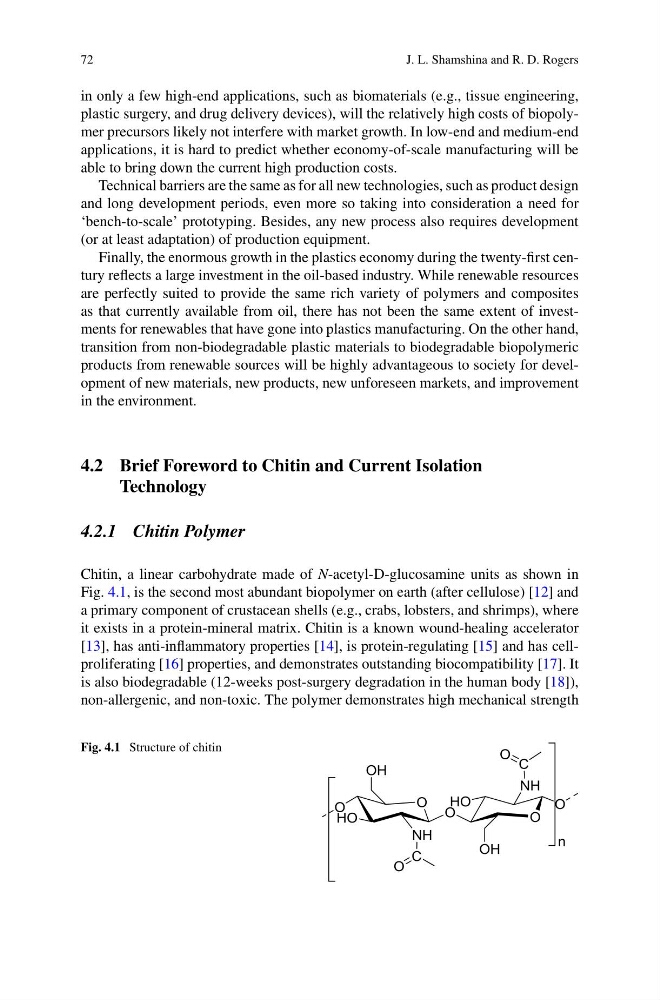
Chitin, a linear carbohydrate made of N-acetyl-D-glucosamine units as shown in
Fig. 4.1, is the second most abundant biopolymer on earth (after cellulose) [12] and
a primary component of crustacean shells (e.g., crabs, lobsters, and shrimps), where
it exists in a protein-mineral matrix. Chitin is a known wound-healing accelerator
[13], has anti-inflammatory properties [14], is protein-regulating [15] and has cellproliferating [16] properties, and demonstrates outstanding biocompatibility [17]. It
is also biodegradable (12-weeks post-surgery degradation in the human body [18]),
non-allergenic, and non-toxic. The polymer demonstrates high mechanical strength
Fig. 4.1 Structure of chitin
J. L. Shamshina and R. D. Rogers
in only a few high-end applications, such as biomaterials (e.g., tissue engineering,
plastic surgery, and drug delivery devices), will the relatively high costs of biopolymer precursors likely not interfere with market growth. In low-end and medium-end
applications, it is hard to predict whether economy-of-scale manufacturing will be
able to bring down the current high production costs.
Technical barriers are the same as for all new technologies, such as product design
and long development periods, even more so taking into consideration a need for
‘bench-to-scale’ prototyping. Besides, any new process also requires development
(or at least adaptation) of production equipment.
Finally, the enormous growth in the plastics economy during the twenty-first century reflects a large investment in the oil-based industry. While renewable resources
are perfectly suited to provide the same rich variety of polymers and composites
as that currently available from oil, there has not been the same extent of investments for renewables that have gone into plastics manufacturing. On the other hand,
transition from non-biodegradable plastic materials to biodegradable biopolymeric
products from renewable sources will be highly advantageous to society for development of new materials, new products, new unforeseen markets, and improvement
in the environment.
4.2 Brief Foreword to Chitin and Current Isolation
Technology
4.2.1 Chitin Polymer
Chitin, a linear carbohydrate made of N-acetyl-D-glucosamine units as shown in
Fig. 4.1, is the second most abundant biopolymer on earth (after cellulose) [12] and
a primary component of crustacean shells (e.g., crabs, lobsters, and shrimps), where
it exists in a protein-mineral matrix. Chitin is a known wound-healing accelerator
[13], has anti-inflammatory properties [14], is protein-regulating [15] and has cellproliferating [16] properties, and demonstrates outstanding biocompatibility [17]. It
is also biodegradable (12-weeks post-surgery degradation in the human body [18]),
non-allergenic, and non-toxic. The polymer demonstrates high mechanical strength
Fig. 4.1 Structure of chitin