

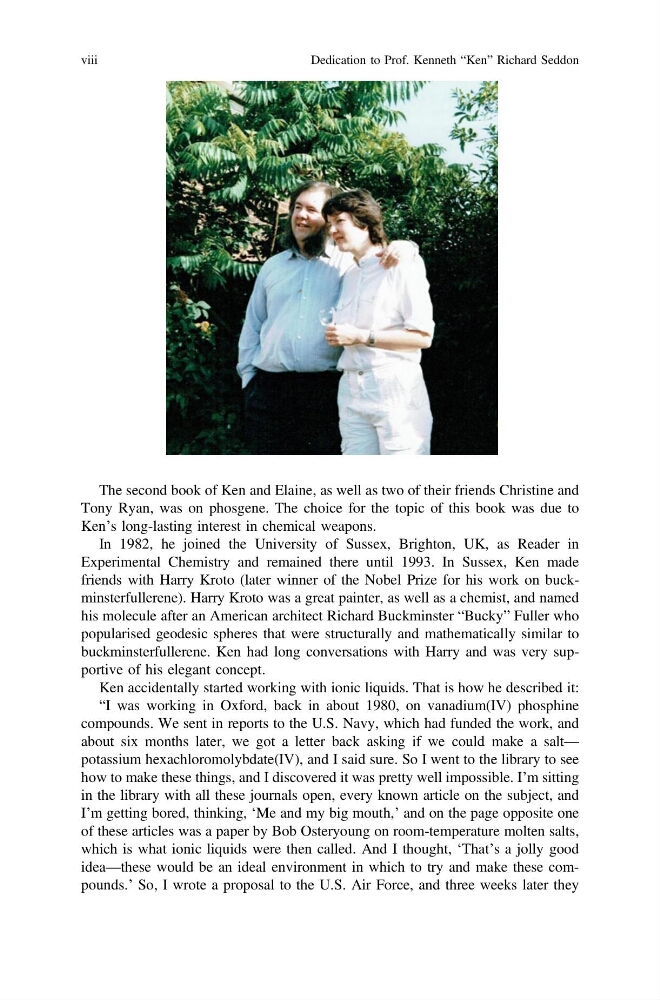
The second book of Ken and Elaine, as well as two of their friends Christine and
Tony Ryan, was on phosgene. The choice for the topic of this book was due to
Ken’s long-lasting interest in chemical weapons.
In 1982, he joined the University of Sussex, Brighton, UK, as Reader in
Experimental Chemistry and remained there until 1993. In Sussex, Ken made
friends with Harry Kroto (later winner of the Nobel Prize for his work on buckminsterfullerene). Harry Kroto was a great painter, as well as a chemist, and named
his molecule after an American architect Richard Buckminster “Bucky” Fuller who
popularised geodesic spheres that were structurally and mathematically similar to
buckminsterfullerene. Ken had long conversations with Harry and was very supportive of his elegant concept.
Ken accidentally started working with ionic liquids. That is how he described it:
“I was working in Oxford, back in about 1980, on vanadium(IV) phosphine
compounds. We sent in reports to the U.S. Navy, which had funded the work, and
about six months later, we got a letter back asking if we could make a salt—
potassium hexachloromolybdate(IV), and I said sure. So I went to the library to see
how to make these things, and I discovered it was pretty well impossible. I’m sitting
in the library with all these journals open, every known article on the subject, and
I’m getting bored, thinking, ‘Me and my big mouth,’ and on the page opposite one
of these articles was a paper by Bob Osteryoung on room-temperature molten salts,
which is what ionic liquids were then called. And I thought, ‘That’s a jolly good
idea—these would be an ideal environment in which to try and make these compounds.’ So, I wrote a proposal to the U.S. Air Force, and three weeks later they
viii
Dedication to Prof. Kenneth “Ken” Richard Seddon
Tony Ryan, was on phosgene. The choice for the topic of this book was due to
Ken’s long-lasting interest in chemical weapons.
In 1982, he joined the University of Sussex, Brighton, UK, as Reader in
Experimental Chemistry and remained there until 1993. In Sussex, Ken made
friends with Harry Kroto (later winner of the Nobel Prize for his work on buckminsterfullerene). Harry Kroto was a great painter, as well as a chemist, and named
his molecule after an American architect Richard Buckminster “Bucky” Fuller who
popularised geodesic spheres that were structurally and mathematically similar to
buckminsterfullerene. Ken had long conversations with Harry and was very supportive of his elegant concept.
Ken accidentally started working with ionic liquids. That is how he described it:
“I was working in Oxford, back in about 1980, on vanadium(IV) phosphine
compounds. We sent in reports to the U.S. Navy, which had funded the work, and
about six months later, we got a letter back asking if we could make a salt—
potassium hexachloromolybdate(IV), and I said sure. So I went to the library to see
how to make these things, and I discovered it was pretty well impossible. I’m sitting
in the library with all these journals open, every known article on the subject, and
I’m getting bored, thinking, ‘Me and my big mouth,’ and on the page opposite one
of these articles was a paper by Bob Osteryoung on room-temperature molten salts,
which is what ionic liquids were then called. And I thought, ‘That’s a jolly good
idea—these would be an ideal environment in which to try and make these compounds.’ So, I wrote a proposal to the U.S. Air Force, and three weeks later they
viii
Dedication to Prof. Kenneth “Ken” Richard Seddon