

34
H. K. Timken et al.
Table 2.1 World’s leading gasoline specifications versus alkylate properties
Specification
RBOB Tier III CARBOB phase 3 Euro VI China V Alkylate
(R + M)/2,
[RON] a
87/89/91
87/89/91
[91/95]
[95]
[95]+
Sulfur, ppm max.
10
20
10
10
< 5
Benzene, vol%
max.
0.62
0.8
1.0
1.0
0
Aromatics, vol%
max.
–
25
35
40
0
Olefins, vol% max. –
6
18
24
0
Oxygen, wt% max. 2.7
2.2
2.7
2.7
0
a [R + M]/2 is the average octane number where R is research octane number (RON) and M is
motor octane number (MON)
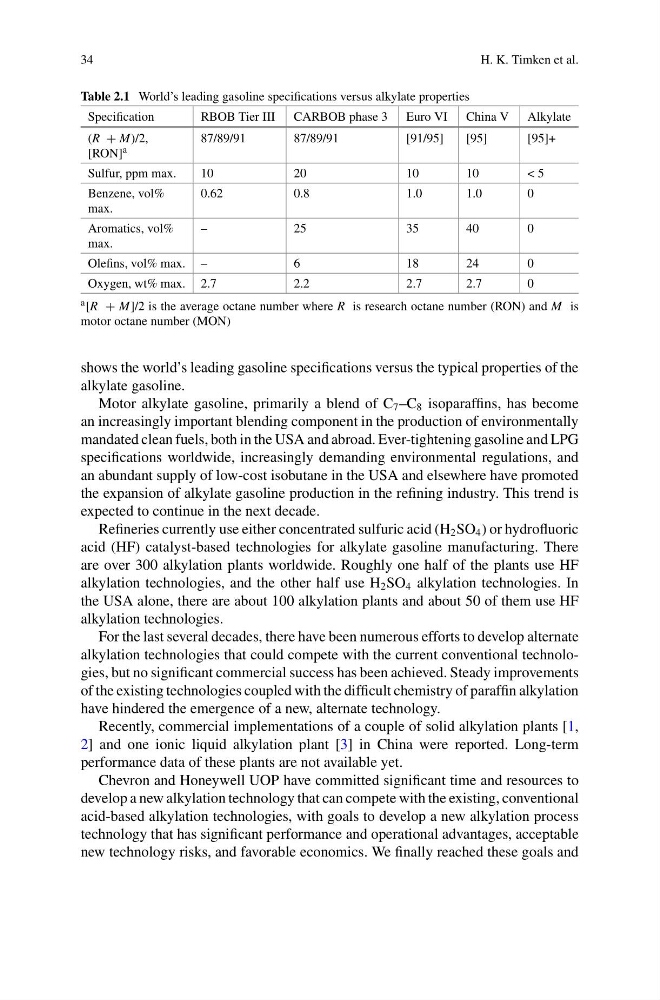
shows the world’s leading gasoline specifications versus the typical properties of the
alkylate gasoline.
Motor alkylate gasoline, primarily a blend of C 7 –C 8 isoparaffins, has become
an increasingly important blending component in the production of environmentally
mandated clean fuels, both in the USA and abroad. Ever-tightening gasoline and LPG
specifications worldwide, increasingly demanding environmental regulations, and
an abundant supply of low-cost isobutane in the USA and elsewhere have promoted
the expansion of alkylate gasoline production in the refining industry. This trend is
expected to continue in the next decade.
Refineries currently use either concentrated sulfuric acid (H 2 SO 4 ) or hydrofluoric
acid (HF) catalyst-based technologies for alkylate gasoline manufacturing. There
are over 300 alkylation plants worldwide. Roughly one half of the plants use HF
alkylation technologies, and the other half use H 2 SO 4 alkylation technologies. In
the USA alone, there are about 100 alkylation plants and about 50 of them use HF
alkylation technologies.
For the last several decades, there have been numerous efforts to develop alternate
alkylation technologies that could compete with the current conventional technologies, but no significant commercial success has been achieved. Steady improvements
of the existing technologies coupled with the difficult chemistry of paraffin alkylation
have hindered the emergence of a new, alternate technology.
Recently, commercial implementations of a couple of solid alkylation plants [1,
2] and one ionic liquid alkylation plant [3] in China were reported. Long-term
performance data of these plants are not available yet.
Chevron and Honeywell UOP have committed significant time and resources to
develop a new alkylation technology that can compete with the existing, conventional
acid-based alkylation technologies, with goals to develop a new alkylation process
technology that has significant performance and operational advantages, acceptable
new technology risks, and favorable economics. We finally reached these goals and
H. K. Timken et al.
Table 2.1 World’s leading gasoline specifications versus alkylate properties
Specification
RBOB Tier III CARBOB phase 3 Euro VI China V Alkylate
(R + M)/2,
[RON] a
87/89/91
87/89/91
[91/95]
[95]
[95]+
Sulfur, ppm max.
10
20
10
10
< 5
Benzene, vol%
max.
0.62
0.8
1.0
1.0
0
Aromatics, vol%
max.
–
25
35
40
0
Olefins, vol% max. –
6
18
24
0
Oxygen, wt% max. 2.7
2.2
2.7
2.7
0
a [R + M]/2 is the average octane number where R is research octane number (RON) and M is
motor octane number (MON)
shows the world’s leading gasoline specifications versus the typical properties of the
alkylate gasoline.
Motor alkylate gasoline, primarily a blend of C 7 –C 8 isoparaffins, has become
an increasingly important blending component in the production of environmentally
mandated clean fuels, both in the USA and abroad. Ever-tightening gasoline and LPG
specifications worldwide, increasingly demanding environmental regulations, and
an abundant supply of low-cost isobutane in the USA and elsewhere have promoted
the expansion of alkylate gasoline production in the refining industry. This trend is
expected to continue in the next decade.
Refineries currently use either concentrated sulfuric acid (H 2 SO 4 ) or hydrofluoric
acid (HF) catalyst-based technologies for alkylate gasoline manufacturing. There
are over 300 alkylation plants worldwide. Roughly one half of the plants use HF
alkylation technologies, and the other half use H 2 SO 4 alkylation technologies. In
the USA alone, there are about 100 alkylation plants and about 50 of them use HF
alkylation technologies.
For the last several decades, there have been numerous efforts to develop alternate
alkylation technologies that could compete with the current conventional technologies, but no significant commercial success has been achieved. Steady improvements
of the existing technologies coupled with the difficult chemistry of paraffin alkylation
have hindered the emergence of a new, alternate technology.
Recently, commercial implementations of a couple of solid alkylation plants [1,
2] and one ionic liquid alkylation plant [3] in China were reported. Long-term
performance data of these plants are not available yet.
Chevron and Honeywell UOP have committed significant time and resources to
develop a new alkylation technology that can compete with the existing, conventional
acid-based alkylation technologies, with goals to develop a new alkylation process
technology that has significant performance and operational advantages, acceptable
new technology risks, and favorable economics. We finally reached these goals and