

274
R. S. Kalb
More than 80% of the participants believe that “ionic liquids are too expensive
in general” (statement 2), but only 40% totally or mostly agree, and 9% totally
disagree. This result reflects a broad distribution of opinions and is focused on the
term “too expensive.” Because chemical value-chain competition always depends on
the intended application of the final product, pricing of intermediates or components
frequently invites prejudice. However, it is important to recognize the broad range
of both well-established and other commercially available specialty chemicals were
once at a higher price point than ionic liquids are today. Currently, ionic liquids
cannot compete with low-price commodity chemicals, and most probably never will,
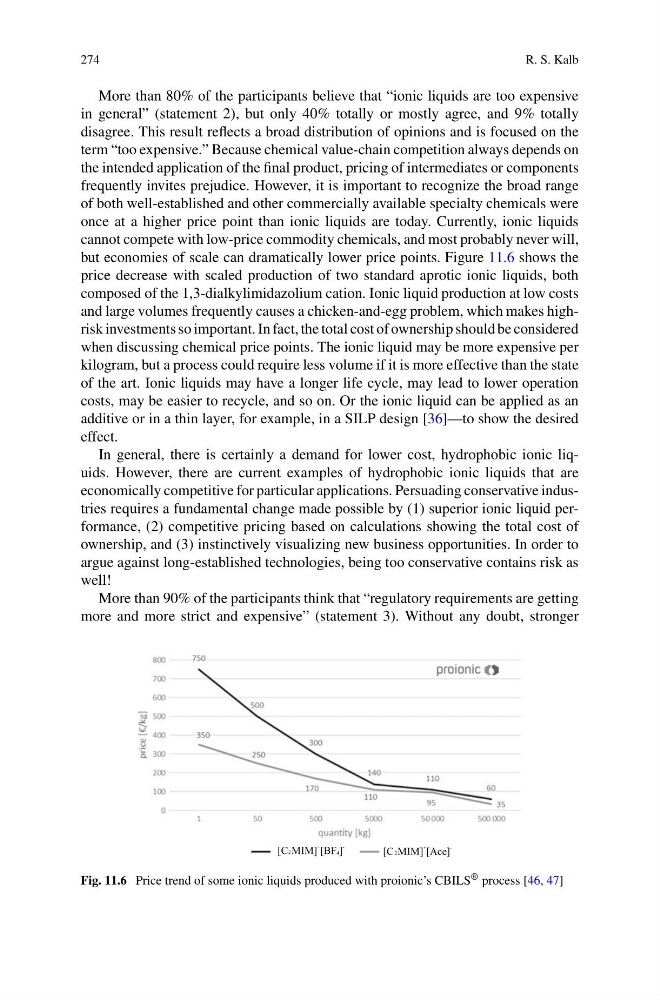
but economies of scale can dramatically lower price points. Figure 11.6 shows the
price decrease with scaled production of two standard aprotic ionic liquids, both
composed of the 1,3-dialkylimidazolium cation. Ionic liquid production at low costs
and large volumes frequently causes a chicken-and-egg problem, which makes highrisk investments so important. In fact, the total cost of ownership should be considered
when discussing chemical price points. The ionic liquid may be more expensive per
kilogram, but a process could require less volume if it is more effective than the state
of the art. Ionic liquids may have a longer life cycle, may lead to lower operation
costs, may be easier to recycle, and so on. Or the ionic liquid can be applied as an
additive or in a thin layer, for example, in a SILP design [36]—to show the desired
effect.
In general, there is certainly a demand for lower cost, hydrophobic ionic liquids. However, there are current examples of hydrophobic ionic liquids that are
economically competitive for particular applications. Persuading conservative industries requires a fundamental change made possible by (1) superior ionic liquid performance, (2) competitive pricing based on calculations showing the total cost of
ownership, and (3) instinctively visualizing new business opportunities. In order to
argue against long-established technologies, being too conservative contains risk as
well!
More than 90% of the participants think that “regulatory requirements are getting
more and more strict and expensive” (statement 3). Without any doubt, stronger
[C2MIM]
+ [BF4]
-
[C2MIM]
+ [Ace]
-
Fig. 11.6 Price trend of some ionic liquids produced with proionic’s CBILS ® process [46, 47]
R. S. Kalb
More than 80% of the participants believe that “ionic liquids are too expensive
in general” (statement 2), but only 40% totally or mostly agree, and 9% totally
disagree. This result reflects a broad distribution of opinions and is focused on the
term “too expensive.” Because chemical value-chain competition always depends on
the intended application of the final product, pricing of intermediates or components
frequently invites prejudice. However, it is important to recognize the broad range
of both well-established and other commercially available specialty chemicals were
once at a higher price point than ionic liquids are today. Currently, ionic liquids
cannot compete with low-price commodity chemicals, and most probably never will,
but economies of scale can dramatically lower price points. Figure 11.6 shows the
price decrease with scaled production of two standard aprotic ionic liquids, both
composed of the 1,3-dialkylimidazolium cation. Ionic liquid production at low costs
and large volumes frequently causes a chicken-and-egg problem, which makes highrisk investments so important. In fact, the total cost of ownership should be considered
when discussing chemical price points. The ionic liquid may be more expensive per
kilogram, but a process could require less volume if it is more effective than the state
of the art. Ionic liquids may have a longer life cycle, may lead to lower operation
costs, may be easier to recycle, and so on. Or the ionic liquid can be applied as an
additive or in a thin layer, for example, in a SILP design [36]—to show the desired
effect.
In general, there is certainly a demand for lower cost, hydrophobic ionic liquids. However, there are current examples of hydrophobic ionic liquids that are
economically competitive for particular applications. Persuading conservative industries requires a fundamental change made possible by (1) superior ionic liquid performance, (2) competitive pricing based on calculations showing the total cost of
ownership, and (3) instinctively visualizing new business opportunities. In order to
argue against long-established technologies, being too conservative contains risk as
well!
More than 90% of the participants think that “regulatory requirements are getting
more and more strict and expensive” (statement 3). Without any doubt, stronger
[C2MIM]
+ [BF4]
-
[C2MIM]
+ [Ace]
-
Fig. 11.6 Price trend of some ionic liquids produced with proionic’s CBILS ® process [46, 47]