

10 Development of New Cellulosic Fibers and Composites …
229
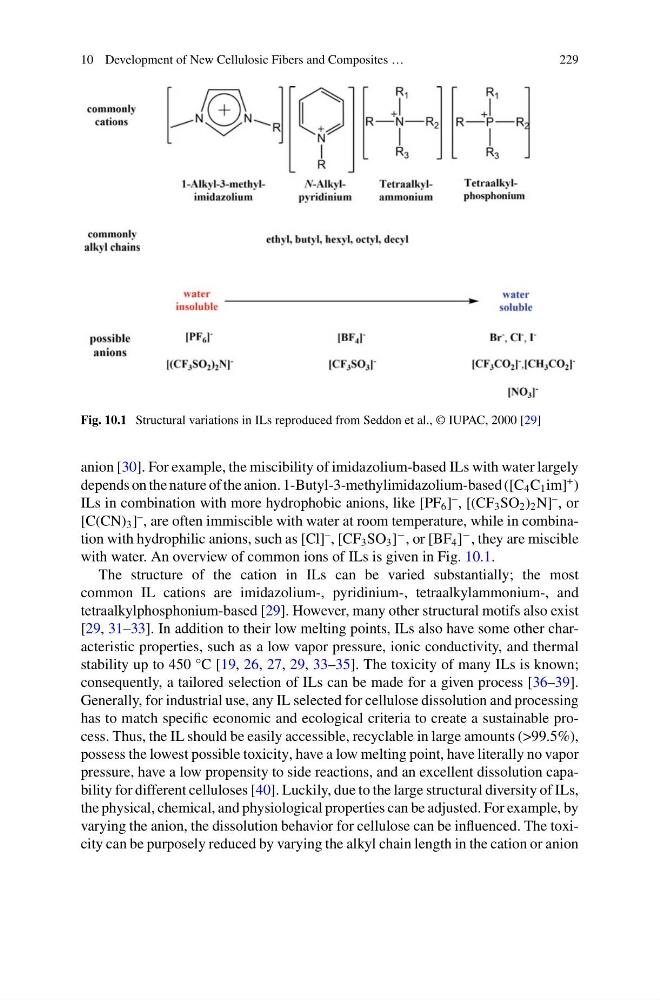
Fig. 10.1 Structural variations in ILs reproduced from Seddon et al., © IUPAC, 2000 [29]
anion [30]. For example, the miscibility of imidazolium-based ILs with water largely
depends on the nature of the anion. 1-Butyl-3-methylimidazolium-based ([C 4 C 1 im]
+ )
ILs in combination with more hydrophobic anions, like [PF 6 ]
– , [(CF 3 SO 2 ) 2 N]
– , or
[C(CN) 3 ]
– , are often immiscible with water at room temperature, while in combination with hydrophilic anions, such as [Cl]
– , [CF 3 SO 3 ]
− , or [BF 4 ]
− , they are miscible
with water. An overview of common ions of ILs is given in Fig. 10.1.
The structure of the cation in ILs can be varied substantially; the most
common IL cations are imidazolium-, pyridinium-, tetraalkylammonium-, and
tetraalkylphosphonium-based [29]. However, many other structural motifs also exist
[29, 31–33]. In addition to their low melting points, ILs also have some other characteristic properties, such as a low vapor pressure, ionic conductivity, and thermal
stability up to 450 °C [19, 26, 27, 29, 33–35]. The toxicity of many ILs is known;
consequently, a tailored selection of ILs can be made for a given process [36–39].
Generally, for industrial use, any IL selected for cellulose dissolution and processing
has to match specific economic and ecological criteria to create a sustainable process. Thus, the IL should be easily accessible, recyclable in large amounts (>99.5%),
possess the lowest possible toxicity, have a low melting point, have literally no vapor
pressure, have a low propensity to side reactions, and an excellent dissolution capability for different celluloses [40]. Luckily, due to the large structural diversity of ILs,
the physical, chemical, and physiological properties can be adjusted. For example, by
varying the anion, the dissolution behavior for cellulose can be influenced. The toxicity can be purposely reduced by varying the alkyl chain length in the cation or anion
229
Fig. 10.1 Structural variations in ILs reproduced from Seddon et al., © IUPAC, 2000 [29]
anion [30]. For example, the miscibility of imidazolium-based ILs with water largely
depends on the nature of the anion. 1-Butyl-3-methylimidazolium-based ([C 4 C 1 im]
+ )
ILs in combination with more hydrophobic anions, like [PF 6 ]
– , [(CF 3 SO 2 ) 2 N]
– , or
[C(CN) 3 ]
– , are often immiscible with water at room temperature, while in combination with hydrophilic anions, such as [Cl]
– , [CF 3 SO 3 ]
− , or [BF 4 ]
− , they are miscible
with water. An overview of common ions of ILs is given in Fig. 10.1.
The structure of the cation in ILs can be varied substantially; the most
common IL cations are imidazolium-, pyridinium-, tetraalkylammonium-, and
tetraalkylphosphonium-based [29]. However, many other structural motifs also exist
[29, 31–33]. In addition to their low melting points, ILs also have some other characteristic properties, such as a low vapor pressure, ionic conductivity, and thermal
stability up to 450 °C [19, 26, 27, 29, 33–35]. The toxicity of many ILs is known;
consequently, a tailored selection of ILs can be made for a given process [36–39].
Generally, for industrial use, any IL selected for cellulose dissolution and processing
has to match specific economic and ecological criteria to create a sustainable process. Thus, the IL should be easily accessible, recyclable in large amounts (>99.5%),
possess the lowest possible toxicity, have a low melting point, have literally no vapor
pressure, have a low propensity to side reactions, and an excellent dissolution capability for different celluloses [40]. Luckily, due to the large structural diversity of ILs,
the physical, chemical, and physiological properties can be adjusted. For example, by
varying the anion, the dissolution behavior for cellulose can be influenced. The toxicity can be purposely reduced by varying the alkyl chain length in the cation or anion