

224
L. M. Haverhals et al.
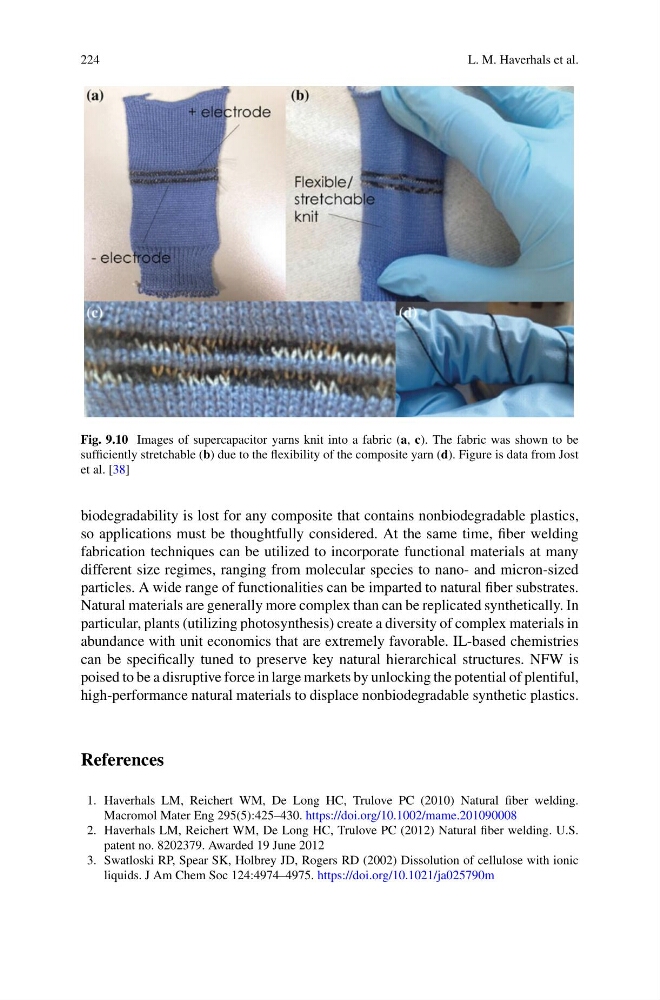
Fig. 9.10 Images of supercapacitor yarns knit into a fabric (a, c). The fabric was shown to be
sufficiently stretchable (b) due to the flexibility of the composite yarn (d). Figure is data from Jost
et al. [38]
biodegradability is lost for any composite that contains nonbiodegradable plastics,
so applications must be thoughtfully considered. At the same time, fiber welding
fabrication techniques can be utilized to incorporate functional materials at many
different size regimes, ranging from molecular species to nano- and micron-sized
particles. A wide range of functionalities can be imparted to natural fiber substrates.
Natural materials are generally more complex than can be replicated synthetically. In
particular, plants (utilizing photosynthesis) create a diversity of complex materials in
abundance with unit economics that are extremely favorable. IL-based chemistries
can be specifically tuned to preserve key natural hierarchical structures. NFW is
poised to be a disruptive force in large markets by unlocking the potential of plentiful,
high-performance natural materials to displace nonbiodegradable synthetic plastics.
References
1. Haverhals LM, Reichert WM, De Long HC, Trulove PC (2010) Natural fiber welding.
Macromol Mater Eng 295(5):425–430. https://doi.org/10.1002/mame.201090008
2. Haverhals LM, Reichert WM, De Long HC, Trulove PC (2012) Natural fiber welding. U.S.
patent no. 8202379. Awarded 19 June 2012
3. Swatloski RP, Spear SK, Holbrey JD, Rogers RD (2002) Dissolution of cellulose with ionic
liquids. J Am Chem Soc 124:4974–4975. https://doi.org/10.1021/ja025790m
L. M. Haverhals et al.
Fig. 9.10 Images of supercapacitor yarns knit into a fabric (a, c). The fabric was shown to be
sufficiently stretchable (b) due to the flexibility of the composite yarn (d). Figure is data from Jost
et al. [38]
biodegradability is lost for any composite that contains nonbiodegradable plastics,
so applications must be thoughtfully considered. At the same time, fiber welding
fabrication techniques can be utilized to incorporate functional materials at many
different size regimes, ranging from molecular species to nano- and micron-sized
particles. A wide range of functionalities can be imparted to natural fiber substrates.
Natural materials are generally more complex than can be replicated synthetically. In
particular, plants (utilizing photosynthesis) create a diversity of complex materials in
abundance with unit economics that are extremely favorable. IL-based chemistries
can be specifically tuned to preserve key natural hierarchical structures. NFW is
poised to be a disruptive force in large markets by unlocking the potential of plentiful,
high-performance natural materials to displace nonbiodegradable synthetic plastics.
References
1. Haverhals LM, Reichert WM, De Long HC, Trulove PC (2010) Natural fiber welding.
Macromol Mater Eng 295(5):425–430. https://doi.org/10.1002/mame.201090008
2. Haverhals LM, Reichert WM, De Long HC, Trulove PC (2012) Natural fiber welding. U.S.
patent no. 8202379. Awarded 19 June 2012
3. Swatloski RP, Spear SK, Holbrey JD, Rogers RD (2002) Dissolution of cellulose with ionic
liquids. J Am Chem Soc 124:4974–4975. https://doi.org/10.1021/ja025790m