

204
T. J. S. Schubert
operated in batch mode, have to be replaced by alternative methods that can be
operated continuously.
In terms of process time, the removal of solvents is the bottleneck in commercial
production of ionic liquids. Otherwise, every synthesis procedure and any purification
step can be performed faster. Consequently, developments for the optimization of
production processes are currently concentrating on faster drying processes, which
are typically achieved by generating larger surfaces of the medium.
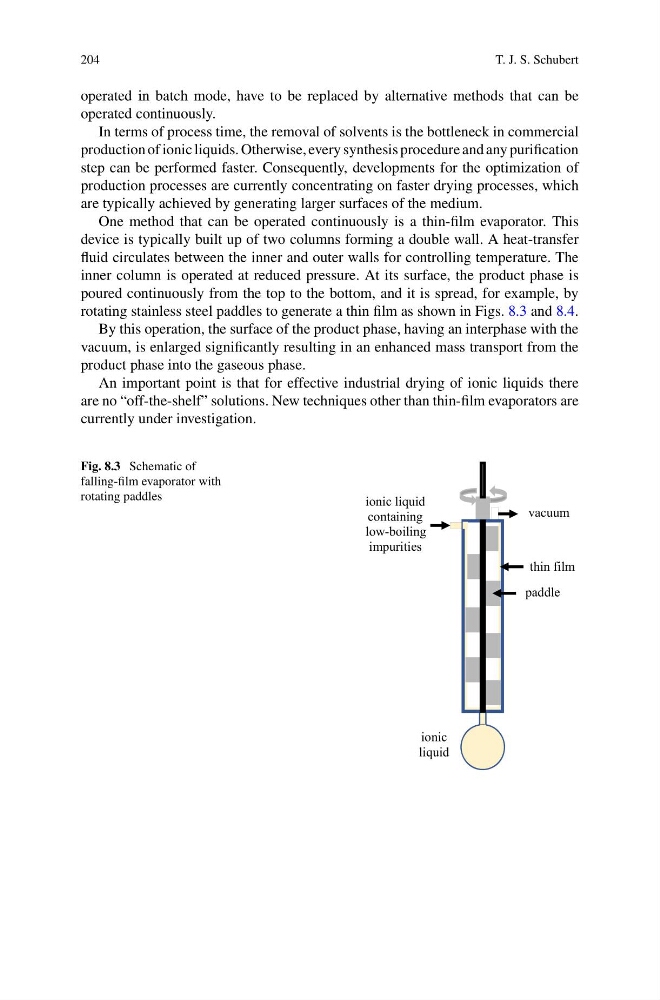
One method that can be operated continuously is a thin-film evaporator. This
device is typically built up of two columns forming a double wall. A heat-transfer
fluid circulates between the inner and outer walls for controlling temperature. The
inner column is operated at reduced pressure. At its surface, the product phase is
poured continuously from the top to the bottom, and it is spread, for example, by
rotating stainless steel paddles to generate a thin film as shown in Figs. 8.3 and 8.4.
By this operation, the surface of the product phase, having an interphase with the
vacuum, is enlarged significantly resulting in an enhanced mass transport from the
product phase into the gaseous phase.
An important point is that for effective industrial drying of ionic liquids there
are no “off-the-shelf” solutions. New techniques other than thin-film evaporators are
currently under investigation.
Fig. 8.3 Schematic of
falling-film evaporator with
rotating paddles
ionic liquid
containing
low-boiling
impurities
thin film
ionic
liquid
vacuum
paddle
T. J. S. Schubert
operated in batch mode, have to be replaced by alternative methods that can be
operated continuously.
In terms of process time, the removal of solvents is the bottleneck in commercial
production of ionic liquids. Otherwise, every synthesis procedure and any purification
step can be performed faster. Consequently, developments for the optimization of
production processes are currently concentrating on faster drying processes, which
are typically achieved by generating larger surfaces of the medium.
One method that can be operated continuously is a thin-film evaporator. This
device is typically built up of two columns forming a double wall. A heat-transfer
fluid circulates between the inner and outer walls for controlling temperature. The
inner column is operated at reduced pressure. At its surface, the product phase is
poured continuously from the top to the bottom, and it is spread, for example, by
rotating stainless steel paddles to generate a thin film as shown in Figs. 8.3 and 8.4.
By this operation, the surface of the product phase, having an interphase with the
vacuum, is enlarged significantly resulting in an enhanced mass transport from the
product phase into the gaseous phase.
An important point is that for effective industrial drying of ionic liquids there
are no “off-the-shelf” solutions. New techniques other than thin-film evaporators are
currently under investigation.
Fig. 8.3 Schematic of
falling-film evaporator with
rotating paddles
ionic liquid
containing
low-boiling
impurities
thin film
ionic
liquid
vacuum
paddle