

6 Gas Chromatography Columns Using Ionic Liquids …
155
was used as headspace solvent for dissolving solid samples. A barrier discharge ionization detector (BID) was utilized for sensitive detection of trace water levels in
pharmaceutical products.
In addition, a rapid analysis (under 4 min) with high selectivity and resolution
of water and ethanol was obtained in consumer products using a Watercol 1910
column. The established method allowed measurement of both ethanol and water at
all concentrations without using any internal standard [132].
The Watercol columns were also used for the determination of trace water content in petroleum products [24]. Due to the complex matrices of petroleum and
petroleum-based products, it is usually difficult to analyze water content using traditional approaches. These samples contain many compounds tending to react with
iodine, which leads to inaccurate results by KFT. A fully automated protocol using
headspace GC along with the BID was developed to accurately quantify trace water
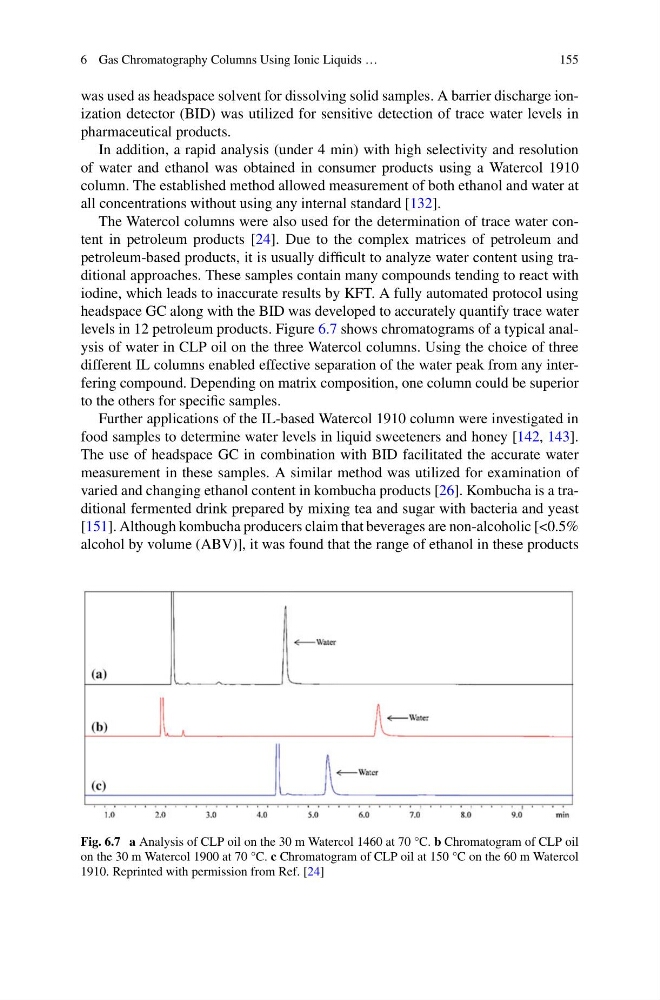
levels in 12 petroleum products. Figure 6.7 shows chromatograms of a typical analysis of water in CLP oil on the three Watercol columns. Using the choice of three
different IL columns enabled effective separation of the water peak from any interfering compound. Depending on matrix composition, one column could be superior
to the others for specific samples.
Further applications of the IL-based Watercol 1910 column were investigated in
food samples to determine water levels in liquid sweeteners and honey [142, 143].
The use of headspace GC in combination with BID facilitated the accurate water
measurement in these samples. A similar method was utilized for examination of
varied and changing ethanol content in kombucha products [26]. Kombucha is a traditional fermented drink prepared by mixing tea and sugar with bacteria and yeast
[151]. Although kombucha producers claim that beverages are non-alcoholic [<0.5%
alcohol by volume (ABV)], it was found that the range of ethanol in these products
Fig. 6.7 a Analysis of CLP oil on the 30 m Watercol 1460 at 70 °C. b Chromatogram of CLP oil
on the 30 m Watercol 1900 at 70 °C. c Chromatogram of CLP oil at 150 °C on the 60 m Watercol
1910. Reprinted with permission from Ref. [24]
155
was used as headspace solvent for dissolving solid samples. A barrier discharge ionization detector (BID) was utilized for sensitive detection of trace water levels in
pharmaceutical products.
In addition, a rapid analysis (under 4 min) with high selectivity and resolution
of water and ethanol was obtained in consumer products using a Watercol 1910
column. The established method allowed measurement of both ethanol and water at
all concentrations without using any internal standard [132].
The Watercol columns were also used for the determination of trace water content in petroleum products [24]. Due to the complex matrices of petroleum and
petroleum-based products, it is usually difficult to analyze water content using traditional approaches. These samples contain many compounds tending to react with
iodine, which leads to inaccurate results by KFT. A fully automated protocol using
headspace GC along with the BID was developed to accurately quantify trace water
levels in 12 petroleum products. Figure 6.7 shows chromatograms of a typical analysis of water in CLP oil on the three Watercol columns. Using the choice of three
different IL columns enabled effective separation of the water peak from any interfering compound. Depending on matrix composition, one column could be superior
to the others for specific samples.
Further applications of the IL-based Watercol 1910 column were investigated in
food samples to determine water levels in liquid sweeteners and honey [142, 143].
The use of headspace GC in combination with BID facilitated the accurate water
measurement in these samples. A similar method was utilized for examination of
varied and changing ethanol content in kombucha products [26]. Kombucha is a traditional fermented drink prepared by mixing tea and sugar with bacteria and yeast
[151]. Although kombucha producers claim that beverages are non-alcoholic [<0.5%
alcohol by volume (ABV)], it was found that the range of ethanol in these products
Fig. 6.7 a Analysis of CLP oil on the 30 m Watercol 1460 at 70 °C. b Chromatogram of CLP oil
on the 30 m Watercol 1900 at 70 °C. c Chromatogram of CLP oil at 150 °C on the 60 m Watercol
1910. Reprinted with permission from Ref. [24]