

134
M. Talebi et al.
Table 6.1 (continued)
IL column
Temperature limits
IL molecular structure and IUPAC name
Watercol 1910
30–180 °C
1,11-Di(3-hydroxyethylimidazolium)3,6,9-trioxaundecane
trifluoromethanesulfonate
Watercol 1900
30–180 °C
1,11-Di(3-methylimidazolium)3,6,9-trioxaundecane
trifluoromethanesulfonate
showing polar behavior [18]. These properties provide unique selectivities for the
separation of a wide variety of compounds. IL stationary phases show high thermal
stability along with high polarity [23], while in case of traditional phases, polarity
is achieved at the cost of thermal stability (e.g., the “highly polar” 1,2,3-tris(2cyanoethoxy)propane (TCEP) stationary phase has an upper temperature limit of
145 °C). IL phases are air and moisture stable compared to the polymeric phases
used in traditional GC columns. This gives them tremendous advantages in the analysis of water and water-based samples [24–26]. The structure of dicationic ILs can
be extensively modified by structural variations in order to optimize and “fine-tune”
their physicochemical properties, selectivities, and polarities [20, 21, 27]. Different
structural variables that affect the behavior of ILs are discussed in the following
sections.
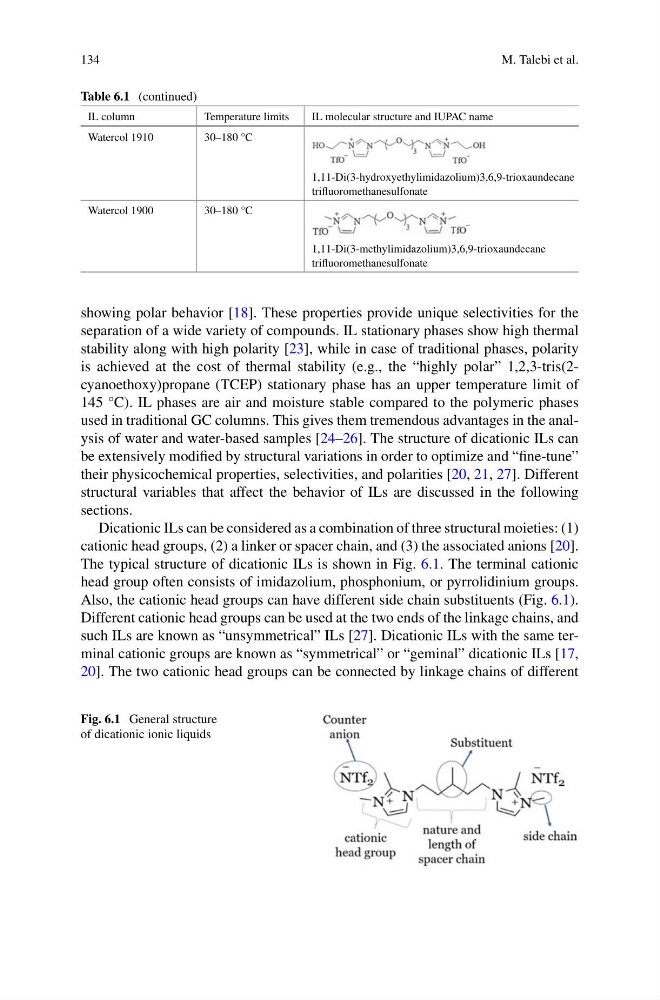
Dicationic ILs can be considered as a combination of three structural moieties: (1)
cationic head groups, (2) a linker or spacer chain, and (3) the associated anions [20].
The typical structure of dicationic ILs is shown in Fig. 6.1. The terminal cationic
head group often consists of imidazolium, phosphonium, or pyrrolidinium groups.
Also, the cationic head groups can have different side chain substituents (Fig. 6.1).
Different cationic head groups can be used at the two ends of the linkage chains, and
such ILs are known as “unsymmetrical” ILs [27]. Dicationic ILs with the same terminal cationic groups are known as “symmetrical” or “geminal” dicationic ILs [17,
20]. The two cationic head groups can be connected by linkage chains of different
Fig. 6.1 General structure
of dicationic ionic liquids
M. Talebi et al.
Table 6.1 (continued)
IL column
Temperature limits
IL molecular structure and IUPAC name
Watercol 1910
30–180 °C
1,11-Di(3-hydroxyethylimidazolium)3,6,9-trioxaundecane
trifluoromethanesulfonate
Watercol 1900
30–180 °C
1,11-Di(3-methylimidazolium)3,6,9-trioxaundecane
trifluoromethanesulfonate
showing polar behavior [18]. These properties provide unique selectivities for the
separation of a wide variety of compounds. IL stationary phases show high thermal
stability along with high polarity [23], while in case of traditional phases, polarity
is achieved at the cost of thermal stability (e.g., the “highly polar” 1,2,3-tris(2cyanoethoxy)propane (TCEP) stationary phase has an upper temperature limit of
145 °C). IL phases are air and moisture stable compared to the polymeric phases
used in traditional GC columns. This gives them tremendous advantages in the analysis of water and water-based samples [24–26]. The structure of dicationic ILs can
be extensively modified by structural variations in order to optimize and “fine-tune”
their physicochemical properties, selectivities, and polarities [20, 21, 27]. Different
structural variables that affect the behavior of ILs are discussed in the following
sections.
Dicationic ILs can be considered as a combination of three structural moieties: (1)
cationic head groups, (2) a linker or spacer chain, and (3) the associated anions [20].
The typical structure of dicationic ILs is shown in Fig. 6.1. The terminal cationic
head group often consists of imidazolium, phosphonium, or pyrrolidinium groups.
Also, the cationic head groups can have different side chain substituents (Fig. 6.1).
Different cationic head groups can be used at the two ends of the linkage chains, and
such ILs are known as “unsymmetrical” ILs [27]. Dicationic ILs with the same terminal cationic groups are known as “symmetrical” or “geminal” dicationic ILs [17,
20]. The two cationic head groups can be connected by linkage chains of different
Fig. 6.1 General structure
of dicationic ionic liquids