

5 Commercial Aspects of Biomass Deconstruction with Ionic Liquids
115
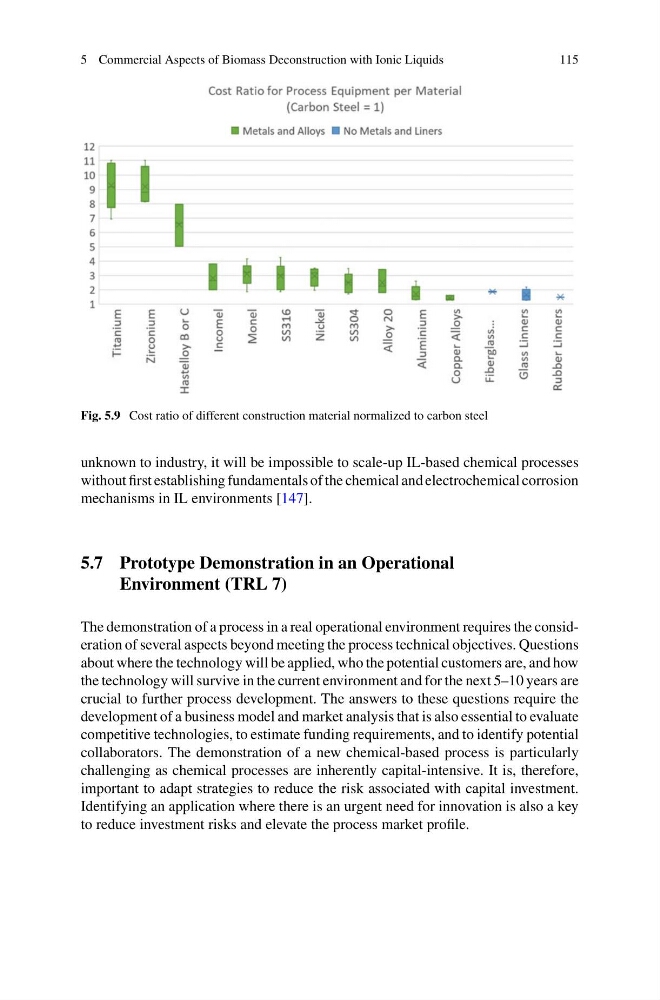
Fig. 5.9 Cost ratio of different construction material normalized to carbon steel
unknown to industry, it will be impossible to scale-up IL-based chemical processes
without first establishing fundamentals of the chemical and electrochemical corrosion
mechanisms in IL environments [147].
5.7 Prototype Demonstration in an Operational
Environment (TRL 7)
The demonstration of a process in a real operational environment requires the consideration of several aspects beyond meeting the process technical objectives. Questions
about where the technology will be applied, who the potential customers are, and how
the technology will survive in the current environment and for the next 5–10 years are
crucial to further process development. The answers to these questions require the
development of a business model and market analysis that is also essential to evaluate
competitive technologies, to estimate funding requirements, and to identify potential
collaborators. The demonstration of a new chemical-based process is particularly
challenging as chemical processes are inherently capital-intensive. It is, therefore,
important to adapt strategies to reduce the risk associated with capital investment.
Identifying an application where there is an urgent need for innovation is also a key
to reduce investment risks and elevate the process market profile.
115
Fig. 5.9 Cost ratio of different construction material normalized to carbon steel
unknown to industry, it will be impossible to scale-up IL-based chemical processes
without first establishing fundamentals of the chemical and electrochemical corrosion
mechanisms in IL environments [147].
5.7 Prototype Demonstration in an Operational
Environment (TRL 7)
The demonstration of a process in a real operational environment requires the consideration of several aspects beyond meeting the process technical objectives. Questions
about where the technology will be applied, who the potential customers are, and how
the technology will survive in the current environment and for the next 5–10 years are
crucial to further process development. The answers to these questions require the
development of a business model and market analysis that is also essential to evaluate
competitive technologies, to estimate funding requirements, and to identify potential
collaborators. The demonstration of a new chemical-based process is particularly
challenging as chemical processes are inherently capital-intensive. It is, therefore,
important to adapt strategies to reduce the risk associated with capital investment.
Identifying an application where there is an urgent need for innovation is also a key
to reduce investment risks and elevate the process market profile.