

104
A. R. Abouelela et al.
considered to be the bottleneck for their large-scale implementation, there were no
previous reports assessing the manufacturing of ILs at scale.
Two PILs were taken as models for the process simulation and economic evaluation: triethylammonium hydrogen sulfate [N 0 2 2 2 ][HSO 4 ] and 1-methylimidazolium
hydrogen sulfate [C 1 im][HSO 4 ]. The study highlighted that the cost of raw materials accounts for 82% of the operating cost of the plant, which is mainly due to the
simple equipment and cheap utilities (cooling water and electricity) involved in the
manufacturing process of the PILs studied. Such an important outcome allowed the
development of a simple formula that estimates the price of any other PILs where
raw materials are expected to dominate the manufacturing price. The formula for the
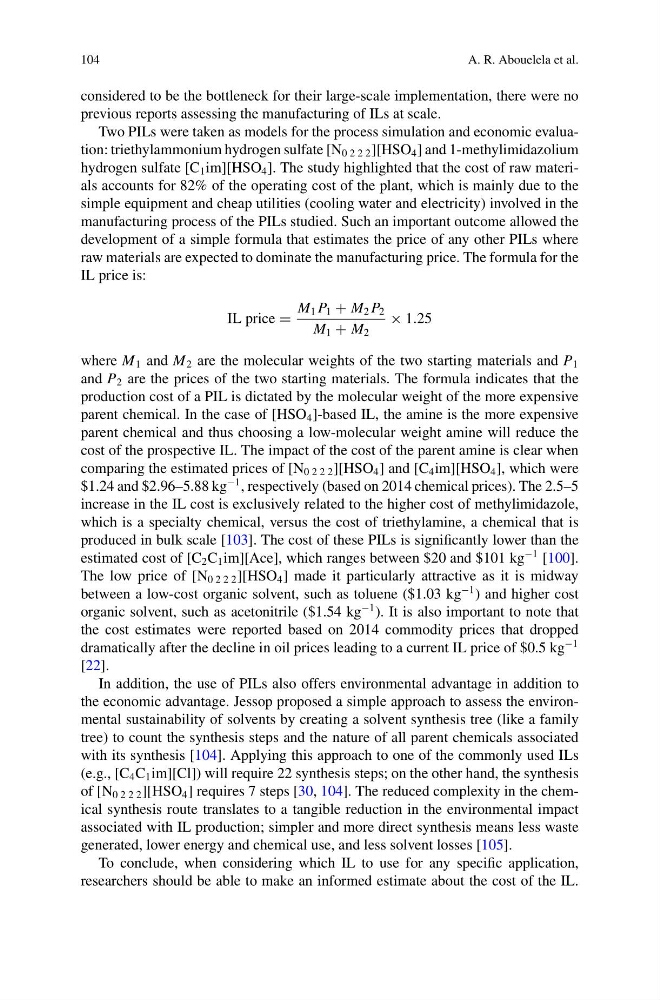
IL price is:
IL price =
M 1 P 1 + M 2 P 2
M 1 + M 2
× 1.25
where M 1 and M 2 are the molecular weights of the two starting materials and P 1
and P 2 are the prices of the two starting materials. The formula indicates that the
production cost of a PIL is dictated by the molecular weight of the more expensive
parent chemical. In the case of [HSO 4 ]-based IL, the amine is the more expensive
parent chemical and thus choosing a low-molecular weight amine will reduce the
cost of the prospective IL. The impact of the cost of the parent amine is clear when
comparing the estimated prices of [N 0 2 2 2 ][HSO 4 ] and [C 4 im][HSO 4 ], which were
$1.24 and $2.96–5.88 kg
−1 , respectively (based on 2014 chemical prices). The 2.5–5
increase in the IL cost is exclusively related to the higher cost of methylimidazole,
which is a specialty chemical, versus the cost of triethylamine, a chemical that is
produced in bulk scale [103]. The cost of these PILs is significantly lower than the
estimated cost of [C 2 C 1 im][Ace], which ranges between $20 and $101 kg
−1 [100].
The low price of [N 0 2 2 2 ][HSO 4 ] made it particularly attractive as it is midway
between a low-cost organic solvent, such as toluene ($1.03 kg
−1 ) and higher cost
organic solvent, such as acetonitrile ($1.54 kg
−1 ). It is also important to note that
the cost estimates were reported based on 2014 commodity prices that dropped
dramatically after the decline in oil prices leading to a current IL price of $0.5 kg
−1
[22].
In addition, the use of PILs also offers environmental advantage in addition to
the economic advantage. Jessop proposed a simple approach to assess the environmental sustainability of solvents by creating a solvent synthesis tree (like a family
tree) to count the synthesis steps and the nature of all parent chemicals associated
with its synthesis [104]. Applying this approach to one of the commonly used ILs
(e.g., [C 4 C 1 im][Cl]) will require 22 synthesis steps; on the other hand, the synthesis
of [N 0 2 2 2 ][HSO 4 ] requires 7 steps [30, 104]. The reduced complexity in the chemical synthesis route translates to a tangible reduction in the environmental impact
associated with IL production; simpler and more direct synthesis means less waste
generated, lower energy and chemical use, and less solvent losses [105].
To conclude, when considering which IL to use for any specific application,
researchers should be able to make an informed estimate about the cost of the IL.
A. R. Abouelela et al.
considered to be the bottleneck for their large-scale implementation, there were no
previous reports assessing the manufacturing of ILs at scale.
Two PILs were taken as models for the process simulation and economic evaluation: triethylammonium hydrogen sulfate [N 0 2 2 2 ][HSO 4 ] and 1-methylimidazolium
hydrogen sulfate [C 1 im][HSO 4 ]. The study highlighted that the cost of raw materials accounts for 82% of the operating cost of the plant, which is mainly due to the
simple equipment and cheap utilities (cooling water and electricity) involved in the
manufacturing process of the PILs studied. Such an important outcome allowed the
development of a simple formula that estimates the price of any other PILs where
raw materials are expected to dominate the manufacturing price. The formula for the
IL price is:
IL price =
M 1 P 1 + M 2 P 2
M 1 + M 2
× 1.25
where M 1 and M 2 are the molecular weights of the two starting materials and P 1
and P 2 are the prices of the two starting materials. The formula indicates that the
production cost of a PIL is dictated by the molecular weight of the more expensive
parent chemical. In the case of [HSO 4 ]-based IL, the amine is the more expensive
parent chemical and thus choosing a low-molecular weight amine will reduce the
cost of the prospective IL. The impact of the cost of the parent amine is clear when
comparing the estimated prices of [N 0 2 2 2 ][HSO 4 ] and [C 4 im][HSO 4 ], which were
$1.24 and $2.96–5.88 kg
−1 , respectively (based on 2014 chemical prices). The 2.5–5
increase in the IL cost is exclusively related to the higher cost of methylimidazole,
which is a specialty chemical, versus the cost of triethylamine, a chemical that is
produced in bulk scale [103]. The cost of these PILs is significantly lower than the
estimated cost of [C 2 C 1 im][Ace], which ranges between $20 and $101 kg
−1 [100].
The low price of [N 0 2 2 2 ][HSO 4 ] made it particularly attractive as it is midway
between a low-cost organic solvent, such as toluene ($1.03 kg
−1 ) and higher cost
organic solvent, such as acetonitrile ($1.54 kg
−1 ). It is also important to note that
the cost estimates were reported based on 2014 commodity prices that dropped
dramatically after the decline in oil prices leading to a current IL price of $0.5 kg
−1
[22].
In addition, the use of PILs also offers environmental advantage in addition to
the economic advantage. Jessop proposed a simple approach to assess the environmental sustainability of solvents by creating a solvent synthesis tree (like a family
tree) to count the synthesis steps and the nature of all parent chemicals associated
with its synthesis [104]. Applying this approach to one of the commonly used ILs
(e.g., [C 4 C 1 im][Cl]) will require 22 synthesis steps; on the other hand, the synthesis
of [N 0 2 2 2 ][HSO 4 ] requires 7 steps [30, 104]. The reduced complexity in the chemical synthesis route translates to a tangible reduction in the environmental impact
associated with IL production; simpler and more direct synthesis means less waste
generated, lower energy and chemical use, and less solvent losses [105].
To conclude, when considering which IL to use for any specific application,
researchers should be able to make an informed estimate about the cost of the IL.