

98
A. R. Abouelela et al.
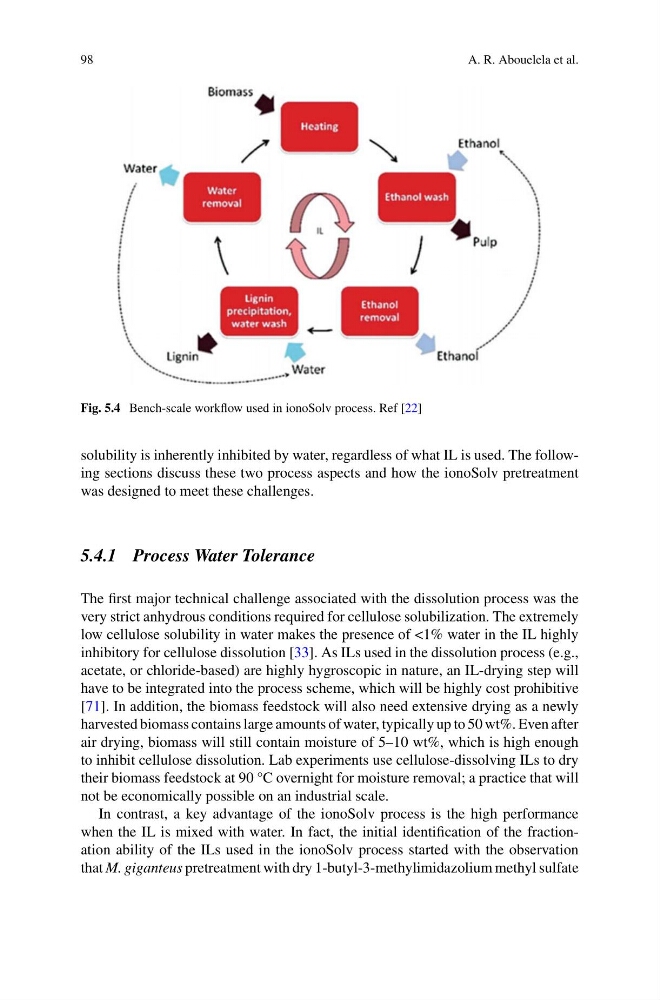
Fig. 5.4 Bench-scale workflow used in ionoSolv process. Ref [22]
solubility is inherently inhibited by water, regardless of what IL is used. The following sections discuss these two process aspects and how the ionoSolv pretreatment
was designed to meet these challenges.
5.4.1 Process Water Tolerance
The first major technical challenge associated with the dissolution process was the
very strict anhydrous conditions required for cellulose solubilization. The extremely
low cellulose solubility in water makes the presence of <1% water in the IL highly
inhibitory for cellulose dissolution [33]. As ILs used in the dissolution process (e.g.,
acetate, or chloride-based) are highly hygroscopic in nature, an IL-drying step will
have to be integrated into the process scheme, which will be highly cost prohibitive
[71]. In addition, the biomass feedstock will also need extensive drying as a newly
harvested biomass contains large amounts of water, typically up to 50 wt%. Even after
air drying, biomass will still contain moisture of 5–10 wt%, which is high enough
to inhibit cellulose dissolution. Lab experiments use cellulose-dissolving ILs to dry
their biomass feedstock at 90 °C overnight for moisture removal; a practice that will
not be economically possible on an industrial scale.
In contrast, a key advantage of the ionoSolv process is the high performance
when the IL is mixed with water. In fact, the initial identification of the fractionation ability of the ILs used in the ionoSolv process started with the observation
that M. giganteus pretreatment with dry 1-butyl-3-methylimidazolium methyl sulfate
A. R. Abouelela et al.
Fig. 5.4 Bench-scale workflow used in ionoSolv process. Ref [22]
solubility is inherently inhibited by water, regardless of what IL is used. The following sections discuss these two process aspects and how the ionoSolv pretreatment
was designed to meet these challenges.
5.4.1 Process Water Tolerance
The first major technical challenge associated with the dissolution process was the
very strict anhydrous conditions required for cellulose solubilization. The extremely
low cellulose solubility in water makes the presence of <1% water in the IL highly
inhibitory for cellulose dissolution [33]. As ILs used in the dissolution process (e.g.,
acetate, or chloride-based) are highly hygroscopic in nature, an IL-drying step will
have to be integrated into the process scheme, which will be highly cost prohibitive
[71]. In addition, the biomass feedstock will also need extensive drying as a newly
harvested biomass contains large amounts of water, typically up to 50 wt%. Even after
air drying, biomass will still contain moisture of 5–10 wt%, which is high enough
to inhibit cellulose dissolution. Lab experiments use cellulose-dissolving ILs to dry
their biomass feedstock at 90 °C overnight for moisture removal; a practice that will
not be economically possible on an industrial scale.
In contrast, a key advantage of the ionoSolv process is the high performance
when the IL is mixed with water. In fact, the initial identification of the fractionation ability of the ILs used in the ionoSolv process started with the observation
that M. giganteus pretreatment with dry 1-butyl-3-methylimidazolium methyl sulfate