

writing. Additionally, Ken only needed 4 h of sleep after he turned 40 and could sit
and work throughout the whole day without food, maybe with the occasional drink.
Lunch was not needed, as Ken did not want to be interrupted and lose the flow.
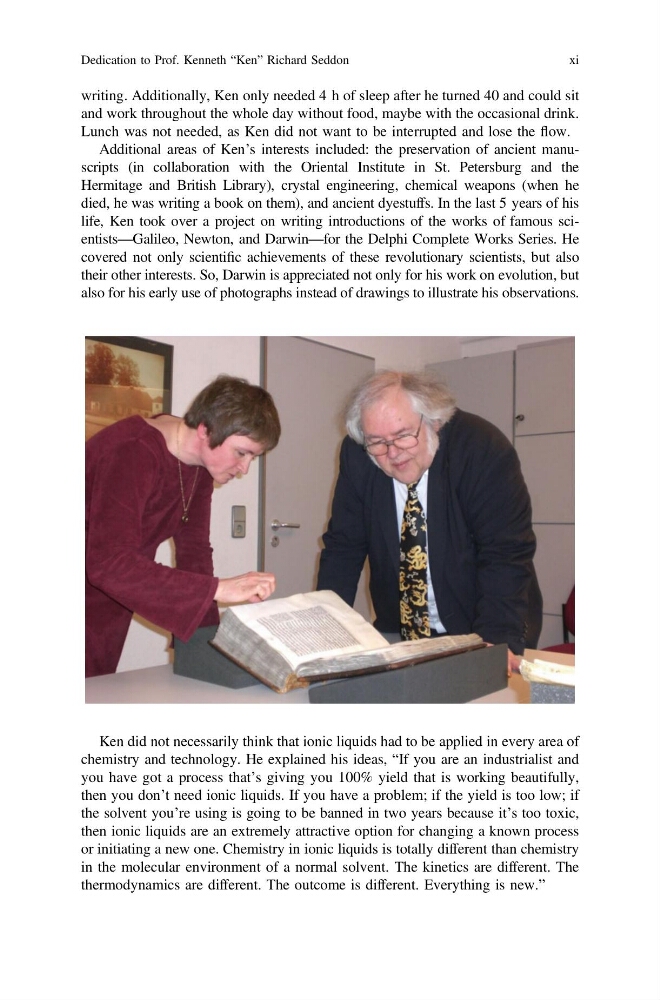
Additional areas of Ken’s interests included: the preservation of ancient manuscripts (in collaboration with the Oriental Institute in St. Petersburg and the
Hermitage and British Library), crystal engineering, chemical weapons (when he
died, he was writing a book on them), and ancient dyestuffs. In the last 5 years of his
life, Ken took over a project on writing introductions of the works of famous scientists—Galileo, Newton, and Darwin—for the Delphi Complete Works Series. He
covered not only scientific achievements of these revolutionary scientists, but also
their other interests. So, Darwin is appreciated not only for his work on evolution, but
also for his early use of photographs instead of drawings to illustrate his observations.
Ken did not necessarily think that ionic liquids had to be applied in every area of
chemistry and technology. He explained his ideas, “If you are an industrialist and
you have got a process that’s giving you 100% yield that is working beautifully,
then you don’t need ionic liquids. If you have a problem; if the yield is too low; if
the solvent you’re using is going to be banned in two years because it’s too toxic,
then ionic liquids are an extremely attractive option for changing a known process
or initiating a new one. Chemistry in ionic liquids is totally different than chemistry
in the molecular environment of a normal solvent. The kinetics are different. The
thermodynamics are different. The outcome is different. Everything is new.”
Dedication to Prof. Kenneth “Ken” Richard Seddon
xi
and work throughout the whole day without food, maybe with the occasional drink.
Lunch was not needed, as Ken did not want to be interrupted and lose the flow.
Additional areas of Ken’s interests included: the preservation of ancient manuscripts (in collaboration with the Oriental Institute in St. Petersburg and the
Hermitage and British Library), crystal engineering, chemical weapons (when he
died, he was writing a book on them), and ancient dyestuffs. In the last 5 years of his
life, Ken took over a project on writing introductions of the works of famous scientists—Galileo, Newton, and Darwin—for the Delphi Complete Works Series. He
covered not only scientific achievements of these revolutionary scientists, but also
their other interests. So, Darwin is appreciated not only for his work on evolution, but
also for his early use of photographs instead of drawings to illustrate his observations.
Ken did not necessarily think that ionic liquids had to be applied in every area of
chemistry and technology. He explained his ideas, “If you are an industrialist and
you have got a process that’s giving you 100% yield that is working beautifully,
then you don’t need ionic liquids. If you have a problem; if the yield is too low; if
the solvent you’re using is going to be banned in two years because it’s too toxic,
then ionic liquids are an extremely attractive option for changing a known process
or initiating a new one. Chemistry in ionic liquids is totally different than chemistry
in the molecular environment of a normal solvent. The kinetics are different. The
thermodynamics are different. The outcome is different. Everything is new.”
Dedication to Prof. Kenneth “Ken” Richard Seddon
xi