

parameters implies the presence of not three but
two linear segments in piecewise linear function
H (Fig. 7.3). This condition is implemented
according to Eq. (7.1) as dependence H(X1, X1,
1, 1, Z1, Z2, X).
The execution of SAM with the examination
of different versions of equations, which describe
the WR formation under environmental impact,
permits to construct the model best in quadratic
residual. The model takes into account the
landscape structure of river basins and has 36
parameters for each of four hydrological seasons.
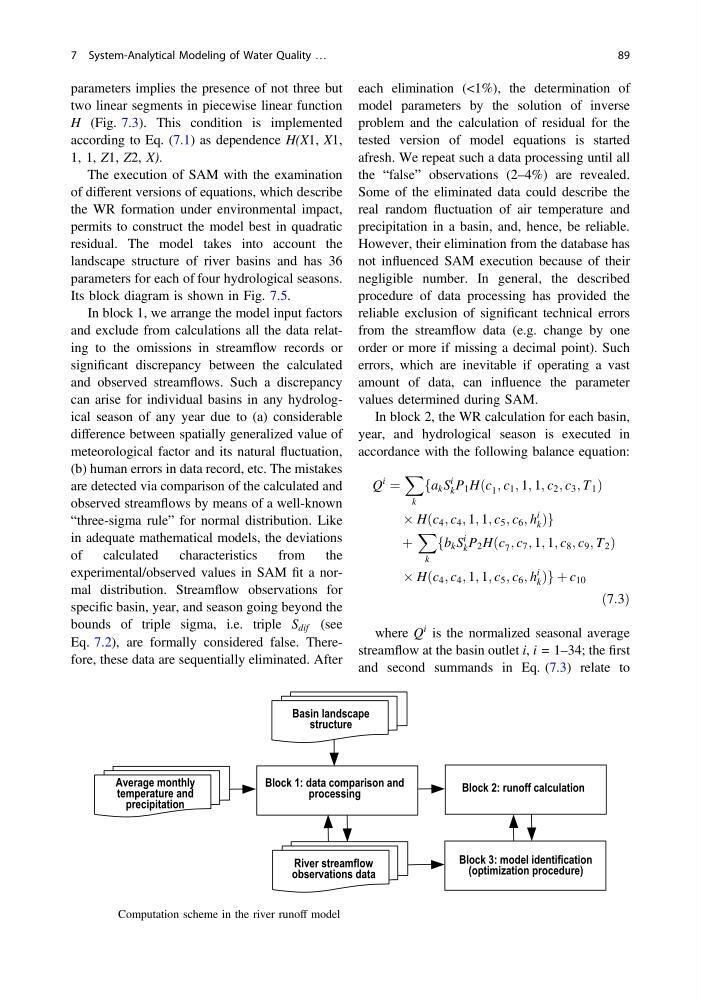
Its block diagram is shown in Fig. 7.5.
In block 1, we arrange the model input factors
and exclude from calculations all the data relating to the omissions in streamflow records or
significant discrepancy between the calculated
and observed streamflows. Such a discrepancy
can arise for individual basins in any hydrological season of any year due to (a) considerable
difference between spatially generalized value of
meteorological factor and its natural fluctuation,
(b) human errors in data record, etc. The mistakes
are detected via comparison of the calculated and
observed streamflows by means of a well-known
“three-sigma rule” for normal distribution. Like
in adequate mathematical models, the deviations
of
calculated
characteristics
from
the
experimental/observed values in SAM fit a normal distribution. Streamflow observations for
specific basin, year, and season going beyond the
bounds of triple sigma, i.e. triple S dif (see
Eq. 7.2), are formally considered false. Therefore, these data are sequentially eliminated. After
each elimination (<1%), the determination of
model parameters by the solution of inverse
problem and the calculation of residual for the
tested version of model equations is started
afresh. We repeat such a data processing until all
the “false” observations (2–4%) are revealed.
Some of the eliminated data could describe the
real random fluctuation of air temperature and
precipitation in a basin, and, hence, be reliable.
However, their elimination from the database has
not influenced SAM execution because of their
negligible number. In general, the described
procedure of data processing has provided the
reliable exclusion of significant technical errors
from the streamflow data (e.g. change by one
order or more if missing a decimal point). Such
errors, which are inevitable if operating a vast
amount of data, can influence the parameter
values determined during SAM.
In block 2, the WR calculation for each basin,
year, and hydrological season is executed in
accordance with the following balance equation:
Q
i
¼
X
k
fa k S
i
k P 1 Hðc 1 ; c 1 ; 1; 1; c 2 ; c 3 ; T 1 Þ
 Hðc 4 ; c 4 ; 1; 1; c 5 ; c 6 ; h
i
k Þg
þ
X
k
fb k S
i
k P 2 Hðc 7 ; c 7 ; 1; 1; c 8 ; c 9 ; T 2 Þ
 Hðc 4 ; c 4 ; 1; 1; c 5 ; c 6 ; h
i
k Þg þ c 10
ð7:3Þ
where Q
i is the normalized seasonal average
streamflow at the basin outlet i, i = 1–34; the first
and second summands in Eq. (7.3) relate to
Basin landscape
structure
Block 1: data comparison and
processing
Block 2: runoff calculation
Block 3: model identification
(optimization procedure)
River streamflow
observations data
Average monthly
temperature and
precipitation
Fig. 7.5 Computation scheme in the river runoff model
7 System-Analytical Modeling of Water Quality …
89
two linear segments in piecewise linear function
H (Fig. 7.3). This condition is implemented
according to Eq. (7.1) as dependence H(X1, X1,
1, 1, Z1, Z2, X).
The execution of SAM with the examination
of different versions of equations, which describe
the WR formation under environmental impact,
permits to construct the model best in quadratic
residual. The model takes into account the
landscape structure of river basins and has 36
parameters for each of four hydrological seasons.
Its block diagram is shown in Fig. 7.5.
In block 1, we arrange the model input factors
and exclude from calculations all the data relating to the omissions in streamflow records or
significant discrepancy between the calculated
and observed streamflows. Such a discrepancy
can arise for individual basins in any hydrological season of any year due to (a) considerable
difference between spatially generalized value of
meteorological factor and its natural fluctuation,
(b) human errors in data record, etc. The mistakes
are detected via comparison of the calculated and
observed streamflows by means of a well-known
“three-sigma rule” for normal distribution. Like
in adequate mathematical models, the deviations
of
calculated
characteristics
from
the
experimental/observed values in SAM fit a normal distribution. Streamflow observations for
specific basin, year, and season going beyond the
bounds of triple sigma, i.e. triple S dif (see
Eq. 7.2), are formally considered false. Therefore, these data are sequentially eliminated. After
each elimination (<1%), the determination of
model parameters by the solution of inverse
problem and the calculation of residual for the
tested version of model equations is started
afresh. We repeat such a data processing until all
the “false” observations (2–4%) are revealed.
Some of the eliminated data could describe the
real random fluctuation of air temperature and
precipitation in a basin, and, hence, be reliable.
However, their elimination from the database has
not influenced SAM execution because of their
negligible number. In general, the described
procedure of data processing has provided the
reliable exclusion of significant technical errors
from the streamflow data (e.g. change by one
order or more if missing a decimal point). Such
errors, which are inevitable if operating a vast
amount of data, can influence the parameter
values determined during SAM.
In block 2, the WR calculation for each basin,
year, and hydrological season is executed in
accordance with the following balance equation:
Q
i
¼
X
k
fa k S
i
k P 1 Hðc 1 ; c 1 ; 1; 1; c 2 ; c 3 ; T 1 Þ
 Hðc 4 ; c 4 ; 1; 1; c 5 ; c 6 ; h
i
k Þg
þ
X
k
fb k S
i
k P 2 Hðc 7 ; c 7 ; 1; 1; c 8 ; c 9 ; T 2 Þ
 Hðc 4 ; c 4 ; 1; 1; c 5 ; c 6 ; h
i
k Þg þ c 10
ð7:3Þ
where Q
i is the normalized seasonal average
streamflow at the basin outlet i, i = 1–34; the first
and second summands in Eq. (7.3) relate to
Basin landscape
structure
Block 1: data comparison and
processing
Block 2: runoff calculation
Block 3: model identification
(optimization procedure)
River streamflow
observations data
Average monthly
temperature and
precipitation
Fig. 7.5 Computation scheme in the river runoff model
7 System-Analytical Modeling of Water Quality …
89