

of the state, only seven districts, viz. Hoshangabad, Betul, Chhindwara, Sagar, Narsinghpur,
Shajapur and Dhar have groundwater potential
above 1.0 billion cubic meters. These districts are
located in south-central part of the state and have
developed canal irrigation resulting in higher
recharge from other sources than rainfall. Other
44 districts have availability below 1.0 BCM per
annum and 17 out of them have potential even
below 0.5 BCM. These are non-command areas
and some of them, such as Dindori, Jhabua,
Barwani, Sidhi and Singrauli, are dominated by
the hilly and dissected terrain unsuitable for rapid
recharge of groundwater and others are small in
size such as Harda, Ashoknagar, Datia, Bhopal
and Neemuch. As such, uneven distribution of
groundwater is mainly due to geological structure, characteristics of soil, nature of terrain and
slope, amount of rainfall and its characteristics,
vegetative cover and size of the district.
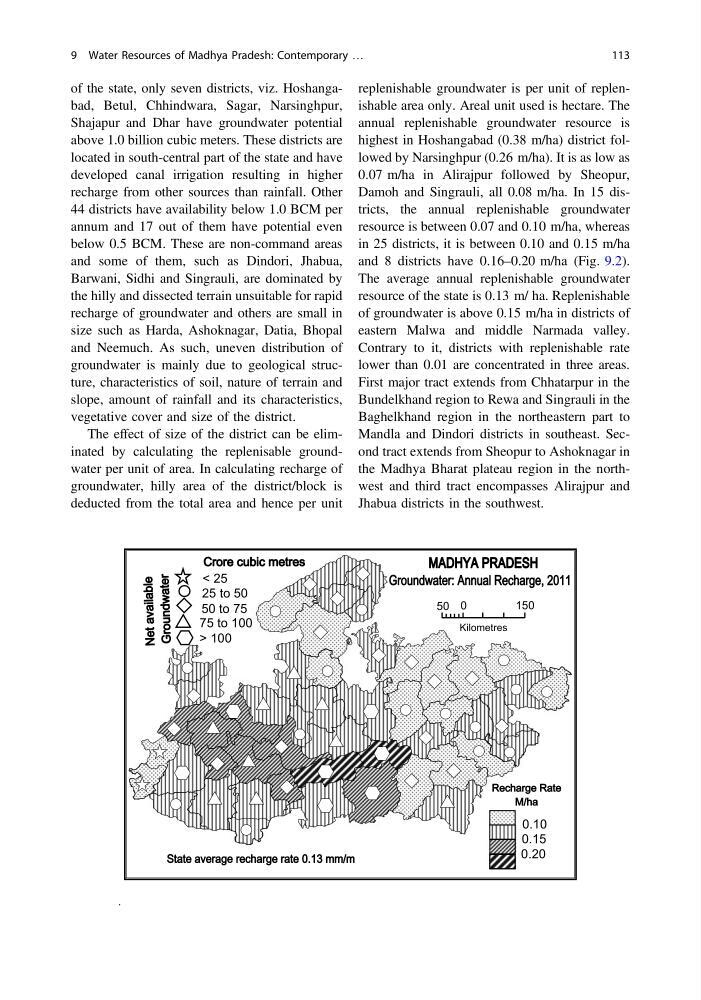
The effect of size of the district can be eliminated by calculating the replenisable groundwater per unit of area. In calculating recharge of
groundwater, hilly area of the district/block is
deducted from the total area and hence per unit
replenishable groundwater is per unit of replenishable area only. Areal unit used is hectare. The
annual replenishable groundwater resource is
highest in Hoshangabad (0.38 m/ha) district followed by Narsinghpur (0.26 m/ha). It is as low as
0.07 m/ha in Alirajpur followed by Sheopur,
Damoh and Singrauli, all 0.08 m/ha. In 15 districts, the annual replenishable groundwater
resource is between 0.07 and 0.10 m/ha, whereas
in 25 districts, it is between 0.10 and 0.15 m/ha
and 8 districts have 0.16–0.20 m/ha (Fig. 9.2).
The average annual replenishable groundwater
resource of the state is 0.13 m/ ha. Replenishable
of groundwater is above 0.15 m/ha in districts of
eastern Malwa and middle Narmada valley.
Contrary to it, districts with replenishable rate
lower than 0.01 are concentrated in three areas.
First major tract extends from Chhatarpur in the
Bundelkhand region to Rewa and Singrauli in the
Baghelkhand region in the northeastern part to
Mandla and Dindori districts in southeast. Second tract extends from Sheopur to Ashoknagar in
the Madhya Bharat plateau region in the northwest and third tract encompasses Alirajpur and
Jhabua districts in the southwest.
50 0
150
Kilometres
< 25
25 to 50
75 to 100
50 to 75
> 100
0.10
0.15
0.20
Fig. 9.2 .
9 Water Resources of Madhya Pradesh: Contemporary …
113
Shajapur and Dhar have groundwater potential
above 1.0 billion cubic meters. These districts are
located in south-central part of the state and have
developed canal irrigation resulting in higher
recharge from other sources than rainfall. Other
44 districts have availability below 1.0 BCM per
annum and 17 out of them have potential even
below 0.5 BCM. These are non-command areas
and some of them, such as Dindori, Jhabua,
Barwani, Sidhi and Singrauli, are dominated by
the hilly and dissected terrain unsuitable for rapid
recharge of groundwater and others are small in
size such as Harda, Ashoknagar, Datia, Bhopal
and Neemuch. As such, uneven distribution of
groundwater is mainly due to geological structure, characteristics of soil, nature of terrain and
slope, amount of rainfall and its characteristics,
vegetative cover and size of the district.
The effect of size of the district can be eliminated by calculating the replenisable groundwater per unit of area. In calculating recharge of
groundwater, hilly area of the district/block is
deducted from the total area and hence per unit
replenishable groundwater is per unit of replenishable area only. Areal unit used is hectare. The
annual replenishable groundwater resource is
highest in Hoshangabad (0.38 m/ha) district followed by Narsinghpur (0.26 m/ha). It is as low as
0.07 m/ha in Alirajpur followed by Sheopur,
Damoh and Singrauli, all 0.08 m/ha. In 15 districts, the annual replenishable groundwater
resource is between 0.07 and 0.10 m/ha, whereas
in 25 districts, it is between 0.10 and 0.15 m/ha
and 8 districts have 0.16–0.20 m/ha (Fig. 9.2).
The average annual replenishable groundwater
resource of the state is 0.13 m/ ha. Replenishable
of groundwater is above 0.15 m/ha in districts of
eastern Malwa and middle Narmada valley.
Contrary to it, districts with replenishable rate
lower than 0.01 are concentrated in three areas.
First major tract extends from Chhatarpur in the
Bundelkhand region to Rewa and Singrauli in the
Baghelkhand region in the northeastern part to
Mandla and Dindori districts in southeast. Second tract extends from Sheopur to Ashoknagar in
the Madhya Bharat plateau region in the northwest and third tract encompasses Alirajpur and
Jhabua districts in the southwest.
50 0
150
Kilometres
< 25
25 to 50
75 to 100
50 to 75
> 100
0.10
0.15
0.20
Fig. 9.2 .
9 Water Resources of Madhya Pradesh: Contemporary …
113