

copolymers, composed of alternating hard segments and soft segments; the soft
segments provide flexibility and hard segments provide strength to the derived PUs.
Most of the soft segments are amorphous and exhibit T g values lesser than room
temperature, which results in polymer softening at room temperature; these soft
segments are responsible for the elasticity of the PU polymer. All the hard segments
are crystalline in nature and their T g value is higher than the room temperature; they
are responsible for the stiffness of the PUs [45]. Owing to the presence of HS and
SS, PUs exhibits thermodynamic immiscibility and micro-phase separation. The
properties of the polymer can be tailored by changing the concentrations and
lengths of the hard and soft segments [55–57, 122–124]. Hydrogen bonding is also
an important factor in PU synthesis, especially with relation to phase separation and
phase morphology. If there exist a large number of hydrogen bonds between the
two phases, the degree of phase mixing will be high. When the number is low,
hydrogen bonds exist only in the hard segments, which increases crystallization and
phase separation. Clough and Schneider [9] first introduced and reported the
two-phase morphology of PUs using small angle X-ray scattering (SAXS). Later,
Koutsky et al. [125] discovered two-phase microstructure establishment in polyesters and polyethers containing PUs using transmission electron microscopy
(TEM), but their results were not conclusive. Subsequently, Chen-Tsai et al. and
Serrano et al. clearly illustrated the two-phase morphology of PUs containing
different percentages of hard segments by SAXS and TEM analyses [7, 126, 127].
Therefore, it can be concluded that PUs show a combination of properties; they
behave like glassy and soft elastomers at the same time, which allows the use of
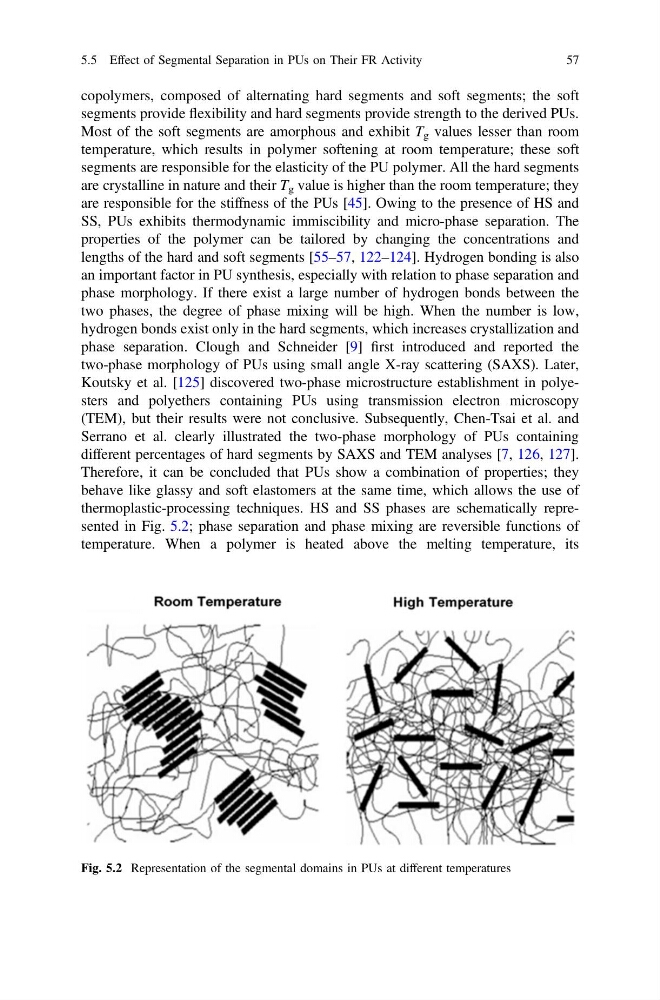
thermoplastic-processing techniques. HS and SS phases are schematically represented in Fig. 5.2; phase separation and phase mixing are reversible functions of
temperature. When a polymer is heated above the melting temperature, its
Fig. 5.2 Representation of the segmental domains in PUs at different temperatures
5.5 Effect of Segmental Separation in PUs on Their FR Activity
57
segments provide flexibility and hard segments provide strength to the derived PUs.
Most of the soft segments are amorphous and exhibit T g values lesser than room
temperature, which results in polymer softening at room temperature; these soft
segments are responsible for the elasticity of the PU polymer. All the hard segments
are crystalline in nature and their T g value is higher than the room temperature; they
are responsible for the stiffness of the PUs [45]. Owing to the presence of HS and
SS, PUs exhibits thermodynamic immiscibility and micro-phase separation. The
properties of the polymer can be tailored by changing the concentrations and
lengths of the hard and soft segments [55–57, 122–124]. Hydrogen bonding is also
an important factor in PU synthesis, especially with relation to phase separation and
phase morphology. If there exist a large number of hydrogen bonds between the
two phases, the degree of phase mixing will be high. When the number is low,
hydrogen bonds exist only in the hard segments, which increases crystallization and
phase separation. Clough and Schneider [9] first introduced and reported the
two-phase morphology of PUs using small angle X-ray scattering (SAXS). Later,
Koutsky et al. [125] discovered two-phase microstructure establishment in polyesters and polyethers containing PUs using transmission electron microscopy
(TEM), but their results were not conclusive. Subsequently, Chen-Tsai et al. and
Serrano et al. clearly illustrated the two-phase morphology of PUs containing
different percentages of hard segments by SAXS and TEM analyses [7, 126, 127].
Therefore, it can be concluded that PUs show a combination of properties; they
behave like glassy and soft elastomers at the same time, which allows the use of
thermoplastic-processing techniques. HS and SS phases are schematically represented in Fig. 5.2; phase separation and phase mixing are reversible functions of
temperature. When a polymer is heated above the melting temperature, its
Fig. 5.2 Representation of the segmental domains in PUs at different temperatures
5.5 Effect of Segmental Separation in PUs on Their FR Activity
57