

the polymers exhibited FR activity even at low P contents (3%); the corresponding
PU exhibited a high LOI value 24.3%. LOI values mainly depend on the crosslink
density and P content. An increase in the crosslink density can improve the modulus
and stability of the polymer, which also influence the FR activity. FR PU sealants
were prepared from ricinoleic acid-containing P and N polyols and methylene
diphenyl diisocyanate. The results indicated a great improvement in the thermal
stability and FR activity along with high char yield and strong barrier properties;
this is because the PHRR, THR, and toxic gas evolution decreased [121]. A variety
of phosphorus-containing polyol FR polymers have been synthesized and they
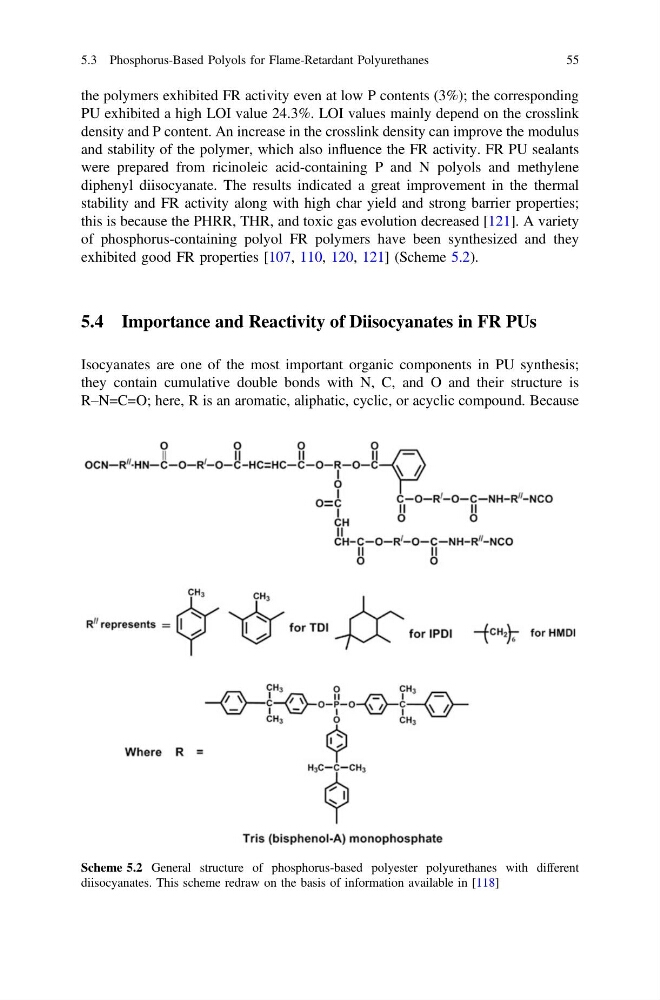
exhibited good FR properties [107, 110, 120, 121] (Scheme 5.2).
5.4 Importance and Reactivity of Diisocyanates in FR PUs
Isocyanates are one of the most important organic components in PU synthesis;
they contain cumulative double bonds with N, C, and O and their structure is
R–N=C=O; here, R is an aromatic, aliphatic, cyclic, or acyclic compound. Because
Scheme 5.2 General structure of phosphorus-based polyester polyurethanes with different
diisocyanates. This scheme redraw on the basis of information available in [118]
5.3 Phosphorus-Based Polyols for Flame-Retardant Polyurethanes
55
PU exhibited a high LOI value 24.3%. LOI values mainly depend on the crosslink
density and P content. An increase in the crosslink density can improve the modulus
and stability of the polymer, which also influence the FR activity. FR PU sealants
were prepared from ricinoleic acid-containing P and N polyols and methylene
diphenyl diisocyanate. The results indicated a great improvement in the thermal
stability and FR activity along with high char yield and strong barrier properties;
this is because the PHRR, THR, and toxic gas evolution decreased [121]. A variety
of phosphorus-containing polyol FR polymers have been synthesized and they
exhibited good FR properties [107, 110, 120, 121] (Scheme 5.2).
5.4 Importance and Reactivity of Diisocyanates in FR PUs
Isocyanates are one of the most important organic components in PU synthesis;
they contain cumulative double bonds with N, C, and O and their structure is
R–N=C=O; here, R is an aromatic, aliphatic, cyclic, or acyclic compound. Because
Scheme 5.2 General structure of phosphorus-based polyester polyurethanes with different
diisocyanates. This scheme redraw on the basis of information available in [118]
5.3 Phosphorus-Based Polyols for Flame-Retardant Polyurethanes
55