

evolution from polymer subjected to combustion [85, 86], but the inclusion of new
analytical methods, such as TGA-FTIR and TGA-MS, is not yet widely used.
Recently, a number of studies have been carried out to understand the mechanism
of smoke inhibition using various smoke inhibitors and FR additives [87–89]. Hastie
et al. [90] studied smoke suppression and inhibition using various metal oxides and
metal derivative compounds as additives. They found out that Ba, Sr, Mo, and W are
highly efficient smoke inhibitors. Some metals, such as Fe and Mn, exhibit smoke
inhibition activity in the form of carbonyl complexes; further, ferrocene is also
considered a highly efficient smoke inhibitor [91, 92]. The surface area of NPs is
important in smoke suppression because NPs with a large surface area can absorb
large amounts of smoke and toxic gases. In this context, aluminum trihydroxide
(ATH)-containing TPU composites and PU foams showed significantly high smoke
suppression [93, 94]. Generally, red phosphorus is used as a FR for PU polymers
[95], but it releases highly toxic phosphine in the presence of water during polymer
combustion. This can be suppressed by using metal oxides, such as ZnO 2 , CdO, and
CuO, as stabilizers in conjunction with red phosphorus; in the presence of these
metal oxides, phosphine is converted into phosphoric acid, which activates char
formation in the condensed phase [96, 97]. Levin et al. [97, 98] prepared flexible PU
foams by adding 0.1% of copper dust, copper sulfate, and cupric oxide and they
noticed a drastic reduction in HCN content by 80–90%; further, the toxicity of the
resulting smoke reduced by 40–70%. Melamine PU foams release 10% more HCN
than PU foams without melamine, but in the presence of Cu 2 O, HCN generation
from melamine PU foams could be reduced by 90% [97, 98]. It was suggested that
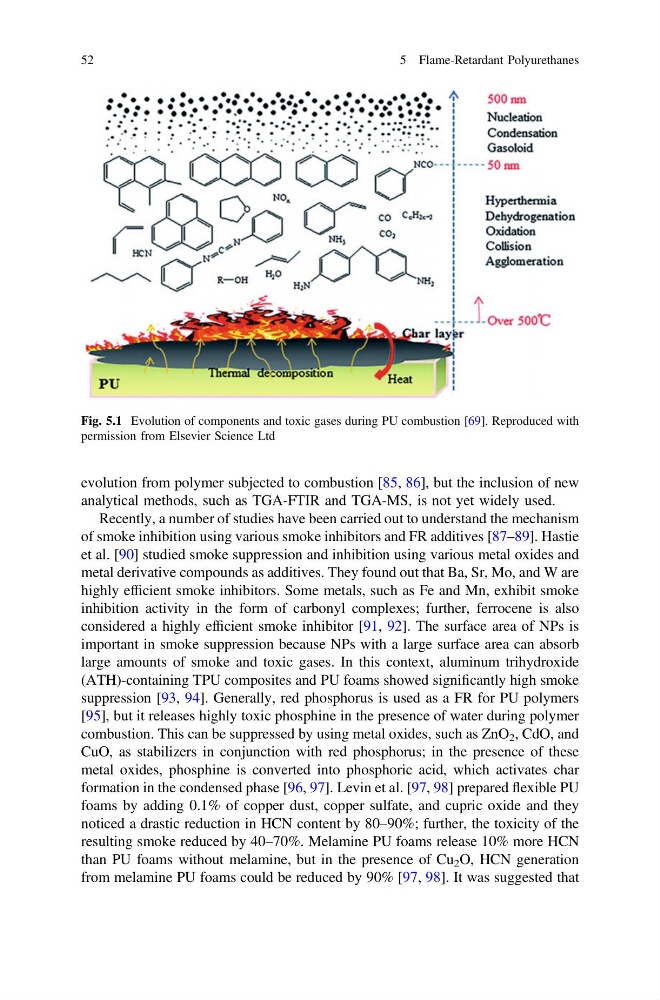
Fig. 5.1 Evolution of components and toxic gases during PU combustion [69]. Reproduced with
permission from Elsevier Science Ltd
52
5 Flame-Retardant Polyurethanes
analytical methods, such as TGA-FTIR and TGA-MS, is not yet widely used.
Recently, a number of studies have been carried out to understand the mechanism
of smoke inhibition using various smoke inhibitors and FR additives [87–89]. Hastie
et al. [90] studied smoke suppression and inhibition using various metal oxides and
metal derivative compounds as additives. They found out that Ba, Sr, Mo, and W are
highly efficient smoke inhibitors. Some metals, such as Fe and Mn, exhibit smoke
inhibition activity in the form of carbonyl complexes; further, ferrocene is also
considered a highly efficient smoke inhibitor [91, 92]. The surface area of NPs is
important in smoke suppression because NPs with a large surface area can absorb
large amounts of smoke and toxic gases. In this context, aluminum trihydroxide
(ATH)-containing TPU composites and PU foams showed significantly high smoke
suppression [93, 94]. Generally, red phosphorus is used as a FR for PU polymers
[95], but it releases highly toxic phosphine in the presence of water during polymer
combustion. This can be suppressed by using metal oxides, such as ZnO 2 , CdO, and
CuO, as stabilizers in conjunction with red phosphorus; in the presence of these
metal oxides, phosphine is converted into phosphoric acid, which activates char
formation in the condensed phase [96, 97]. Levin et al. [97, 98] prepared flexible PU
foams by adding 0.1% of copper dust, copper sulfate, and cupric oxide and they
noticed a drastic reduction in HCN content by 80–90%; further, the toxicity of the
resulting smoke reduced by 40–70%. Melamine PU foams release 10% more HCN
than PU foams without melamine, but in the presence of Cu 2 O, HCN generation
from melamine PU foams could be reduced by 90% [97, 98]. It was suggested that
Fig. 5.1 Evolution of components and toxic gases during PU combustion [69]. Reproduced with
permission from Elsevier Science Ltd
52
5 Flame-Retardant Polyurethanes