

5.1 Thermal Degradation and Evolution of Components
During PU Combustion
Even though a vast number of reports are available on the thermal decomposition,
FRs, and smoke inhibition strategies of PU polymers, the relationship between
thermal decomposition, FR activity, and toxic gas evolution is still not completely
understood. However, such an understanding is necessary to enhance the FR
activity and decrease toxic smoke evolution during PU combustion. Thermal stability and decomposition are important factors in analyzing the FR activity of a
given polymer; thermal degradation reflects the break-down of the polymer into
small airborne particles and gases when the material is exposed to flame or
increased temperature. These degraded flammable components enter into the
atmosphere, owing to which the material catches fire. However, when the tested
polymers are thermally more stable and do not decompose even at high temperatures, no airborne particles are generated, which minimizes the flammability of the
material. In some cases, polymers degrade rapidly to form a char layer, which can
prevent further polymer degradation and prevent oxygen from coming into contact
with the substrate. Thermo-gravimetric analysis (TGA) is a useful technique to
evaluate the thermal stability of polymers. Many researchers reported that PUs start
to degrade at around 180–200 °C in the presence of nitrogen and the degradation
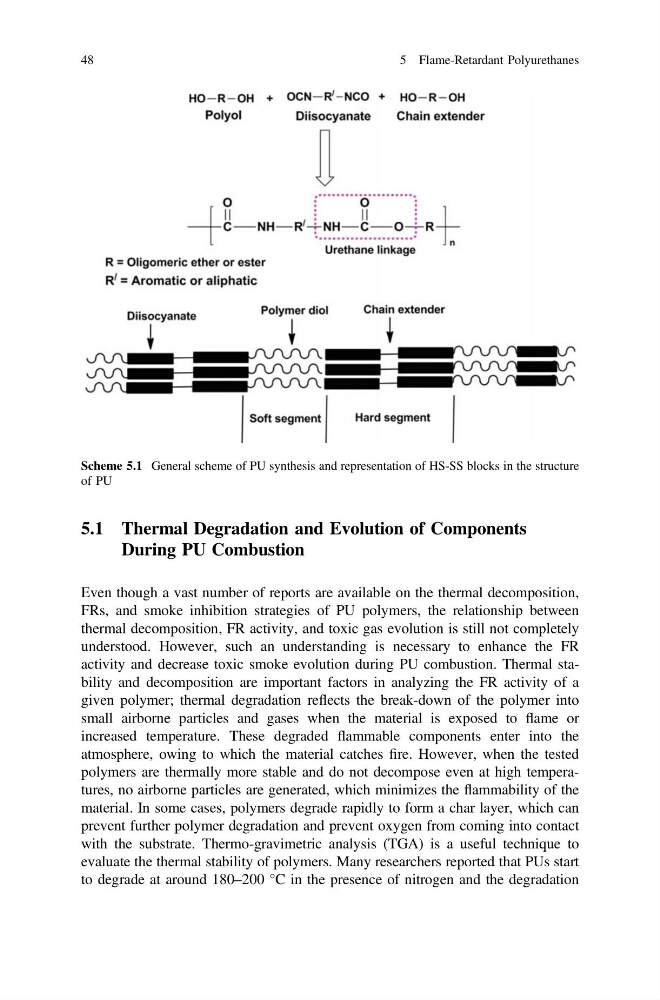
Scheme 5.1 General scheme of PU synthesis and representation of HS-SS blocks in the structure
of PU
48
5 Flame-Retardant Polyurethanes
During PU Combustion
Even though a vast number of reports are available on the thermal decomposition,
FRs, and smoke inhibition strategies of PU polymers, the relationship between
thermal decomposition, FR activity, and toxic gas evolution is still not completely
understood. However, such an understanding is necessary to enhance the FR
activity and decrease toxic smoke evolution during PU combustion. Thermal stability and decomposition are important factors in analyzing the FR activity of a
given polymer; thermal degradation reflects the break-down of the polymer into
small airborne particles and gases when the material is exposed to flame or
increased temperature. These degraded flammable components enter into the
atmosphere, owing to which the material catches fire. However, when the tested
polymers are thermally more stable and do not decompose even at high temperatures, no airborne particles are generated, which minimizes the flammability of the
material. In some cases, polymers degrade rapidly to form a char layer, which can
prevent further polymer degradation and prevent oxygen from coming into contact
with the substrate. Thermo-gravimetric analysis (TGA) is a useful technique to
evaluate the thermal stability of polymers. Many researchers reported that PUs start
to degrade at around 180–200 °C in the presence of nitrogen and the degradation
Scheme 5.1 General scheme of PU synthesis and representation of HS-SS blocks in the structure
of PU
48
5 Flame-Retardant Polyurethanes