

compounds containing –OH and –NH 2 groups are capable of reacting with isocyanates to form FR-PUs, they become part of the polymer main chain. Reaction
between POCl 3 and PET results in the formation of a basic caged bicyclic compound PEPA [117], as shown in Scheme 4.11. Similarly, Ou and his team [118]
synthesized a caged spirocyclic structure of tri(2,6,7-trioxa-1-phosphabicyclo
[2,2,2] octane-1-oxo-4-methanol)phosphate (trimer of PEPA), as shown in
Scheme 4.11.
The high phosphorus content and symmetrical caged structure offer excellent
thermal stability and FR activity. Li and Ou [119] reported that the trimer showed
superior FR activity than PEPA. They used the trimer as a FR additive for polyolefins and ethylene vinyl acetate copolymers (EVA) and found that the
trimer-containing polymers exhibited excellent FR activity due to the high phosphorus content and structural symmetry. Phosphorus-containing carbonizing agents
(CA) (Scheme 4.11) were synthesized from PEPA and they exhibited excellent IFR
activity via a condensed-phase mechanism. Some studies reported that the presence
of metal-containing compounds improved the IFR activity of polymers [120–122].
Xie et al. [123] briefly studied the FR activity of polyethylene using different types
of metal chelating agents and the correlation between the metal compounds and IFR
activity of polyethylene. They found out that metal chelates convert the more stable
alkyl peroxy radicals, strongly accelerating the formation of char. It was also
confirmed that the presence of aromatic chelating compounds improved the FR
activity, but the effect of specific metals on the FR activity was not analyzed. DDP
was synthesized from ditrimethylolpropan (Di-TMP), POCl 3 and 2-amino ethanol
[124], and used as a FR additive for FR fabric coatings; the coated fabrics exhibited
high FR activity compared to uncoated fabrics. P,N-containing caged bicyclic
phosphate (P-N IFR) was synthesized and used as a FR additive to prepare FR
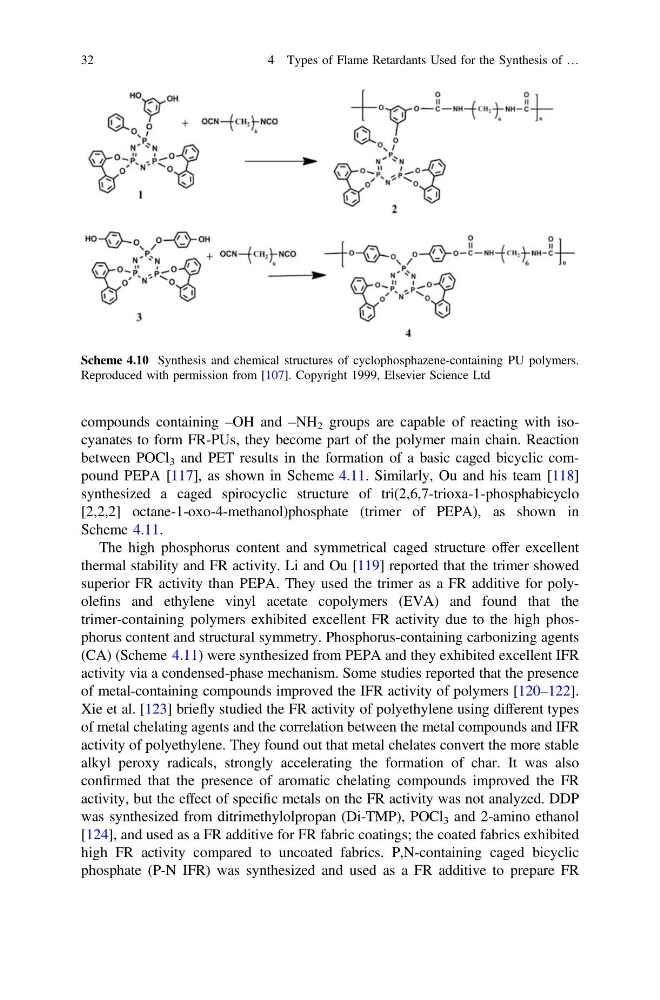
Scheme 4.10 Synthesis and chemical structures of cyclophosphazene-containing PU polymers.
Reproduced with permission from [107]. Copyright 1999, Elsevier Science Ltd
32
4 Types of Flame Retardants Used for the Synthesis of …
between POCl 3 and PET results in the formation of a basic caged bicyclic compound PEPA [117], as shown in Scheme 4.11. Similarly, Ou and his team [118]
synthesized a caged spirocyclic structure of tri(2,6,7-trioxa-1-phosphabicyclo
[2,2,2] octane-1-oxo-4-methanol)phosphate (trimer of PEPA), as shown in
Scheme 4.11.
The high phosphorus content and symmetrical caged structure offer excellent
thermal stability and FR activity. Li and Ou [119] reported that the trimer showed
superior FR activity than PEPA. They used the trimer as a FR additive for polyolefins and ethylene vinyl acetate copolymers (EVA) and found that the
trimer-containing polymers exhibited excellent FR activity due to the high phosphorus content and structural symmetry. Phosphorus-containing carbonizing agents
(CA) (Scheme 4.11) were synthesized from PEPA and they exhibited excellent IFR
activity via a condensed-phase mechanism. Some studies reported that the presence
of metal-containing compounds improved the IFR activity of polymers [120–122].
Xie et al. [123] briefly studied the FR activity of polyethylene using different types
of metal chelating agents and the correlation between the metal compounds and IFR
activity of polyethylene. They found out that metal chelates convert the more stable
alkyl peroxy radicals, strongly accelerating the formation of char. It was also
confirmed that the presence of aromatic chelating compounds improved the FR
activity, but the effect of specific metals on the FR activity was not analyzed. DDP
was synthesized from ditrimethylolpropan (Di-TMP), POCl 3 and 2-amino ethanol
[124], and used as a FR additive for FR fabric coatings; the coated fabrics exhibited
high FR activity compared to uncoated fabrics. P,N-containing caged bicyclic
phosphate (P-N IFR) was synthesized and used as a FR additive to prepare FR
Scheme 4.10 Synthesis and chemical structures of cyclophosphazene-containing PU polymers.
Reproduced with permission from [107]. Copyright 1999, Elsevier Science Ltd
32
4 Types of Flame Retardants Used for the Synthesis of …