

tautomerization [62, 63]. Due to tautomerization, the phosphorus atom in DOPO
is highly reactive towards nucleophilic and electrophilic compounds. A reaction
between DOPO and P-benzoquinone leads to the formation of mono substituted
P-benzoquinone, which is subsequently tautomerized to yield DOPO-DQ as the
product [60, 64, 65]. Similarly, DOPO reacts with 1,4-naphthoquinone to form
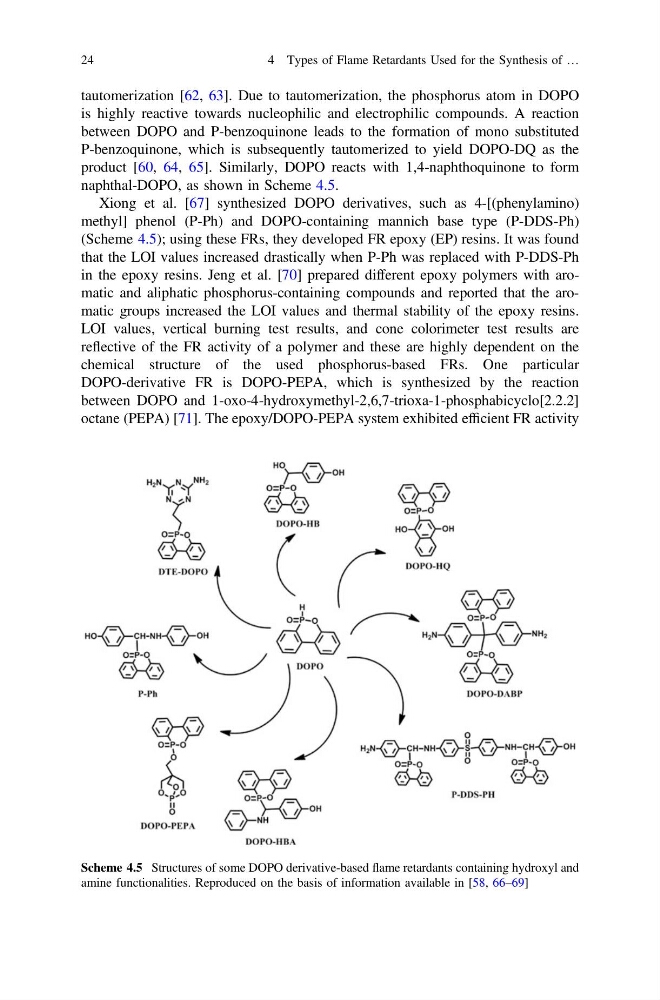
naphthal-DOPO, as shown in Scheme 4.5.
Xiong et al. [67] synthesized DOPO derivatives, such as 4-[(phenylamino)
methyl] phenol (P-Ph) and DOPO-containing mannich base type (P-DDS-Ph)
(Scheme 4.5); using these FRs, they developed FR epoxy (EP) resins. It was found
that the LOI values increased drastically when P-Ph was replaced with P-DDS-Ph
in the epoxy resins. Jeng et al. [70] prepared different epoxy polymers with aromatic and aliphatic phosphorus-containing compounds and reported that the aromatic groups increased the LOI values and thermal stability of the epoxy resins.
LOI values, vertical burning test results, and cone colorimeter test results are
reflective of the FR activity of a polymer and these are highly dependent on the
chemical structure of the used phosphorus-based FRs. One particular
DOPO-derivative FR is DOPO-PEPA, which is synthesized by the reaction
between DOPO and 1-oxo-4-hydroxymethyl-2,6,7-trioxa-1-phosphabicyclo[2.2.2]
octane (PEPA) [71]. The epoxy/DOPO-PEPA system exhibited efficient FR activity
Scheme 4.5 Structures of some DOPO derivative-based flame retardants containing hydroxyl and
amine functionalities. Reproduced on the basis of information available in [58, 66–69]
24
4 Types of Flame Retardants Used for the Synthesis of …
is highly reactive towards nucleophilic and electrophilic compounds. A reaction
between DOPO and P-benzoquinone leads to the formation of mono substituted
P-benzoquinone, which is subsequently tautomerized to yield DOPO-DQ as the
product [60, 64, 65]. Similarly, DOPO reacts with 1,4-naphthoquinone to form
naphthal-DOPO, as shown in Scheme 4.5.
Xiong et al. [67] synthesized DOPO derivatives, such as 4-[(phenylamino)
methyl] phenol (P-Ph) and DOPO-containing mannich base type (P-DDS-Ph)
(Scheme 4.5); using these FRs, they developed FR epoxy (EP) resins. It was found
that the LOI values increased drastically when P-Ph was replaced with P-DDS-Ph
in the epoxy resins. Jeng et al. [70] prepared different epoxy polymers with aromatic and aliphatic phosphorus-containing compounds and reported that the aromatic groups increased the LOI values and thermal stability of the epoxy resins.
LOI values, vertical burning test results, and cone colorimeter test results are
reflective of the FR activity of a polymer and these are highly dependent on the
chemical structure of the used phosphorus-based FRs. One particular
DOPO-derivative FR is DOPO-PEPA, which is synthesized by the reaction
between DOPO and 1-oxo-4-hydroxymethyl-2,6,7-trioxa-1-phosphabicyclo[2.2.2]
octane (PEPA) [71]. The epoxy/DOPO-PEPA system exhibited efficient FR activity
Scheme 4.5 Structures of some DOPO derivative-based flame retardants containing hydroxyl and
amine functionalities. Reproduced on the basis of information available in [58, 66–69]
24
4 Types of Flame Retardants Used for the Synthesis of …