

typically important include, but are not limited to, the time to ignition, the mass loss
rate during combustion, time to and the value of the maximum amount of heat
released during combustion, total amount of heat released during the test.
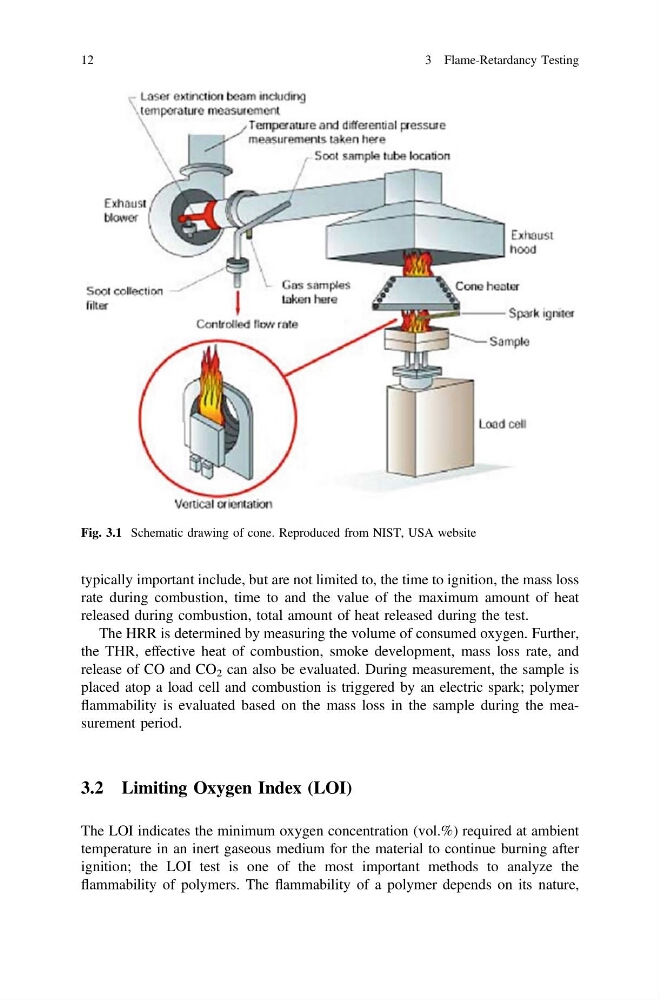
The HRR is determined by measuring the volume of consumed oxygen. Further,
the THR, effective heat of combustion, smoke development, mass loss rate, and
release of CO and CO 2 can also be evaluated. During measurement, the sample is
placed atop a load cell and combustion is triggered by an electric spark; polymer
flammability is evaluated based on the mass loss in the sample during the measurement period.
3.2 Limiting Oxygen Index (LOI)
The LOI indicates the minimum oxygen concentration (vol.%) required at ambient
temperature in an inert gaseous medium for the material to continue burning after
ignition; the LOI test is one of the most important methods to analyze the
flammability of polymers. The flammability of a polymer depends on its nature,
Fig. 3.1 Schematic drawing of cone. Reproduced from NIST, USA website
12
3 Flame-Retardancy Testing
rate during combustion, time to and the value of the maximum amount of heat
released during combustion, total amount of heat released during the test.
The HRR is determined by measuring the volume of consumed oxygen. Further,
the THR, effective heat of combustion, smoke development, mass loss rate, and
release of CO and CO 2 can also be evaluated. During measurement, the sample is
placed atop a load cell and combustion is triggered by an electric spark; polymer
flammability is evaluated based on the mass loss in the sample during the measurement period.
3.2 Limiting Oxygen Index (LOI)
The LOI indicates the minimum oxygen concentration (vol.%) required at ambient
temperature in an inert gaseous medium for the material to continue burning after
ignition; the LOI test is one of the most important methods to analyze the
flammability of polymers. The flammability of a polymer depends on its nature,
Fig. 3.1 Schematic drawing of cone. Reproduced from NIST, USA website
12
3 Flame-Retardancy Testing