

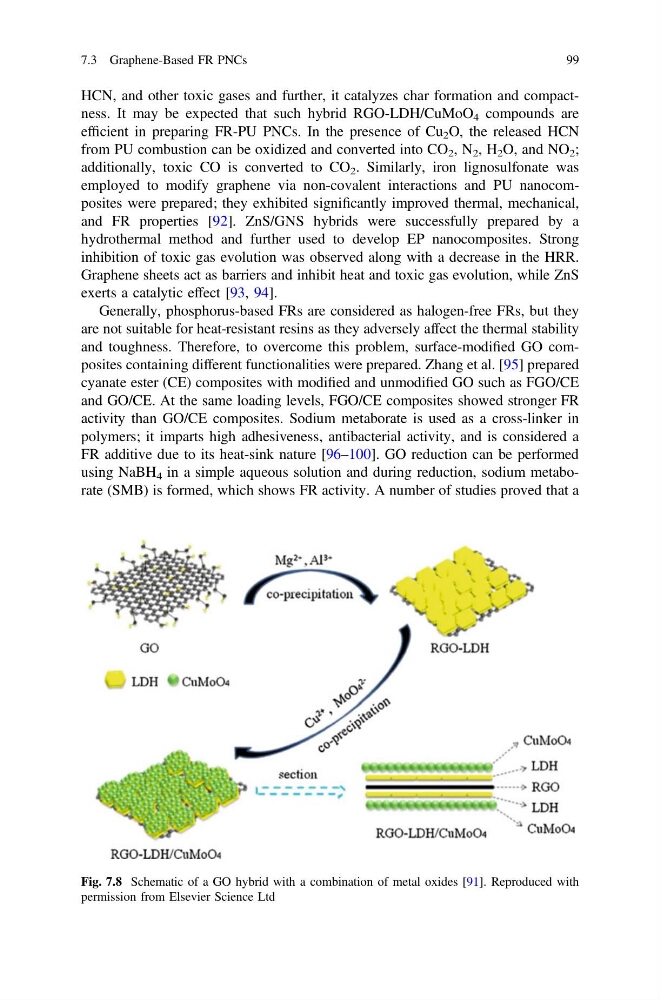
HCN, and other toxic gases and further, it catalyzes char formation and compactness. It may be expected that such hybrid RGO-LDH/CuMoO 4 compounds are
efficient in preparing FR-PU PNCs. In the presence of Cu 2 O, the released HCN
from PU combustion can be oxidized and converted into CO 2 , N 2 , H 2 O, and NO 2 ;
additionally, toxic CO is converted to CO 2 . Similarly, iron lignosulfonate was
employed to modify graphene via non-covalent interactions and PU nanocomposites were prepared; they exhibited significantly improved thermal, mechanical,
and FR properties [92]. ZnS/GNS hybrids were successfully prepared by a
hydrothermal method and further used to develop EP nanocomposites. Strong
inhibition of toxic gas evolution was observed along with a decrease in the HRR.
Graphene sheets act as barriers and inhibit heat and toxic gas evolution, while ZnS
exerts a catalytic effect [93, 94].
Generally, phosphorus-based FRs are considered as halogen-free FRs, but they
are not suitable for heat-resistant resins as they adversely affect the thermal stability
and toughness. Therefore, to overcome this problem, surface-modified GO composites containing different functionalities were prepared. Zhang et al. [95] prepared
cyanate ester (CE) composites with modified and unmodified GO such as FGO/CE
and GO/CE. At the same loading levels, FGO/CE composites showed stronger FR
activity than GO/CE composites. Sodium metaborate is used as a cross-linker in
polymers; it imparts high adhesiveness, antibacterial activity, and is considered a
FR additive due to its heat-sink nature [96–100]. GO reduction can be performed
using NaBH 4 in a simple aqueous solution and during reduction, sodium metaborate (SMB) is formed, which shows FR activity. A number of studies proved that a
Fig. 7.8 Schematic of a GO hybrid with a combination of metal oxides [91]. Reproduced with
permission from Elsevier Science Ltd
7.3 Graphene-Based FR PNCs
99
efficient in preparing FR-PU PNCs. In the presence of Cu 2 O, the released HCN
from PU combustion can be oxidized and converted into CO 2 , N 2 , H 2 O, and NO 2 ;
additionally, toxic CO is converted to CO 2 . Similarly, iron lignosulfonate was
employed to modify graphene via non-covalent interactions and PU nanocomposites were prepared; they exhibited significantly improved thermal, mechanical,
and FR properties [92]. ZnS/GNS hybrids were successfully prepared by a
hydrothermal method and further used to develop EP nanocomposites. Strong
inhibition of toxic gas evolution was observed along with a decrease in the HRR.
Graphene sheets act as barriers and inhibit heat and toxic gas evolution, while ZnS
exerts a catalytic effect [93, 94].
Generally, phosphorus-based FRs are considered as halogen-free FRs, but they
are not suitable for heat-resistant resins as they adversely affect the thermal stability
and toughness. Therefore, to overcome this problem, surface-modified GO composites containing different functionalities were prepared. Zhang et al. [95] prepared
cyanate ester (CE) composites with modified and unmodified GO such as FGO/CE
and GO/CE. At the same loading levels, FGO/CE composites showed stronger FR
activity than GO/CE composites. Sodium metaborate is used as a cross-linker in
polymers; it imparts high adhesiveness, antibacterial activity, and is considered a
FR additive due to its heat-sink nature [96–100]. GO reduction can be performed
using NaBH 4 in a simple aqueous solution and during reduction, sodium metaborate (SMB) is formed, which shows FR activity. A number of studies proved that a
Fig. 7.8 Schematic of a GO hybrid with a combination of metal oxides [91]. Reproduced with
permission from Elsevier Science Ltd
7.3 Graphene-Based FR PNCs
99