

89
Results and Discussion
Cooling Mechanism
To computationally demonstrate the creation of cooling photons by the heliumaided curtain wall, the dynamic photon proliferation has been determined by integrating Eqs. (5.15) and (5.16). Owing to the cool-state region J(ω) and the consistent
weak coupling, the curtain wall surface is expected to proliferate photons [28, 32].
Hence, J(ω) represents the quantum area defining the density of state (DOS) area
generated in the photovoltaic cell through the standard cooling photon mode V(ω)
within the photonic band (PB) and the PV cell [33, 34]. Moreover, photon production should follow the Weisskopf-Wigner assumption. Subsequently, the proliferated HcPs will conduct a dynamic mode (A, B, and C) in the curtain wall, as
described in Table 5.1 [25, 35].
Within the C curtain wall, Ω C represents a fine frequency cutoff, which evades
the bifunctional DOS. The A and B curtain wall in the same way necessitates a
fine hertz cutoff at Ω d to evade adverse DOS (Fig. 5.5). e rfc (x) and Li 2 (x) are therefore additive and di-logarithmic variables in that order. The DOS here, noted as
ϱ PC (ω), is therefore calculated through the photon eigenfunctions and eigenfrequencies of Maxwell’s rules [38, 39]. In the A curtain wall, the DOS is provided by
PC
e
e
ω
ω ω
ω ω
( )∝ −
−
(
)
1
Θ
, where Θ(ω − ω e ) is the Heaviside step function,
and ω e stands for the PBE’s frequency at the provided DOS.
The DOS is needed for precisely foreseeing the non-Weisskopf-Wigner mode’s
qualitative state as well as the photon cell’s photon cooling state in a C calculation in
the curtain wall. Projected DOS (PDOS) and the DOS are revealed in Fig. 5.6. In a 3D
curtain wall, the DOS next to the PBE is illustrated as PC
e
e
ω
ω ω
ω ω
( )∝ −
−
(
)
1
Θ
.
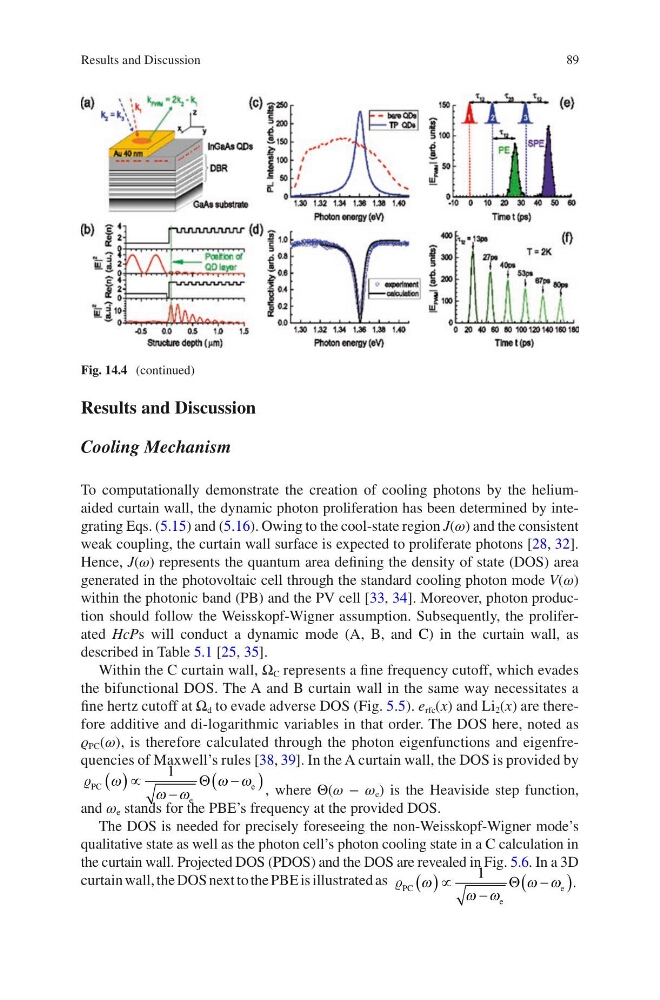
Fig. 14.4 (continued)
Results and Discussion
Results and Discussion
Cooling Mechanism
To computationally demonstrate the creation of cooling photons by the heliumaided curtain wall, the dynamic photon proliferation has been determined by integrating Eqs. (5.15) and (5.16). Owing to the cool-state region J(ω) and the consistent
weak coupling, the curtain wall surface is expected to proliferate photons [28, 32].
Hence, J(ω) represents the quantum area defining the density of state (DOS) area
generated in the photovoltaic cell through the standard cooling photon mode V(ω)
within the photonic band (PB) and the PV cell [33, 34]. Moreover, photon production should follow the Weisskopf-Wigner assumption. Subsequently, the proliferated HcPs will conduct a dynamic mode (A, B, and C) in the curtain wall, as
described in Table 5.1 [25, 35].
Within the C curtain wall, Ω C represents a fine frequency cutoff, which evades
the bifunctional DOS. The A and B curtain wall in the same way necessitates a
fine hertz cutoff at Ω d to evade adverse DOS (Fig. 5.5). e rfc (x) and Li 2 (x) are therefore additive and di-logarithmic variables in that order. The DOS here, noted as
ϱ PC (ω), is therefore calculated through the photon eigenfunctions and eigenfrequencies of Maxwell’s rules [38, 39]. In the A curtain wall, the DOS is provided by
PC
e
e
ω
ω ω
ω ω
( )∝ −
−
(
)
1
Θ
, where Θ(ω − ω e ) is the Heaviside step function,
and ω e stands for the PBE’s frequency at the provided DOS.
The DOS is needed for precisely foreseeing the non-Weisskopf-Wigner mode’s
qualitative state as well as the photon cell’s photon cooling state in a C calculation in
the curtain wall. Projected DOS (PDOS) and the DOS are revealed in Fig. 5.6. In a 3D
curtain wall, the DOS next to the PBE is illustrated as PC
e
e
ω
ω ω
ω ω
( )∝ −
−
(
)
1
Θ
.
Fig. 14.4 (continued)
Results and Discussion