

36
M S
S
S
S
0
0
3
2
0
5
2
0
2
3
1
5
3
1
1507
420
1
> @
§
©
¨
·
¹
¸
§
©
¨
·
¹
¸
§
©
¨
·
¹
¸
–
7
2 1 2
1
/
.
instead of
(2.51)
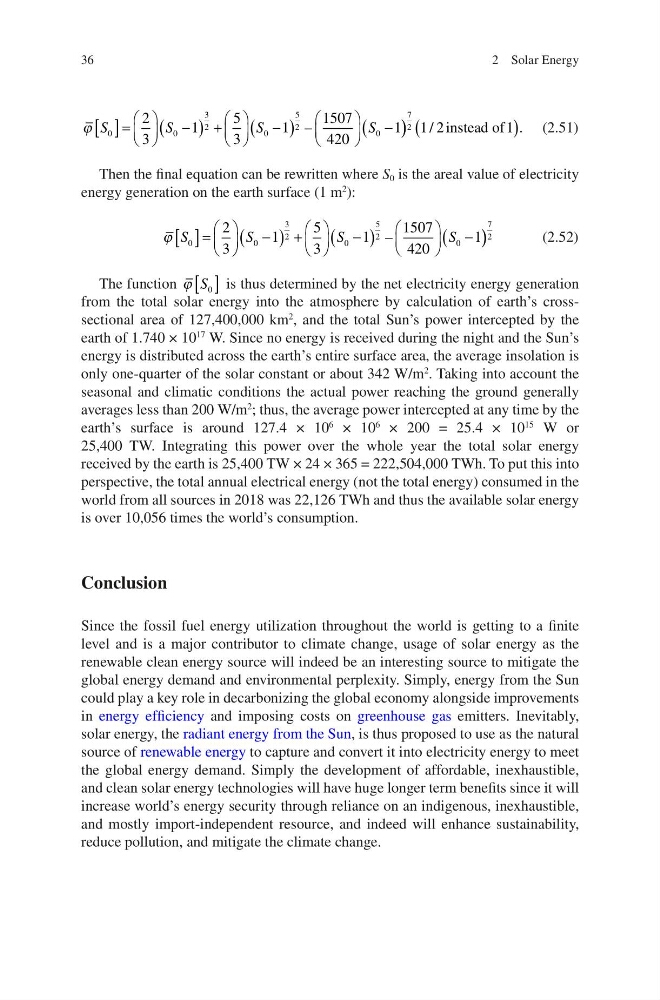
Then the final equation can be rewritten where S 0 is the areal value of electricity
energy generation on the earth surface (1 m
2
):
M S
S
S
S
0
0
3
2
0
5
2
0
2
3
1
5
3
1
1507
420
1
> @
§
©
¨
·
¹
¸
§
©
¨
·
¹
¸
§
©
¨
·
¹
¸
–
7
2
(2.52)
The function M S 0
> @ is thus determined by the net electricity energy generation
from the total solar energy into the atmosphere by calculation of earth’s crosssectional area of 127,400,000 km
2
, and the total Sun’s power intercepted by the
earth of 1.740 × 10
17
W. Since no energy is received during the night and the Sun’s
energy is distributed across the earth’s entire surface area, the average insolation is
only one-quarter of the solar constant or about 342 W/m
2
. Taking into account the
seasonal and climatic conditions the actual power reaching the ground generally
averages less than 200 W/m
2
; thus, the average power intercepted at any time by the
earth’s surface is around 127.4 × 10
6
× 10
6
× 200 = 25.4 × 10
15
W or
25,400 TW. Integrating this power over the whole year the total solar energy
received by the earth is 25,400 TW × 24 × 365 = 222,504,000 TWh. To put this into
perspective, the total annual electrical energy (not the total energy) consumed in the
world from all sources in 2018 was 22,126 TWh and thus the available solar energy
is over 10,056 times the world’s consumption.
Conclusion
Since the fossil fuel energy utilization throughout the world is getting to a finite
level and is a major contributor to climate change, usage of solar energy as the
renewable clean energy source will indeed be an interesting source to mitigate the
global energy demand and environmental perplexity. Simply, energy from the Sun
could play a key role in decarbonizing the global economy alongside improvements
in energy efficiency and imposing costs on greenhouse gas emitters. Inevitably,
solar energy, the radiant energy from the Sun, is thus proposed to use as the natural
source of renewable energy to capture and convert it into electricity energy to meet
the global energy demand. Simply the development of affordable, inexhaustible,
and clean solar energy technologies will have huge longer term benefits since it will
increase world’s energy security through reliance on an indigenous, inexhaustible,
and mostly import-independent resource, and indeed will enhance sustainability,
reduce pollution, and mitigate the climate change.
2 Solar Energy
M S
S
S
S
0
0
3
2
0
5
2
0
2
3
1
5
3
1
1507
420
1
> @
§
©
¨
·
¹
¸
§
©
¨
·
¹
¸
§
©
¨
·
¹
¸
–
7
2 1 2
1
/
.
instead of
(2.51)
Then the final equation can be rewritten where S 0 is the areal value of electricity
energy generation on the earth surface (1 m
2
):
M S
S
S
S
0
0
3
2
0
5
2
0
2
3
1
5
3
1
1507
420
1
> @
§
©
¨
·
¹
¸
§
©
¨
·
¹
¸
§
©
¨
·
¹
¸
–
7
2
(2.52)
The function M S 0
> @ is thus determined by the net electricity energy generation
from the total solar energy into the atmosphere by calculation of earth’s crosssectional area of 127,400,000 km
2
, and the total Sun’s power intercepted by the
earth of 1.740 × 10
17
W. Since no energy is received during the night and the Sun’s
energy is distributed across the earth’s entire surface area, the average insolation is
only one-quarter of the solar constant or about 342 W/m
2
. Taking into account the
seasonal and climatic conditions the actual power reaching the ground generally
averages less than 200 W/m
2
; thus, the average power intercepted at any time by the
earth’s surface is around 127.4 × 10
6
× 10
6
× 200 = 25.4 × 10
15
W or
25,400 TW. Integrating this power over the whole year the total solar energy
received by the earth is 25,400 TW × 24 × 365 = 222,504,000 TWh. To put this into
perspective, the total annual electrical energy (not the total energy) consumed in the
world from all sources in 2018 was 22,126 TWh and thus the available solar energy
is over 10,056 times the world’s consumption.
Conclusion
Since the fossil fuel energy utilization throughout the world is getting to a finite
level and is a major contributor to climate change, usage of solar energy as the
renewable clean energy source will indeed be an interesting source to mitigate the
global energy demand and environmental perplexity. Simply, energy from the Sun
could play a key role in decarbonizing the global economy alongside improvements
in energy efficiency and imposing costs on greenhouse gas emitters. Inevitably,
solar energy, the radiant energy from the Sun, is thus proposed to use as the natural
source of renewable energy to capture and convert it into electricity energy to meet
the global energy demand. Simply the development of affordable, inexhaustible,
and clean solar energy technologies will have huge longer term benefits since it will
increase world’s energy security through reliance on an indigenous, inexhaustible,
and mostly import-independent resource, and indeed will enhance sustainability,
reduce pollution, and mitigate the climate change.
2 Solar Energy