

434
A p k
n k p
n p
p p k
n k p
n
,
scalars
b
b
f
f
( ) ≡
+
(
) + ( )
+
(
)
+
(
) −
1
2
1
,
,
p p
p p k
p
p k
( )
+
(
)
+
+
(
)
2
2
2
2 ,
,
fermions
(21.52)
with
n p
p
n p
p
b
f
( ) ≡
−
(
)
−
( ) ≡
−
(
)
+
1
1
1
1
exp
,
exp
.
β
µ
β
µ
(21.53)
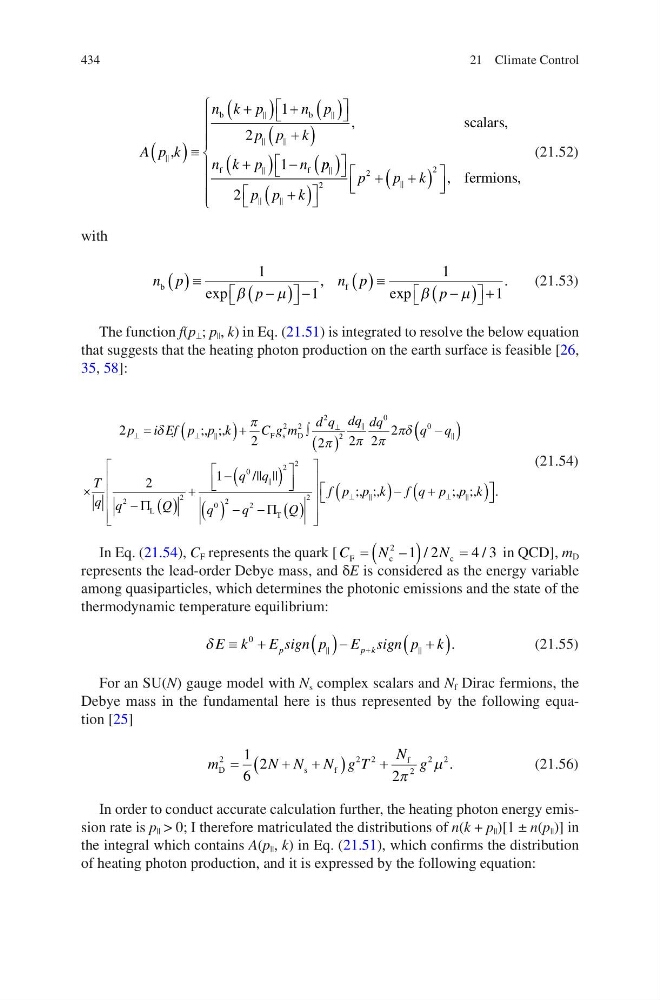
The function f(p ⊥ ; p || , k) in Eq. (21.51) is integrated to resolve the below equation
that suggests that the heating photon production on the earth surface is feasible [26,
35, 58]:
2
2
2
2 2
2
2 2
2
2
0
0
p i Ef p p k
C g m
d q dq dq
q q
⊥
⊥
⊥
=
(
) +
∫ ( )
−
δ
π
π
π π
πδ
;, ;,
F s
D
( (
)
×
− ( )
+
− (
)
( ) − − ( )
T
q q
Q
q q
q
q
Q
2
1
2
2
0
2
2
0
2
2
2
Π
Π
L
T
|| ||
/
(
) − +
(
)
⊥
⊥
f p p k f q p p k
;, ;,
;, ;,
.
(21.54)
In Eq. (21.54), C F represents the quark [ C
N
N
F
c
c
= (
)
=
2
1 2
4 3
– /
/ in QCD], m D
represents the lead-order Debye mass, and δE is considered as the energy variable
among quasiparticles, which determines the photonic emissions and the state of the
thermodynamic temperature equilibrium:
δ E k E sign p
E sign p k
p
p k
≡ +
( ) −
+
(
)
+
0
.
(21.55)
For an SU(N) gauge model with N s complex scalars and N f Dirac fermions, the
Debye mass in the fundamental here is thus represented by the following equation [25]
m
N N N g T
N g
D
s
f
f
2
2 2
2
2 2
1
6
2
2
=
+ +
(
)
+ π
µ .
(21.56)
In order to conduct accurate calculation further, the heating photon energy emission rate is p || > 0; I therefore matriculated the distributions of n(k + p || )[1 ± n(p || )] in
the integral which contains A(p || , k) in Eq. (21.51), which confirms the distribution
of heating photon production, and it is expressed by the following equation:
21 Climate Control
A p k
n k p
n p
p p k
n k p
n
,
scalars
b
b
f
f
( ) ≡
+
(
) + ( )
+
(
)
+
(
) −
1
2
1
,
,
p p
p p k
p
p k
( )
+
(
)
+
+
(
)
2
2
2
2 ,
,
fermions
(21.52)
with
n p
p
n p
p
b
f
( ) ≡
−
(
)
−
( ) ≡
−
(
)
+
1
1
1
1
exp
,
exp
.
β
µ
β
µ
(21.53)
The function f(p ⊥ ; p || , k) in Eq. (21.51) is integrated to resolve the below equation
that suggests that the heating photon production on the earth surface is feasible [26,
35, 58]:
2
2
2
2 2
2
2 2
2
2
0
0
p i Ef p p k
C g m
d q dq dq
q q
⊥
⊥
⊥
=
(
) +
∫ ( )
−
δ
π
π
π π
πδ
;, ;,
F s
D
( (
)
×
− ( )
+
− (
)
( ) − − ( )
T
q q
Q
q q
q
q
Q
2
1
2
2
0
2
2
0
2
2
2
Π
Π
L
T
|| ||
/
(
) − +
(
)
⊥
⊥
f p p k f q p p k
;, ;,
;, ;,
.
(21.54)
In Eq. (21.54), C F represents the quark [ C
N
N
F
c
c
= (
)
=
2
1 2
4 3
– /
/ in QCD], m D
represents the lead-order Debye mass, and δE is considered as the energy variable
among quasiparticles, which determines the photonic emissions and the state of the
thermodynamic temperature equilibrium:
δ E k E sign p
E sign p k
p
p k
≡ +
( ) −
+
(
)
+
0
.
(21.55)
For an SU(N) gauge model with N s complex scalars and N f Dirac fermions, the
Debye mass in the fundamental here is thus represented by the following equation [25]
m
N N N g T
N g
D
s
f
f
2
2 2
2
2 2
1
6
2
2
=
+ +
(
)
+ π
µ .
(21.56)
In order to conduct accurate calculation further, the heating photon energy emission rate is p || > 0; I therefore matriculated the distributions of n(k + p || )[1 ± n(p || )] in
the integral which contains A(p || , k) in Eq. (21.51), which confirms the distribution
of heating photon production, and it is expressed by the following equation:
21 Climate Control