

423
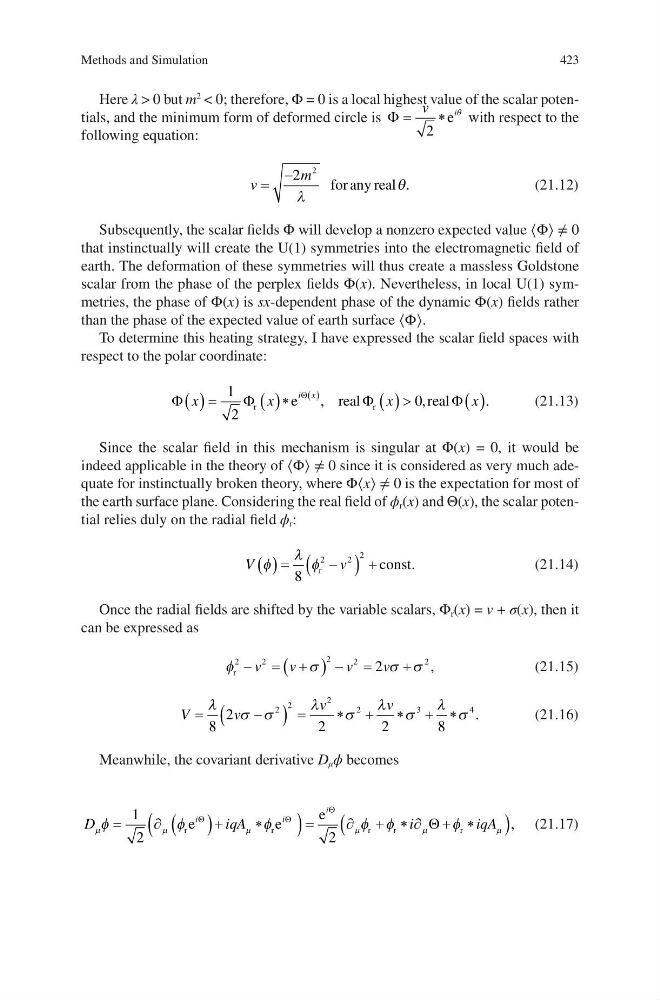
Here λ > 0 but m
2
< 0; therefore, Φ = 0 is a local highest value of the scalar potentials, and the minimum form of deformed circle is Φ =
∗
v
i
2
e
θ with respect to the
following equation:
v
m
=
−2
2
λ
θ
for any real .
(21.12)
Subsequently, the scalar fields Φ will develop a nonzero expected value 〈Φ〉 ≠ 0
that instinctually will create the U(1) symmetries into the electromagnetic field of
earth. The deformation of these symmetries will thus create a massless Goldstone
scalar from the phase of the perplex fields Φ(x). Nevertheless, in local U(1) symmetries, the phase of Φ(x) is sx-dependent phase of the dynamic Φ(x) fields rather
than the phase of the expected value of earth surface 〈Φ〉.
To determine this heating strategy, I have expressed the scalar field spaces with
respect to the polar coordinate:
Φ
Φ
Φ
Φ
Θ
x
x
x
x
i x
( ) =
( )∗
( ) >
( )
( )
1
2
0
r
r
e
real
real
,
,
.
(21.13)
Since the scalar field in this mechanism is singular at Φ(x) = 0, it would be
indeed applicable in the theory of 〈Φ〉 ≠ 0 since it is considered as very much adequate for instinctually broken theory, where Φ〈x〉 ≠ 0 is the expectation for most of
the earth surface plane. Considering the real field of ϕ r (x) and Θ(x), the scalar potential relies duly on the radial field ϕ r :
V
v
φ
λ φ
( ) =
−
(
) +
8
2
2
2
r
const.
(21.14)
Once the radial fields are shifted by the variable scalars, Φ r (x) = v + σ(x), then it
can be expressed as
φ
σ
σ σ
r
2
2
2
2
2
2
− = +
(
) − =
+
v
v
v
v
,
(21.15)
V
v
v
v
=
−
(
) = ∗ + ∗ + ∗
λ
σ σ
λ
σ
λ σ
λ σ
8
2
2
2
8
2
2
2
2
3
4 .
(21.16)
Meanwhile, the covariant derivative D μ ϕ becomes
D
i qA
i
i qA
i
i
i
µ
µ
µ
µ
µ
µ
φ
φ
φ
φ φ
φ
=
∂ ( ) + ∗
(
) = ∂ + ∗ ∂ + ∗
(
)
1
2
2
r
r
r
r
r
e
e
e
Θ
Θ
Θ
Θ
, (21.17)
Methods and Simulation
Here λ > 0 but m
2
< 0; therefore, Φ = 0 is a local highest value of the scalar potentials, and the minimum form of deformed circle is Φ =
∗
v
i
2
e
θ with respect to the
following equation:
v
m
=
−2
2
λ
θ
for any real .
(21.12)
Subsequently, the scalar fields Φ will develop a nonzero expected value 〈Φ〉 ≠ 0
that instinctually will create the U(1) symmetries into the electromagnetic field of
earth. The deformation of these symmetries will thus create a massless Goldstone
scalar from the phase of the perplex fields Φ(x). Nevertheless, in local U(1) symmetries, the phase of Φ(x) is sx-dependent phase of the dynamic Φ(x) fields rather
than the phase of the expected value of earth surface 〈Φ〉.
To determine this heating strategy, I have expressed the scalar field spaces with
respect to the polar coordinate:
Φ
Φ
Φ
Φ
Θ
x
x
x
x
i x
( ) =
( )∗
( ) >
( )
( )
1
2
0
r
r
e
real
real
,
,
.
(21.13)
Since the scalar field in this mechanism is singular at Φ(x) = 0, it would be
indeed applicable in the theory of 〈Φ〉 ≠ 0 since it is considered as very much adequate for instinctually broken theory, where Φ〈x〉 ≠ 0 is the expectation for most of
the earth surface plane. Considering the real field of ϕ r (x) and Θ(x), the scalar potential relies duly on the radial field ϕ r :
V
v
φ
λ φ
( ) =
−
(
) +
8
2
2
2
r
const.
(21.14)
Once the radial fields are shifted by the variable scalars, Φ r (x) = v + σ(x), then it
can be expressed as
φ
σ
σ σ
r
2
2
2
2
2
2
− = +
(
) − =
+
v
v
v
v
,
(21.15)
V
v
v
v
=
−
(
) = ∗ + ∗ + ∗
λ
σ σ
λ
σ
λ σ
λ σ
8
2
2
2
8
2
2
2
2
3
4 .
(21.16)
Meanwhile, the covariant derivative D μ ϕ becomes
D
i qA
i
i qA
i
i
i
µ
µ
µ
µ
µ
µ
φ
φ
φ
φ φ
φ
=
∂ ( ) + ∗
(
) = ∂ + ∗ ∂ + ∗
(
)
1
2
2
r
r
r
r
r
e
e
e
Θ
Θ
Θ
Θ
, (21.17)
Methods and Simulation