

30
u t t
d
J
i t t
i t t
,
e
e
b
c
e
0
1
1
0
0
ª
c
f
³
6
'
Z
Z
Z
Z Z
Z
Z
Z
Z
¬ ¬
º ¼
2
2 2
S
Z
J
(2.30)
where c w w
ª ¬
º ¼
6 Z
Z
Z Z Z
b
b
6
/
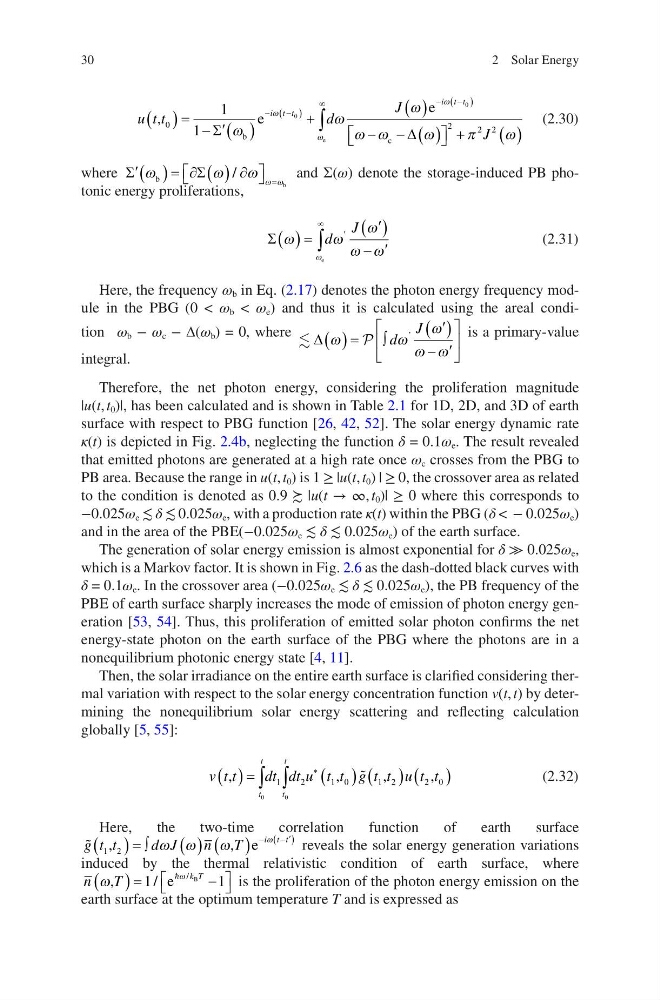
and Σ(ω) denote the storage-induced PB photonic energy proliferations,
6 Z
Z
Z
Z Z
Z
c
c
f
c
³
e
d
J
(2.31)
Here, the frequency ω b in Eq. (2.17) denotes the photon energy frequency module in the PBG (0 < ω b < ω e ) and thus it is calculated using the areal condition ω b − ω c − ∆(ω b ) = 0, where
' Z
Z
Z
Z Z
³
ª
¬
«
º
¼
»
c
c
d
J
’
is a primary-value
integral.
Therefore, the net photon energy, considering the proliferation magnitude
|u(t, t 0 )|, has been calculated and is shown in Table 2.1 for 1D, 2D, and 3D of earth
surface with respect to PBG function [26, 42, 52]. The solar energy dynamic rate
κ(t) is depicted in Fig. 2.4b, neglecting the function δ = 0.1ω e . The result revealed
that emitted photons are generated at a high rate once ω c crosses from the PBG to
PB area. Because the range in u(t, t 0 ) is 1 ≥ |u(t, t 0 ) | ≥ 0, the crossover area as related
to the condition is denoted as 0.9 ≿ |u(t → ∞, t 0 )| ≥ 0 where this corresponds to
−0.025ω e ≲ δ ≲ 0.025ω e , with a production rate κ(t) within the PBG (δ < − 0.025ω e )
and in the area of the PBE(−0.025ω e ≲ δ ≲ 0.025ω e ) of the earth surface.
The generation of solar energy emission is almost exponential for δ ≫ 0.025ω e ,
which is a Markov factor. It is shown in Fig. 2.6 as the dash-dotted black curves with
δ = 0.1ω e . In the crossover area (−0.025ω e ≲ δ ≲ 0.025ω e ), the PB frequency of the
PBE of earth surface sharply increases the mode of emission of photon energy generation [53, 54]. Thus, this proliferation of emitted solar photon confirms the net
energy-state photon on the earth surface of the PBG where the photons are in a
nonequilibrium photonic energy state [4, 11].
Then, the solar irradiance on the entire earth surface is clarified considering thermal variation with respect to the solar energy concentration function v(t, t) by determining the nonequilibrium solar energy scattering and reflecting calculation
globally [5, 55]:
v t t
dt dt u t t g t t u t t
t
t
t
t
,
,
,
,
³ ³
0
0
1
2
1 0
1 2
2 0
(2.32)
Here,
the
two-time
correlation
function
of
earth
surface
g t t
d J
n T
i t t
1 2
,
, e
³
c
Z Z
Z
Z
reveals the solar energy generation variations
induced by the thermal relativistic condition of earth surface, where
n T
k T
Z
Z
,
e
B
ª ¬
º ¼
1
1
/
/
is the proliferation of the photon energy emission on the
earth surface at the optimum temperature T and is expressed as
2 Solar Energy
u t t
d
J
i t t
i t t
,
e
e
b
c
e
0
1
1
0
0
ª
c
f
³
6
'
Z
Z
Z
Z Z
Z
Z
Z
Z
¬ ¬
º ¼
2
2 2
S
Z
J
(2.30)
where c w w
ª ¬
º ¼
6 Z
Z
Z Z Z
b
b
6
/
and Σ(ω) denote the storage-induced PB photonic energy proliferations,
6 Z
Z
Z
Z Z
Z
c
c
f
c
³
e
d
J
(2.31)
Here, the frequency ω b in Eq. (2.17) denotes the photon energy frequency module in the PBG (0 < ω b < ω e ) and thus it is calculated using the areal condition ω b − ω c − ∆(ω b ) = 0, where
' Z
Z
Z
Z Z
³
ª
¬
«
º
¼
»
c
c
d
J
’
is a primary-value
integral.
Therefore, the net photon energy, considering the proliferation magnitude
|u(t, t 0 )|, has been calculated and is shown in Table 2.1 for 1D, 2D, and 3D of earth
surface with respect to PBG function [26, 42, 52]. The solar energy dynamic rate
κ(t) is depicted in Fig. 2.4b, neglecting the function δ = 0.1ω e . The result revealed
that emitted photons are generated at a high rate once ω c crosses from the PBG to
PB area. Because the range in u(t, t 0 ) is 1 ≥ |u(t, t 0 ) | ≥ 0, the crossover area as related
to the condition is denoted as 0.9 ≿ |u(t → ∞, t 0 )| ≥ 0 where this corresponds to
−0.025ω e ≲ δ ≲ 0.025ω e , with a production rate κ(t) within the PBG (δ < − 0.025ω e )
and in the area of the PBE(−0.025ω e ≲ δ ≲ 0.025ω e ) of the earth surface.
The generation of solar energy emission is almost exponential for δ ≫ 0.025ω e ,
which is a Markov factor. It is shown in Fig. 2.6 as the dash-dotted black curves with
δ = 0.1ω e . In the crossover area (−0.025ω e ≲ δ ≲ 0.025ω e ), the PB frequency of the
PBE of earth surface sharply increases the mode of emission of photon energy generation [53, 54]. Thus, this proliferation of emitted solar photon confirms the net
energy-state photon on the earth surface of the PBG where the photons are in a
nonequilibrium photonic energy state [4, 11].
Then, the solar irradiance on the entire earth surface is clarified considering thermal variation with respect to the solar energy concentration function v(t, t) by determining the nonequilibrium solar energy scattering and reflecting calculation
globally [5, 55]:
v t t
dt dt u t t g t t u t t
t
t
t
t
,
,
,
,
³ ³
0
0
1
2
1 0
1 2
2 0
(2.32)
Here,
the
two-time
correlation
function
of
earth
surface
g t t
d J
n T
i t t
1 2
,
, e
³
c
Z Z
Z
Z
reveals the solar energy generation variations
induced by the thermal relativistic condition of earth surface, where
n T
k T
Z
Z
,
e
B
ª ¬
º ¼
1
1
/
/
is the proliferation of the photon energy emission on the
earth surface at the optimum temperature T and is expressed as
2 Solar Energy