

289
Response Surface Analysis
From the earlier discussions on the effect of the operation parameters on the photocatalytic reaction rate, it can be seen that these parameters would affect the system
indifferently. Overall, it can be interpreted that a multivariable (MV) optimization
approach is actually required to optimize a photoreactor system as parameter interaction might exist. Parameter interactions refer to the relationship between operating parameters such as TiO 2 loading on pH or pH on radiant flux. For the optimization
of a photoreactor system, the conventional one-parameter-at-a-time approach is
mostly used to unveil the effects of one parameter after another. Although this conventional optimization approach is widely acceptable, the reported outcomes could
be of insignificance and have less predictive power if the condition for one operating
parameter changes.
This has led to the application of effective design of experiments (DOE), statistical analysis, and response surface analysis for photocatalytic studies [40, 60, 161,
190, 194]. Using this approach, different permutations of experimental design are
involved and the operational parameters and spans are defined. As compared to the
conventional one-parameter-at-a-time approach, the MV optimization approach has
predetermined experimental points that are dispersed uniformly throughout the
study domain; that is, only a small region is covered in the domain of conventional
study. This allows the optimization process to be more time effective and enhances
the identification of parameter interactions, where they can be interpreted using
commercial statistical software such as Design Expert
®
software.
Chong et al. [60] proposed the use of Taguchi-DOE approach, together with the
analysis of variance, statistical regression, and response surface analysis, to study
the combined effects of four key operation parameters that affect the photocatalytic
reaction rate in an annular photoreactor. They utilized 9 experimental permutations
to analyze the 81 possible parameter combinations. It was reported that the interaction between the TiO 2 loading and aeration rate had a positive synergistic effect on
the overall reaction rate. A response surface model was developed to correlate the
reaction rate dependency on the four different parameters according to the statistical
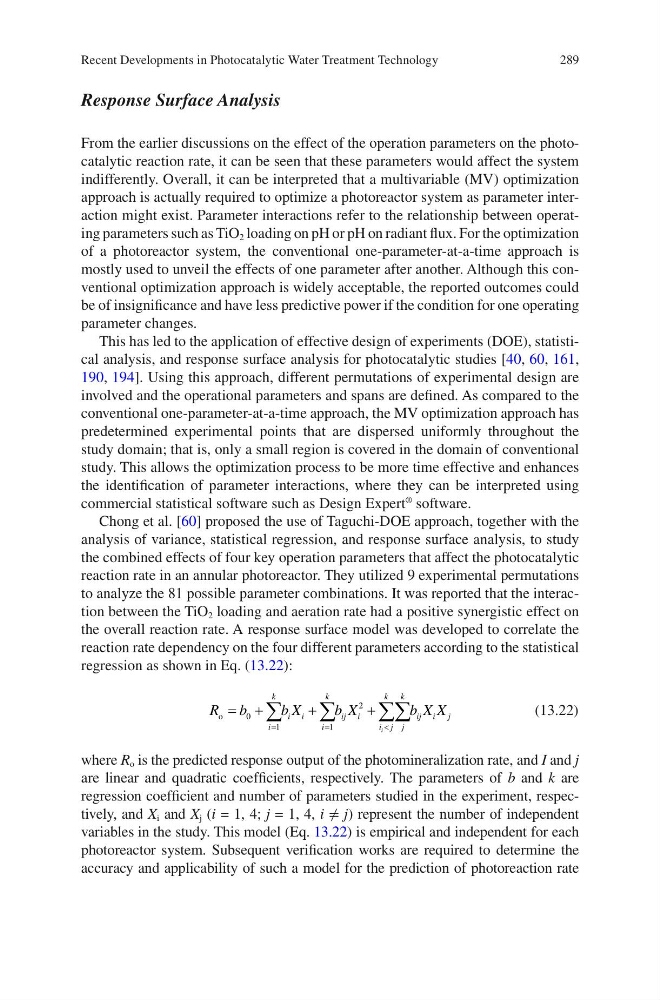
regression as shown in Eq. (13.22):
R b
b X
b X
b X X
i
k
i i
i
k
ij i
i j
k
j
k
ij i j
i
o = +
+
+
=
=
<
∑
∑
∑∑
0
1
1
2
(13.22)
where R o is the predicted response output of the photomineralization rate, and I and j
are linear and quadratic coefficients, respectively. The parameters of b and k are
regression coefficient and number of parameters studied in the experiment, respectively, and X i and X j (i = 1, 4; j = 1, 4, i ≠ j) represent the number of independent
variables in the study. This model (Eq. 13.22) is empirical and independent for each
photoreactor system. Subsequent verification works are required to determine the
accuracy and applicability of such a model for the prediction of photoreaction rate
Recent Developments in Photocatalytic Water Treatment Technology
Response Surface Analysis
From the earlier discussions on the effect of the operation parameters on the photocatalytic reaction rate, it can be seen that these parameters would affect the system
indifferently. Overall, it can be interpreted that a multivariable (MV) optimization
approach is actually required to optimize a photoreactor system as parameter interaction might exist. Parameter interactions refer to the relationship between operating parameters such as TiO 2 loading on pH or pH on radiant flux. For the optimization
of a photoreactor system, the conventional one-parameter-at-a-time approach is
mostly used to unveil the effects of one parameter after another. Although this conventional optimization approach is widely acceptable, the reported outcomes could
be of insignificance and have less predictive power if the condition for one operating
parameter changes.
This has led to the application of effective design of experiments (DOE), statistical analysis, and response surface analysis for photocatalytic studies [40, 60, 161,
190, 194]. Using this approach, different permutations of experimental design are
involved and the operational parameters and spans are defined. As compared to the
conventional one-parameter-at-a-time approach, the MV optimization approach has
predetermined experimental points that are dispersed uniformly throughout the
study domain; that is, only a small region is covered in the domain of conventional
study. This allows the optimization process to be more time effective and enhances
the identification of parameter interactions, where they can be interpreted using
commercial statistical software such as Design Expert
®
software.
Chong et al. [60] proposed the use of Taguchi-DOE approach, together with the
analysis of variance, statistical regression, and response surface analysis, to study
the combined effects of four key operation parameters that affect the photocatalytic
reaction rate in an annular photoreactor. They utilized 9 experimental permutations
to analyze the 81 possible parameter combinations. It was reported that the interaction between the TiO 2 loading and aeration rate had a positive synergistic effect on
the overall reaction rate. A response surface model was developed to correlate the
reaction rate dependency on the four different parameters according to the statistical
regression as shown in Eq. (13.22):
R b
b X
b X
b X X
i
k
i i
i
k
ij i
i j
k
j
k
ij i j
i
o = +
+
+
=
=
<
∑
∑
∑∑
0
1
1
2
(13.22)
where R o is the predicted response output of the photomineralization rate, and I and j
are linear and quadratic coefficients, respectively. The parameters of b and k are
regression coefficient and number of parameters studied in the experiment, respectively, and X i and X j (i = 1, 4; j = 1, 4, i ≠ j) represent the number of independent
variables in the study. This model (Eq. 13.22) is empirical and independent for each
photoreactor system. Subsequent verification works are required to determine the
accuracy and applicability of such a model for the prediction of photoreaction rate
Recent Developments in Photocatalytic Water Treatment Technology