

283
reaction temperature (>80 °C) promotes the recombination of charge carriers and
disfavors the adsorption of organic compounds onto the TiO 2 surface [103]. At a
reaction temperature greater than 80 °C, the photocatalytic reaction is interpreted
with Langmuir–Hinshelwood (L–H) mechanism where the adsorption of reactants
is disfavored resulting in KC becoming “1.” This will reduce the L–H expression
(Eq. 13.23) into the apparent rate equation r = k apparent C. All these drastically reduce
the photocatalytic activity of TiO 2 when the reaction temperature rises. The desorption of degraded products from the TiO 2 surface is the rate-limiting step when temperatures rise. On the contrary, a low temperature below 80 °C actually favors
adsorption which is a spontaneous exothermic phenomenon, resulting in getting KC
of L–H model “1,” enhancing the adsorption of final reaction products. A further
reaction in temperature down to 0 °C will cause an increase in the apparent activation energy. As a consequence, the optimum reaction temperature for photomineralization is reported to be in the range of 20–80 °C [205].
For photo-disinfection using TiO 2 photocatalysis, the increase in the reaction
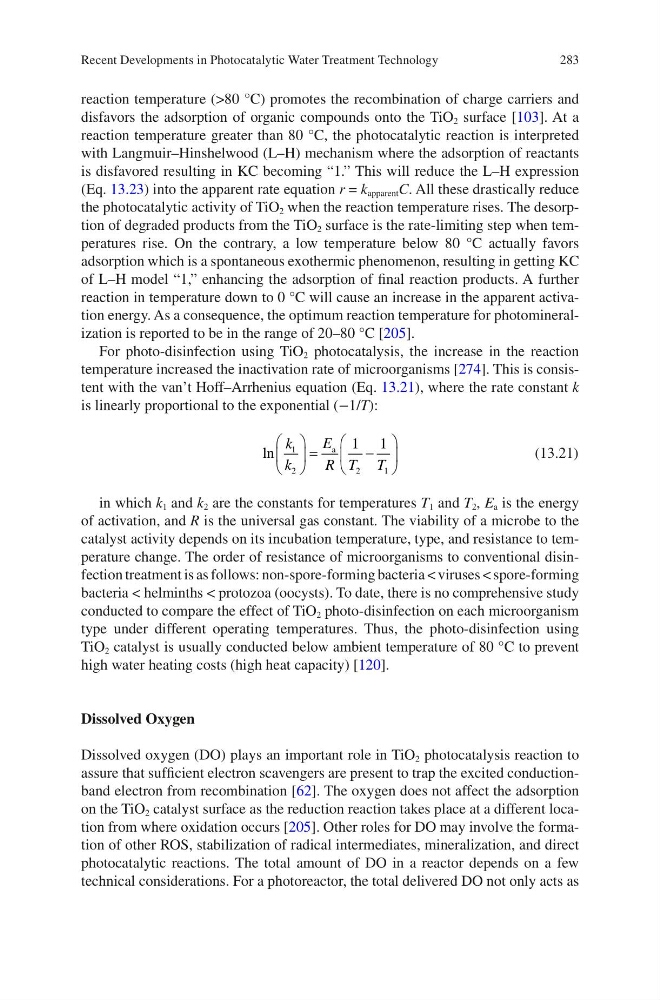
temperature increased the inactivation rate of microorganisms [274]. This is consistent with the van’t Hoff–Arrhenius equation (Eq. 13.21), where the rate constant k
is linearly proportional to the exponential (−1/T):
ln
k
k
E
R T T
1
2
2
1
1 1
=
−
a
(13.21)
in which k 1 and k 2 are the constants for temperatures T 1 and T 2 , E a is the energy
of activation, and R is the universal gas constant. The viability of a microbe to the
catalyst activity depends on its incubation temperature, type, and resistance to temperature change. The order of resistance of microorganisms to conventional disinfection treatment is as follows: non-spore-forming bacteria < viruses < spore-forming
bacteria < helminths < protozoa (oocysts). To date, there is no comprehensive study
conducted to compare the effect of TiO 2 photo-disinfection on each microorganism
type under different operating temperatures. Thus, the photo-disinfection using
TiO 2 catalyst is usually conducted below ambient temperature of 80 °C to prevent
high water heating costs (high heat capacity) [120].
Dissolved Oxygen
Dissolved oxygen (DO) plays an important role in TiO 2 photocatalysis reaction to
assure that sufficient electron scavengers are present to trap the excited conductionband electron from recombination [62]. The oxygen does not affect the adsorption
on the TiO 2 catalyst surface as the reduction reaction takes place at a different location from where oxidation occurs [205]. Other roles for DO may involve the formation of other ROS, stabilization of radical intermediates, mineralization, and direct
photocatalytic reactions. The total amount of DO in a reactor depends on a few
technical considerations. For a photoreactor, the total delivered DO not only acts as
Recent Developments in Photocatalytic Water Treatment Technology
reaction temperature (>80 °C) promotes the recombination of charge carriers and
disfavors the adsorption of organic compounds onto the TiO 2 surface [103]. At a
reaction temperature greater than 80 °C, the photocatalytic reaction is interpreted
with Langmuir–Hinshelwood (L–H) mechanism where the adsorption of reactants
is disfavored resulting in KC becoming “1.” This will reduce the L–H expression
(Eq. 13.23) into the apparent rate equation r = k apparent C. All these drastically reduce
the photocatalytic activity of TiO 2 when the reaction temperature rises. The desorption of degraded products from the TiO 2 surface is the rate-limiting step when temperatures rise. On the contrary, a low temperature below 80 °C actually favors
adsorption which is a spontaneous exothermic phenomenon, resulting in getting KC
of L–H model “1,” enhancing the adsorption of final reaction products. A further
reaction in temperature down to 0 °C will cause an increase in the apparent activation energy. As a consequence, the optimum reaction temperature for photomineralization is reported to be in the range of 20–80 °C [205].
For photo-disinfection using TiO 2 photocatalysis, the increase in the reaction
temperature increased the inactivation rate of microorganisms [274]. This is consistent with the van’t Hoff–Arrhenius equation (Eq. 13.21), where the rate constant k
is linearly proportional to the exponential (−1/T):
ln
k
k
E
R T T
1
2
2
1
1 1
=
−
a
(13.21)
in which k 1 and k 2 are the constants for temperatures T 1 and T 2 , E a is the energy
of activation, and R is the universal gas constant. The viability of a microbe to the
catalyst activity depends on its incubation temperature, type, and resistance to temperature change. The order of resistance of microorganisms to conventional disinfection treatment is as follows: non-spore-forming bacteria < viruses < spore-forming
bacteria < helminths < protozoa (oocysts). To date, there is no comprehensive study
conducted to compare the effect of TiO 2 photo-disinfection on each microorganism
type under different operating temperatures. Thus, the photo-disinfection using
TiO 2 catalyst is usually conducted below ambient temperature of 80 °C to prevent
high water heating costs (high heat capacity) [120].
Dissolved Oxygen
Dissolved oxygen (DO) plays an important role in TiO 2 photocatalysis reaction to
assure that sufficient electron scavengers are present to trap the excited conductionband electron from recombination [62]. The oxygen does not affect the adsorption
on the TiO 2 catalyst surface as the reduction reaction takes place at a different location from where oxidation occurs [205]. Other roles for DO may involve the formation of other ROS, stabilization of radical intermediates, mineralization, and direct
photocatalytic reactions. The total amount of DO in a reactor depends on a few
technical considerations. For a photoreactor, the total delivered DO not only acts as
Recent Developments in Photocatalytic Water Treatment Technology