

276
the application of hybrid photocatalysis-membrane processes. Application of such a
hybrid system prevents the use of a coagulation, flocculation, or sedimentation to
separate the catalyst particles from the treated water stream. Other benefits include
further energy saving and size of process installation and site area required.
The hybrid photocatalytic-membrane reactor system is generally known as the
“photocatalytic membrane reactors” (PMRs). This is owing to the nature of the
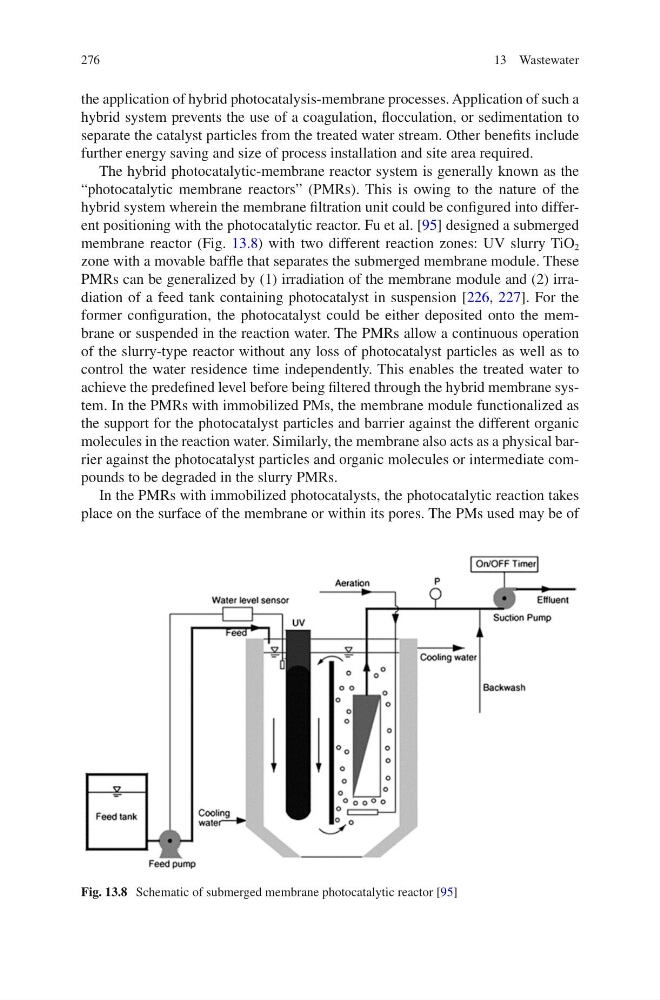
hybrid system wherein the membrane filtration unit could be configured into different positioning with the photocatalytic reactor. Fu et al. [95] designed a submerged
membrane reactor (Fig. 13.8) with two different reaction zones: UV slurry TiO 2
zone with a movable baffle that separates the submerged membrane module. These
PMRs can be generalized by (1) irradiation of the membrane module and (2) irradiation of a feed tank containing photocatalyst in suspension [226, 227]. For the
former configuration, the photocatalyst could be either deposited onto the membrane or suspended in the reaction water. The PMRs allow a continuous operation
of the slurry-type reactor without any loss of photocatalyst particles as well as to
control the water residence time independently. This enables the treated water to
achieve the predefined level before being filtered through the hybrid membrane system. In the PMRs with immobilized PMs, the membrane module functionalized as
the support for the photocatalyst particles and barrier against the different organic
molecules in the reaction water. Similarly, the membrane also acts as a physical barrier against the photocatalyst particles and organic molecules or intermediate compounds to be degraded in the slurry PMRs.
In the PMRs with immobilized photocatalysts, the photocatalytic reaction takes
place on the surface of the membrane or within its pores. The PMs used may be of
Fig. 13.8 Schematic of submerged membrane photocatalytic reactor [95]
13 Wastewater
the application of hybrid photocatalysis-membrane processes. Application of such a
hybrid system prevents the use of a coagulation, flocculation, or sedimentation to
separate the catalyst particles from the treated water stream. Other benefits include
further energy saving and size of process installation and site area required.
The hybrid photocatalytic-membrane reactor system is generally known as the
“photocatalytic membrane reactors” (PMRs). This is owing to the nature of the
hybrid system wherein the membrane filtration unit could be configured into different positioning with the photocatalytic reactor. Fu et al. [95] designed a submerged
membrane reactor (Fig. 13.8) with two different reaction zones: UV slurry TiO 2
zone with a movable baffle that separates the submerged membrane module. These
PMRs can be generalized by (1) irradiation of the membrane module and (2) irradiation of a feed tank containing photocatalyst in suspension [226, 227]. For the
former configuration, the photocatalyst could be either deposited onto the membrane or suspended in the reaction water. The PMRs allow a continuous operation
of the slurry-type reactor without any loss of photocatalyst particles as well as to
control the water residence time independently. This enables the treated water to
achieve the predefined level before being filtered through the hybrid membrane system. In the PMRs with immobilized PMs, the membrane module functionalized as
the support for the photocatalyst particles and barrier against the different organic
molecules in the reaction water. Similarly, the membrane also acts as a physical barrier against the photocatalyst particles and organic molecules or intermediate compounds to be degraded in the slurry PMRs.
In the PMRs with immobilized photocatalysts, the photocatalytic reaction takes
place on the surface of the membrane or within its pores. The PMs used may be of
Fig. 13.8 Schematic of submerged membrane photocatalytic reactor [95]
13 Wastewater