

17
implementing the solar quantum dynamics which is clarified as the most acceptable
quantum technology to calculate the net solar energy emission on earth [10, 20, 30].
This is because the earth surface can emit solar irradiance accurately at a given
temperature of approximately 700 °C where the energy density of the solar radiation
is derived from the maximum solar energy generation from a single solar photon
excitation [3, 12, 31].
The amount of global solar radiation calculation on the earth surface is further
clarified considering the three background solar data calculation by using pyrheliometer to measure direct beam radiation coming from the sun and radius of the
earth surface [24, 32, 33]. Then, the pyranometer is also used to measure total
hemispherical radiation beam plus diffusion on a horizontal surface and the net
global total irradiance (W/m
2
) is measured on a horizontal surface by a pyranometer
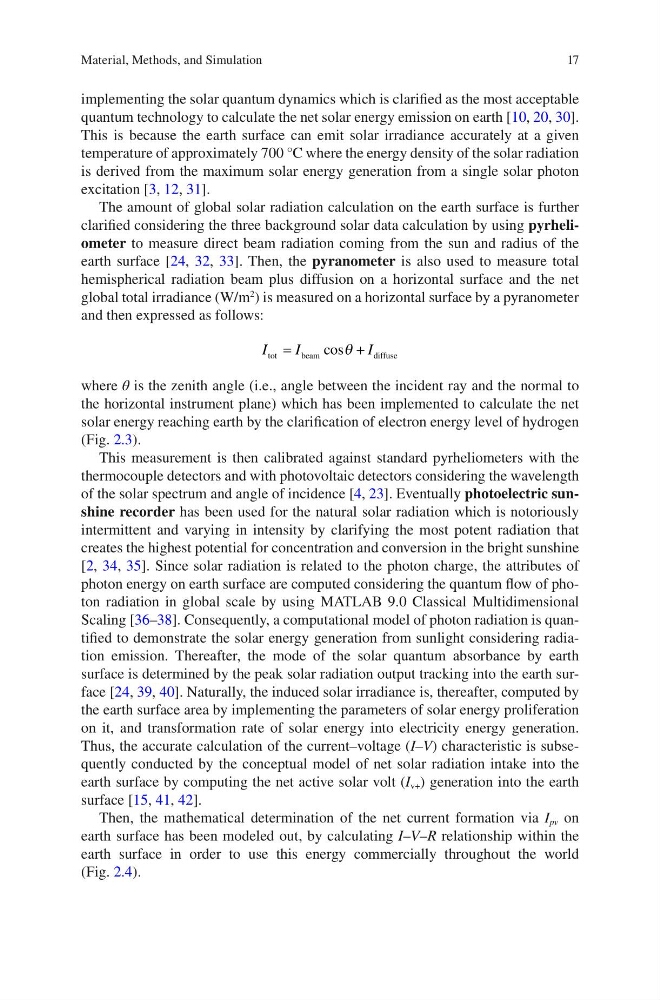
and then expressed as follows:
I
I
I
tot
b eam
diffuse
cosT
where θ is the zenith angle (i.e., angle between the incident ray and the normal to
the horizontal instrument plane) which has been implemented to calculate the net
solar energy reaching earth by the clarification of electron energy level of hydrogen
(Fig. 2.3).
This measurement is then calibrated against standard pyrheliometers with the
thermocouple detectors and with photovoltaic detectors considering the wavelength
of the solar spectrum and angle of incidence [4, 23]. Eventually photoelectric sunshine recorder has been used for the natural solar radiation which is notoriously
intermittent and varying in intensity by clarifying the most potent radiation that
creates the highest potential for concentration and conversion in the bright sunshine
[2, 34, 35]. Since solar radiation is related to the photon charge, the attributes of
photon energy on earth surface are computed considering the quantum flow of photon radiation in global scale by using MATLAB 9.0 Classical Multidimensional
Scaling [36–38]. Consequently, a computational model of photon radiation is quantified to demonstrate the solar energy generation from sunlight considering radiation emission. Thereafter, the mode of the solar quantum absorbance by earth
surface is determined by the peak solar radiation output tracking into the earth surface [24, 39, 40]. Naturally, the induced solar irradiance is, thereafter, computed by
the earth surface area by implementing the parameters of solar energy proliferation
on it, and transformation rate of solar energy into electricity energy generation.
Thus, the accurate calculation of the current–voltage (I–V) characteristic is subsequently conducted by the conceptual model of net solar radiation intake into the
earth surface by computing the net active solar volt (I v+ ) generation into the earth
surface [15, 41, 42].
Then, the mathematical determination of the net current formation via I pv on
earth surface has been modeled out, by calculating I–V–R relationship within the
earth surface in order to use this energy commercially throughout the world
(Fig. 2.4).
Material, Methods, and Simulation
implementing the solar quantum dynamics which is clarified as the most acceptable
quantum technology to calculate the net solar energy emission on earth [10, 20, 30].
This is because the earth surface can emit solar irradiance accurately at a given
temperature of approximately 700 °C where the energy density of the solar radiation
is derived from the maximum solar energy generation from a single solar photon
excitation [3, 12, 31].
The amount of global solar radiation calculation on the earth surface is further
clarified considering the three background solar data calculation by using pyrheliometer to measure direct beam radiation coming from the sun and radius of the
earth surface [24, 32, 33]. Then, the pyranometer is also used to measure total
hemispherical radiation beam plus diffusion on a horizontal surface and the net
global total irradiance (W/m
2
) is measured on a horizontal surface by a pyranometer
and then expressed as follows:
I
I
I
tot
b eam
diffuse
cosT
where θ is the zenith angle (i.e., angle between the incident ray and the normal to
the horizontal instrument plane) which has been implemented to calculate the net
solar energy reaching earth by the clarification of electron energy level of hydrogen
(Fig. 2.3).
This measurement is then calibrated against standard pyrheliometers with the
thermocouple detectors and with photovoltaic detectors considering the wavelength
of the solar spectrum and angle of incidence [4, 23]. Eventually photoelectric sunshine recorder has been used for the natural solar radiation which is notoriously
intermittent and varying in intensity by clarifying the most potent radiation that
creates the highest potential for concentration and conversion in the bright sunshine
[2, 34, 35]. Since solar radiation is related to the photon charge, the attributes of
photon energy on earth surface are computed considering the quantum flow of photon radiation in global scale by using MATLAB 9.0 Classical Multidimensional
Scaling [36–38]. Consequently, a computational model of photon radiation is quantified to demonstrate the solar energy generation from sunlight considering radiation emission. Thereafter, the mode of the solar quantum absorbance by earth
surface is determined by the peak solar radiation output tracking into the earth surface [24, 39, 40]. Naturally, the induced solar irradiance is, thereafter, computed by
the earth surface area by implementing the parameters of solar energy proliferation
on it, and transformation rate of solar energy into electricity energy generation.
Thus, the accurate calculation of the current–voltage (I–V) characteristic is subsequently conducted by the conceptual model of net solar radiation intake into the
earth surface by computing the net active solar volt (I v+ ) generation into the earth
surface [15, 41, 42].
Then, the mathematical determination of the net current formation via I pv on
earth surface has been modeled out, by calculating I–V–R relationship within the
earth surface in order to use this energy commercially throughout the world
(Fig. 2.4).
Material, Methods, and Simulation