

253
can form toxic DBPs (e.g., halogenated disinfection by-products, carcinogenic
nitrosamines, bromate). UV disinfection emerged as an alternative for oxidative
disinfection as it produces minimal DBPs, while it requires high dosage for certain
viruses (e.g., adenoviruses). These limitations urge the development of alternative
methods that can enhance the robustness of disinfection while avoiding DBP
formation.
Our previous review on antimicrobial nanomaterials highlighted the potential of
nanotechnology in disinfection and microbial control [178]. Many nanomaterials,
including nano-Ag, nano-ZnO, nano-TiO 2 , nano-Ce 2 O 4 , CNTs, and fullerenes,
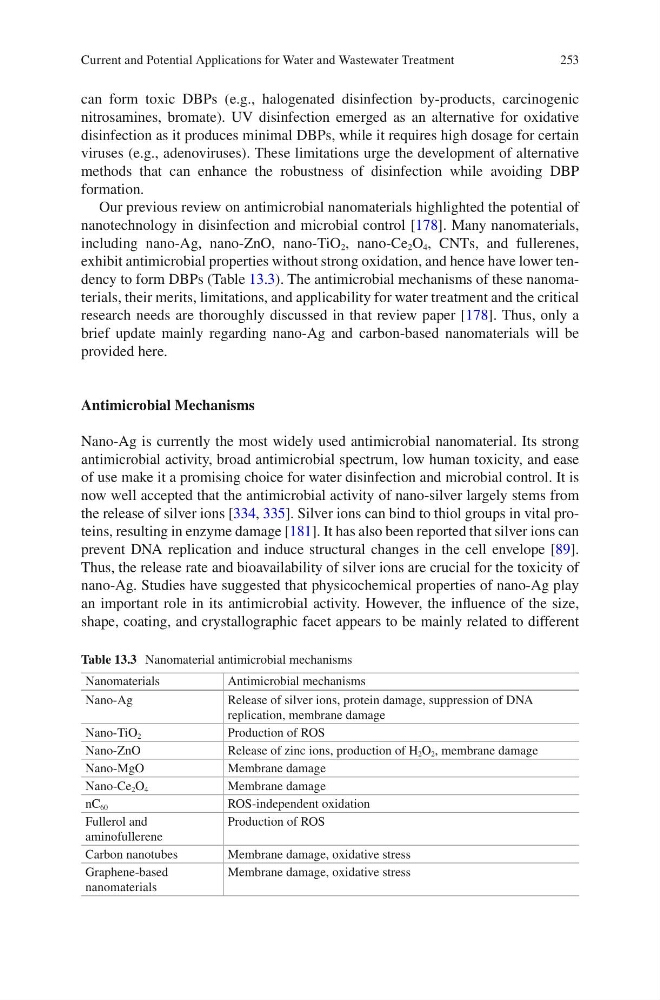
exhibit antimicrobial properties without strong oxidation, and hence have lower tendency to form DBPs (Table 13.3). The antimicrobial mechanisms of these nanomaterials, their merits, limitations, and applicability for water treatment and the critical
research needs are thoroughly discussed in that review paper [178]. Thus, only a
brief update mainly regarding nano-Ag and carbon-based nanomaterials will be
provided here.
Antimicrobial Mechanisms
Nano-Ag is currently the most widely used antimicrobial nanomaterial. Its strong
antimicrobial activity, broad antimicrobial spectrum, low human toxicity, and ease
of use make it a promising choice for water disinfection and microbial control. It is
now well accepted that the antimicrobial activity of nano-silver largely stems from
the release of silver ions [334, 335]. Silver ions can bind to thiol groups in vital proteins, resulting in enzyme damage [181]. It has also been reported that silver ions can
prevent DNA replication and induce structural changes in the cell envelope [89].
Thus, the release rate and bioavailability of silver ions are crucial for the toxicity of
nano-Ag. Studies have suggested that physicochemical properties of nano-Ag play
an important role in its antimicrobial activity. However, the influence of the size,
shape, coating, and crystallographic facet appears to be mainly related to different
Table 13.3 Nanomaterial antimicrobial mechanisms
Nanomaterials
Antimicrobial mechanisms
Nano-Ag
Release of silver ions, protein damage, suppression of DNA
replication, membrane damage
Nano-TiO 2
Production of ROS
Nano-ZnO
Release of zinc ions, production of H 2 O 2 , membrane damage
Nano-MgO
Membrane damage
Nano-Ce 2 O 4
Membrane damage
nC 60
ROS-independent oxidation
Fullerol and
aminofullerene
Production of ROS
Carbon nanotubes
Membrane damage, oxidative stress
Graphene-based
nanomaterials
Membrane damage, oxidative stress
Current and Potential Applications for Water and Wastewater Treatment
can form toxic DBPs (e.g., halogenated disinfection by-products, carcinogenic
nitrosamines, bromate). UV disinfection emerged as an alternative for oxidative
disinfection as it produces minimal DBPs, while it requires high dosage for certain
viruses (e.g., adenoviruses). These limitations urge the development of alternative
methods that can enhance the robustness of disinfection while avoiding DBP
formation.
Our previous review on antimicrobial nanomaterials highlighted the potential of
nanotechnology in disinfection and microbial control [178]. Many nanomaterials,
including nano-Ag, nano-ZnO, nano-TiO 2 , nano-Ce 2 O 4 , CNTs, and fullerenes,
exhibit antimicrobial properties without strong oxidation, and hence have lower tendency to form DBPs (Table 13.3). The antimicrobial mechanisms of these nanomaterials, their merits, limitations, and applicability for water treatment and the critical
research needs are thoroughly discussed in that review paper [178]. Thus, only a
brief update mainly regarding nano-Ag and carbon-based nanomaterials will be
provided here.
Antimicrobial Mechanisms
Nano-Ag is currently the most widely used antimicrobial nanomaterial. Its strong
antimicrobial activity, broad antimicrobial spectrum, low human toxicity, and ease
of use make it a promising choice for water disinfection and microbial control. It is
now well accepted that the antimicrobial activity of nano-silver largely stems from
the release of silver ions [334, 335]. Silver ions can bind to thiol groups in vital proteins, resulting in enzyme damage [181]. It has also been reported that silver ions can
prevent DNA replication and induce structural changes in the cell envelope [89].
Thus, the release rate and bioavailability of silver ions are crucial for the toxicity of
nano-Ag. Studies have suggested that physicochemical properties of nano-Ag play
an important role in its antimicrobial activity. However, the influence of the size,
shape, coating, and crystallographic facet appears to be mainly related to different
Table 13.3 Nanomaterial antimicrobial mechanisms
Nanomaterials
Antimicrobial mechanisms
Nano-Ag
Release of silver ions, protein damage, suppression of DNA
replication, membrane damage
Nano-TiO 2
Production of ROS
Nano-ZnO
Release of zinc ions, production of H 2 O 2 , membrane damage
Nano-MgO
Membrane damage
Nano-Ce 2 O 4
Membrane damage
nC 60
ROS-independent oxidation
Fullerol and
aminofullerene
Production of ROS
Carbon nanotubes
Membrane damage, oxidative stress
Graphene-based
nanomaterials
Membrane damage, oxidative stress
Current and Potential Applications for Water and Wastewater Treatment