

243
nanoscale counterparts have higher adsorption capacity and faster kinetics because
of the higher specific surface area, shorter intraparticle diffusion distance, and larger
number of surface reaction sites (i.e., corners, edges, vacancies). For instance, as the
particle size of nano-magnetite decreased from 300 to 11 nm, its arsenic adsorption
capacity increased more than 100 times [32, 33]. Much of this observed increase in
adsorption was attributed to the increase in specific surface area as the 300 and 20 nm
magnetite particles have similar surface area-normalized arsenic adsorption capacity
(~6 μmol/m
2
or 3.6 atoms/nm
2
). However, when particle size was reduced to below
20 nm, the specific surface area-normalized adsorption capacity increased, with
11 nm magnetite nanoparticles absorbing three times more arsenic (~18 μmol/m
2
or
11 atoms/nm
2
), suggesting a “nanoscale effect.” This “nanoscale effect” was attributed to the change of magnetite surface structure which creates new adsorption site
vacancies [34, 35].
In addition to high adsorption capacity, some iron oxide nanoparticles, e.g.,
nano-maghemite and nano-magnetite, can be superparamagnetic. Magnetism is
highly volume dependent as it stems from the collective interaction of atomic
magnetic dipoles. If the size of a ferro- or ferri-magnet decreases to the critical
value (~40 nm), the magnet changes from multiple domains to single domain with
higher magnetic susceptibility [17, 36]. As the size further decreases, magnetic
particles become superparamagnetic, losing permanent magnetic moments while
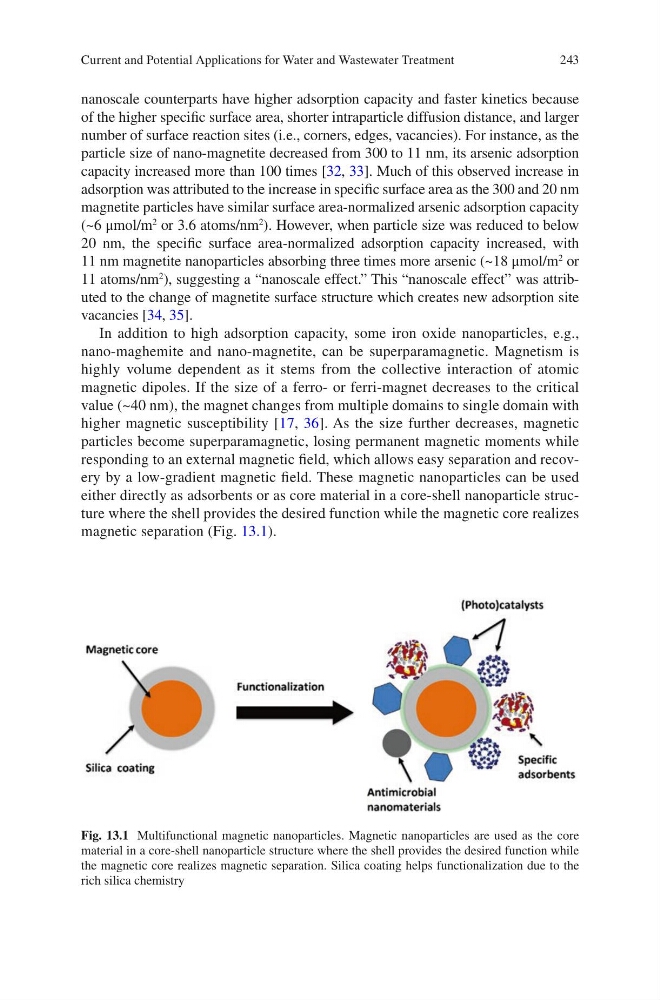
responding to an external magnetic field, which allows easy separation and recovery by a low- gradient magnetic field. These magnetic nanoparticles can be used
either directly as adsorbents or as core material in a core-shell nanoparticle structure where the shell provides the desired function while the magnetic core realizes
magnetic separation (Fig. 13.1).
Fig. 13.1 Multifunctional magnetic nanoparticles. Magnetic nanoparticles are used as the core
material in a core-shell nanoparticle structure where the shell provides the desired function while
the magnetic core realizes magnetic separation. Silica coating helps functionalization due to the
rich silica chemistry
Current and Potential Applications for Water and Wastewater Treatment
nanoscale counterparts have higher adsorption capacity and faster kinetics because
of the higher specific surface area, shorter intraparticle diffusion distance, and larger
number of surface reaction sites (i.e., corners, edges, vacancies). For instance, as the
particle size of nano-magnetite decreased from 300 to 11 nm, its arsenic adsorption
capacity increased more than 100 times [32, 33]. Much of this observed increase in
adsorption was attributed to the increase in specific surface area as the 300 and 20 nm
magnetite particles have similar surface area-normalized arsenic adsorption capacity
(~6 μmol/m
2
or 3.6 atoms/nm
2
). However, when particle size was reduced to below
20 nm, the specific surface area-normalized adsorption capacity increased, with
11 nm magnetite nanoparticles absorbing three times more arsenic (~18 μmol/m
2
or
11 atoms/nm
2
), suggesting a “nanoscale effect.” This “nanoscale effect” was attributed to the change of magnetite surface structure which creates new adsorption site
vacancies [34, 35].
In addition to high adsorption capacity, some iron oxide nanoparticles, e.g.,
nano-maghemite and nano-magnetite, can be superparamagnetic. Magnetism is
highly volume dependent as it stems from the collective interaction of atomic
magnetic dipoles. If the size of a ferro- or ferri-magnet decreases to the critical
value (~40 nm), the magnet changes from multiple domains to single domain with
higher magnetic susceptibility [17, 36]. As the size further decreases, magnetic
particles become superparamagnetic, losing permanent magnetic moments while
responding to an external magnetic field, which allows easy separation and recovery by a low- gradient magnetic field. These magnetic nanoparticles can be used
either directly as adsorbents or as core material in a core-shell nanoparticle structure where the shell provides the desired function while the magnetic core realizes
magnetic separation (Fig. 13.1).
Fig. 13.1 Multifunctional magnetic nanoparticles. Magnetic nanoparticles are used as the core
material in a core-shell nanoparticle structure where the shell provides the desired function while
the magnetic core realizes magnetic separation. Silica coating helps functionalization due to the
rich silica chemistry
Current and Potential Applications for Water and Wastewater Treatment