

241
A major drawback of activated carbon is its low adsorption affinity for lowmolecular- weight polar organic compounds. CNTs strongly adsorb many of these
polar organic compounds due to the diverse contaminant-CNT interactions including hydrophobic effect, π-π interactions, hydrogen bonding, covalent bonding, and
electrostatic interactions [8, 13]. The π electron-rich CNT surface allows π-π interactions with organic molecules with C-C bonds or benzene rings, such as polycyclic
aromatic hydrocarbons (PAHs) and polar aromatic compounds [14, 15]. Organic
compounds which have -COOH, -OH, and -NH 2 functional groups could also form
hydrogen bond with the graphitic CNT surface which donates electrons [16, 17].
Electrostatic attraction facilitates the adsorption of positively charged organic
chemicals such as some antibiotics at suitable pH [12, 18].
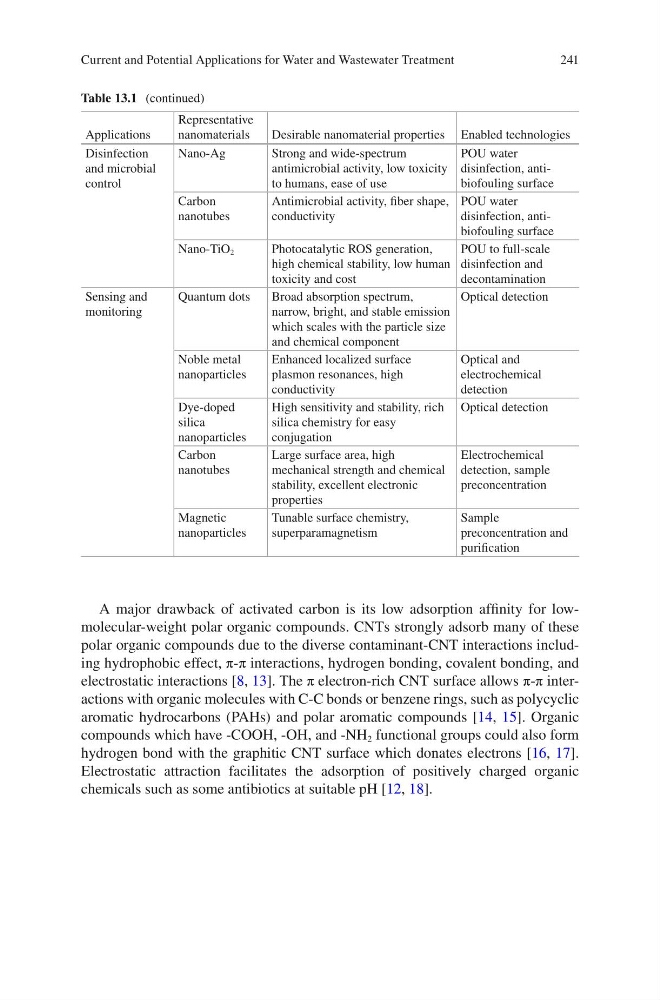
Table 13.1 (continued)
Applications
Representative
nanomaterials
Desirable nanomaterial properties Enabled technologies
Disinfection
and microbial
control
Nano-Ag
Strong and wide-spectrum
antimicrobial activity, low toxicity
to humans, ease of use
POU water
disinfection, antibiofouling surface
Carbon
nanotubes
Antimicrobial activity, fiber shape,
conductivity
POU water
disinfection, antibiofouling surface
Nano-TiO 2
Photocatalytic ROS generation,
high chemical stability, low human
toxicity and cost
POU to full-scale
disinfection and
decontamination
Sensing and
monitoring
Quantum dots
Broad absorption spectrum,
narrow, bright, and stable emission
which scales with the particle size
and chemical component
Optical detection
Noble metal
nanoparticles
Enhanced localized surface
plasmon resonances, high
conductivity
Optical and
electrochemical
detection
Dye-doped
silica
nanoparticles
High sensitivity and stability, rich
silica chemistry for easy
conjugation
Optical detection
Carbon
nanotubes
Large surface area, high
mechanical strength and chemical
stability, excellent electronic
properties
Electrochemical
detection, sample
preconcentration
Magnetic
nanoparticles
Tunable surface chemistry,
superparamagnetism
Sample
preconcentration and
purification
Current and Potential Applications for Water and Wastewater Treatment
A major drawback of activated carbon is its low adsorption affinity for lowmolecular- weight polar organic compounds. CNTs strongly adsorb many of these
polar organic compounds due to the diverse contaminant-CNT interactions including hydrophobic effect, π-π interactions, hydrogen bonding, covalent bonding, and
electrostatic interactions [8, 13]. The π electron-rich CNT surface allows π-π interactions with organic molecules with C-C bonds or benzene rings, such as polycyclic
aromatic hydrocarbons (PAHs) and polar aromatic compounds [14, 15]. Organic
compounds which have -COOH, -OH, and -NH 2 functional groups could also form
hydrogen bond with the graphitic CNT surface which donates electrons [16, 17].
Electrostatic attraction facilitates the adsorption of positively charged organic
chemicals such as some antibiotics at suitable pH [12, 18].
Table 13.1 (continued)
Applications
Representative
nanomaterials
Desirable nanomaterial properties Enabled technologies
Disinfection
and microbial
control
Nano-Ag
Strong and wide-spectrum
antimicrobial activity, low toxicity
to humans, ease of use
POU water
disinfection, antibiofouling surface
Carbon
nanotubes
Antimicrobial activity, fiber shape,
conductivity
POU water
disinfection, antibiofouling surface
Nano-TiO 2
Photocatalytic ROS generation,
high chemical stability, low human
toxicity and cost
POU to full-scale
disinfection and
decontamination
Sensing and
monitoring
Quantum dots
Broad absorption spectrum,
narrow, bright, and stable emission
which scales with the particle size
and chemical component
Optical detection
Noble metal
nanoparticles
Enhanced localized surface
plasmon resonances, high
conductivity
Optical and
electrochemical
detection
Dye-doped
silica
nanoparticles
High sensitivity and stability, rich
silica chemistry for easy
conjugation
Optical detection
Carbon
nanotubes
Large surface area, high
mechanical strength and chemical
stability, excellent electronic
properties
Electrochemical
detection, sample
preconcentration
Magnetic
nanoparticles
Tunable surface chemistry,
superparamagnetism
Sample
preconcentration and
purification
Current and Potential Applications for Water and Wastewater Treatment