

193
Mathematic Experiment on Car
The calculative application of this wind power in the car has been implemented to
use the wind energy eventually for all transportation vehicles. Interesting, the design
of wind turbine for the car and its mechanical and electrical system encountered
including all operational systems, strength of the wind, shears, and intensity and
frequency of the turbulent fluctuations have been calculated which suggested that
application of wind energy in the car is very much functional (Fig. 10.9).
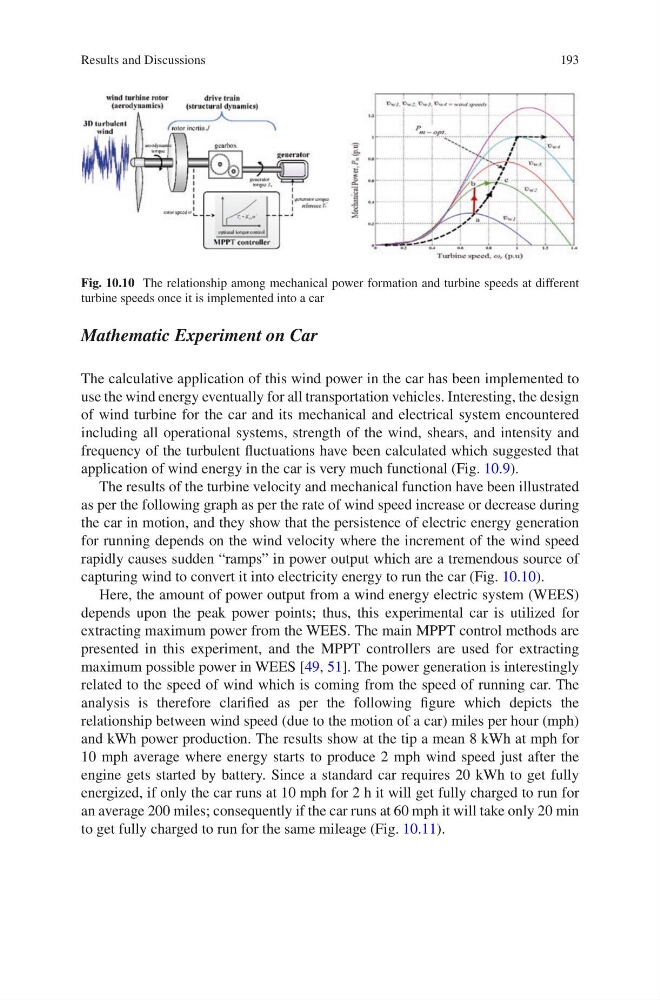
The results of the turbine velocity and mechanical function have been illustrated
as per the following graph as per the rate of wind speed increase or decrease during
the car in motion, and they show that the persistence of electric energy generation
for running depends on the wind velocity where the increment of the wind speed
rapidly causes sudden “ramps” in power output which are a tremendous source of
capturing wind to convert it into electricity energy to run the car (Fig. 10.10).
Here, the amount of power output from a wind energy electric system (WEES)
depends upon the peak power points; thus, this experimental car is utilized for
extracting maximum power from the WEES. The main MPPT control methods are
presented in this experiment, and the MPPT controllers are used for extracting
maximum possible power in WEES [49, 51]. The power generation is interestingly
related to the speed of wind which is coming from the speed of running car. The
analysis is therefore clarified as per the following figure which depicts the
relationship between wind speed (due to the motion of a car) miles per hour (mph)
and kWh power production. The results show at the tip a mean 8 kWh at mph for
10 mph average where energy starts to produce 2 mph wind speed just after the
engine gets started by battery. Since a standard car requires 20 kWh to get fully
energized, if only the car runs at 10 mph for 2 h it will get fully charged to run for
an average 200 miles; consequently if the car runs at 60 mph it will take only 20 min
to get fully charged to run for the same mileage (Fig. 10.11).
Fig. 10.10 The relationship among mechanical power formation and turbine speeds at different
turbine speeds once it is implemented into a car
Results and Discussions
Mathematic Experiment on Car
The calculative application of this wind power in the car has been implemented to
use the wind energy eventually for all transportation vehicles. Interesting, the design
of wind turbine for the car and its mechanical and electrical system encountered
including all operational systems, strength of the wind, shears, and intensity and
frequency of the turbulent fluctuations have been calculated which suggested that
application of wind energy in the car is very much functional (Fig. 10.9).
The results of the turbine velocity and mechanical function have been illustrated
as per the following graph as per the rate of wind speed increase or decrease during
the car in motion, and they show that the persistence of electric energy generation
for running depends on the wind velocity where the increment of the wind speed
rapidly causes sudden “ramps” in power output which are a tremendous source of
capturing wind to convert it into electricity energy to run the car (Fig. 10.10).
Here, the amount of power output from a wind energy electric system (WEES)
depends upon the peak power points; thus, this experimental car is utilized for
extracting maximum power from the WEES. The main MPPT control methods are
presented in this experiment, and the MPPT controllers are used for extracting
maximum possible power in WEES [49, 51]. The power generation is interestingly
related to the speed of wind which is coming from the speed of running car. The
analysis is therefore clarified as per the following figure which depicts the
relationship between wind speed (due to the motion of a car) miles per hour (mph)
and kWh power production. The results show at the tip a mean 8 kWh at mph for
10 mph average where energy starts to produce 2 mph wind speed just after the
engine gets started by battery. Since a standard car requires 20 kWh to get fully
energized, if only the car runs at 10 mph for 2 h it will get fully charged to run for
an average 200 miles; consequently if the car runs at 60 mph it will take only 20 min
to get fully charged to run for the same mileage (Fig. 10.11).
Fig. 10.10 The relationship among mechanical power formation and turbine speeds at different
turbine speeds once it is implemented into a car
Results and Discussions