

173
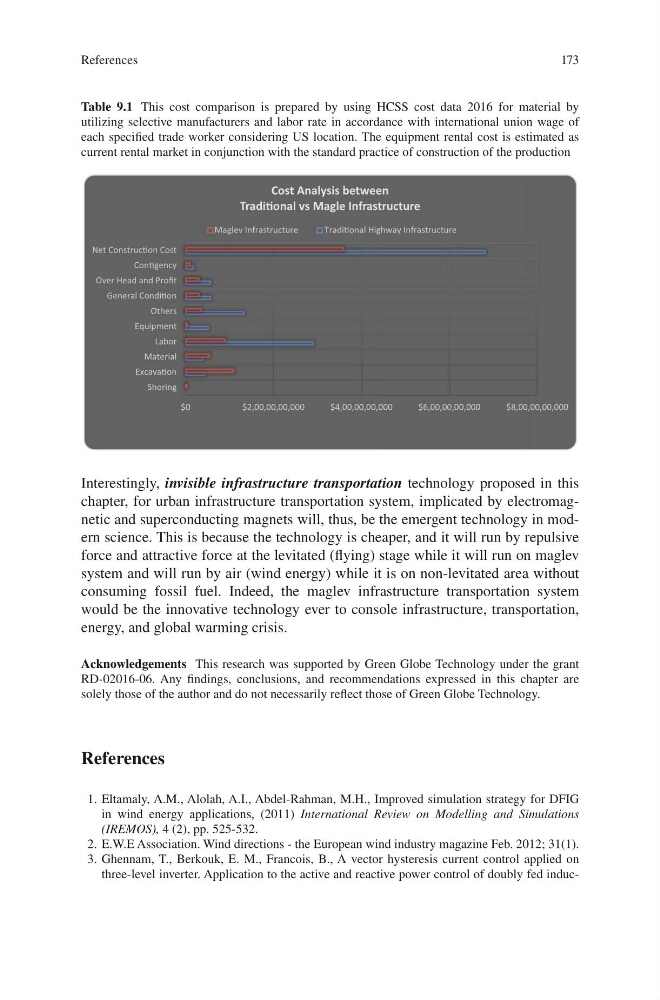
Interestingly, invisible infrastructure transportation technology proposed in this
chapter, for urban infrastructure transportation system, implicated by electromagnetic and superconducting magnets will, thus, be the emergent technology in modern science. This is because the technology is cheaper, and it will run by repulsive
force and attractive force at the levitated (flying) stage while it will run on maglev
system and will run by air (wind energy) while it is on non-levitated area without
consuming fossil fuel. Indeed, the maglev infrastructure transportation system
would be the innovative technology ever to console infrastructure, transportation,
energy, and global warming crisis.
Acknowledgements This research was supported by Green Globe Technology under the grant
RD-02016-06. Any findings, conclusions, and recommendations expressed in this chapter are
solely those of the author and do not necessarily reflect those of Green Globe Technology.
References
1. Eltamaly, A.M., Alolah, A.I., Abdel-Rahman, M.H., Improved simulation strategy for DFIG
in wind energy applications, (2011) International Review on Modelling and Simulations
(IREMOS), 4 (2), pp. 525-532.
2. E.W.E Association. Wind directions - the European wind industry magazine Feb. 2012; 31(1).
3. Ghennam, T., Berkouk, E. M., Francois, B., A vector hysteresis current control applied on
three-level inverter. Application to the active and reactive power control of doubly fed induc$0
$2,00,00,00,000
$ 4,00,00,00,000
$ 6,00,00,00,000
$ 8,00,00,00,000
Shoring
ExcavaƟon
Material
Labor
Equipment
Others
General CondiƟon
Over Head and Profit
ConƟgency
Net ConstrucƟon Cost
Cost Analysis between
TradiƟonal vs Magle Infrastructure
Maglev Infrastructure
TradiƟonal Highway Infrastructure
Table 9.1 This cost comparison is prepared by using HCSS cost data 2016 for material by
utilizing selective manufacturers and labor rate in accordance with international union wage of
each specified trade worker considering US location. The equipment rental cost is estimated as
current rental market in conjunction with the standard practice of construction of the production
References
Interestingly, invisible infrastructure transportation technology proposed in this
chapter, for urban infrastructure transportation system, implicated by electromagnetic and superconducting magnets will, thus, be the emergent technology in modern science. This is because the technology is cheaper, and it will run by repulsive
force and attractive force at the levitated (flying) stage while it will run on maglev
system and will run by air (wind energy) while it is on non-levitated area without
consuming fossil fuel. Indeed, the maglev infrastructure transportation system
would be the innovative technology ever to console infrastructure, transportation,
energy, and global warming crisis.
Acknowledgements This research was supported by Green Globe Technology under the grant
RD-02016-06. Any findings, conclusions, and recommendations expressed in this chapter are
solely those of the author and do not necessarily reflect those of Green Globe Technology.
References
1. Eltamaly, A.M., Alolah, A.I., Abdel-Rahman, M.H., Improved simulation strategy for DFIG
in wind energy applications, (2011) International Review on Modelling and Simulations
(IREMOS), 4 (2), pp. 525-532.
2. E.W.E Association. Wind directions - the European wind industry magazine Feb. 2012; 31(1).
3. Ghennam, T., Berkouk, E. M., Francois, B., A vector hysteresis current control applied on
three-level inverter. Application to the active and reactive power control of doubly fed induc$0
$2,00,00,00,000
$ 4,00,00,00,000
$ 6,00,00,00,000
$ 8,00,00,00,000
Shoring
ExcavaƟon
Material
Labor
Equipment
Others
General CondiƟon
Over Head and Profit
ConƟgency
Net ConstrucƟon Cost
Cost Analysis between
TradiƟonal vs Magle Infrastructure
Maglev Infrastructure
TradiƟonal Highway Infrastructure
Table 9.1 This cost comparison is prepared by using HCSS cost data 2016 for material by
utilizing selective manufacturers and labor rate in accordance with international union wage of
each specified trade worker considering US location. The equipment rental cost is estimated as
current rental market in conjunction with the standard practice of construction of the production
References