

5
perturbation [12–14]. Interestingly, the effects of these radiations on biochemical
functions of pathogenic cell have enough frequencies of photonic momentum
energy to break down the biochemical bonds of the pathogens and cause severe
malfunction of their cellular function.
Since the effects of UVGI on pathogens depend on the radiation’s frequency and
wavelength, the release of UVGI from sunlight is being measured and controlled by
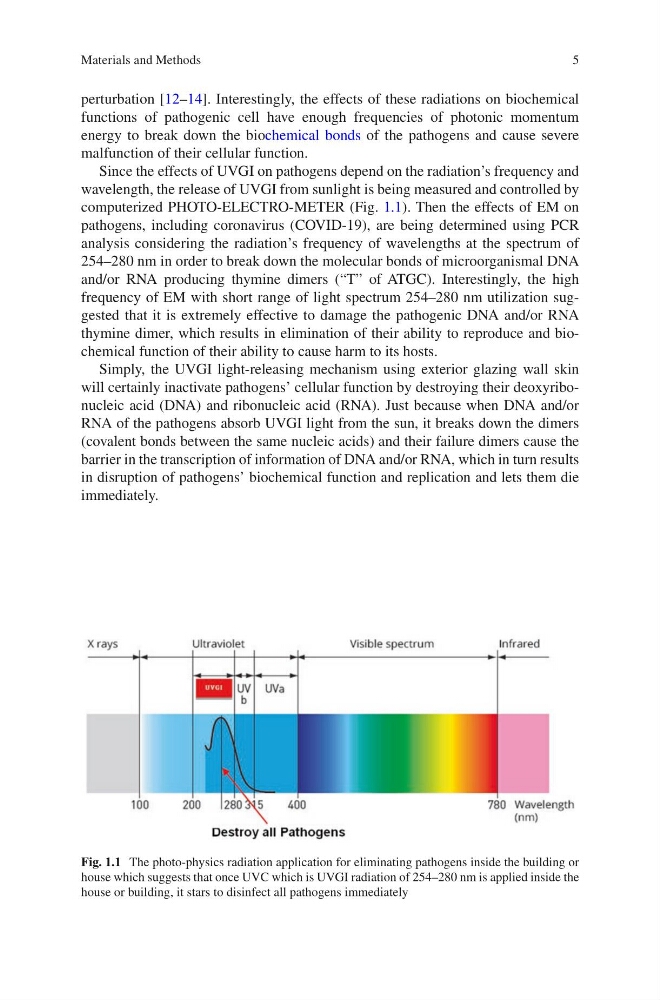
computerized PHOTO-ELECTRO-METER (Fig. 1.1). Then the effects of EM on
pathogens, including coronavirus (COVID-19), are being determined using PCR
analysis considering the radiation’s frequency of wavelengths at the spectrum of
254–280 nm in order to break down the molecular bonds of microorganismal DNA
and/or RNA producing thymine dimers (“T” of ATGC). Interestingly, the high
frequency of EM with short range of light spectrum 254–280 nm utilization suggested that it is extremely effective to damage the pathogenic DNA and/or RNA
thymine dimer, which results in elimination of their ability to reproduce and biochemical function of their ability to cause harm to its hosts.
Simply, the UVGI light-releasing mechanism using exterior glazing wall skin
will certainly inactivate pathogens’ cellular function by destroying their deoxyribonucleic acid (DNA) and ribonucleic acid (RNA). Just because when DNA and/or
RNA of the pathogens absorb UVGI light from the sun, it breaks down the dimers
(covalent bonds between the same nucleic acids) and their failure dimers cause the
barrier in the transcription of information of DNA and/or RNA, which in turn results
in disruption of pathogens’ biochemical function and replication and lets them die
immediately.
Fig. 1.1 The photo-physics radiation application for eliminating pathogens inside the building or
house which suggests that once UVC which is UVGI radiation of 254–280 nm is applied inside the
house or building, it stars to disinfect all pathogens immediately
Materials and Methods
perturbation [12–14]. Interestingly, the effects of these radiations on biochemical
functions of pathogenic cell have enough frequencies of photonic momentum
energy to break down the biochemical bonds of the pathogens and cause severe
malfunction of their cellular function.
Since the effects of UVGI on pathogens depend on the radiation’s frequency and
wavelength, the release of UVGI from sunlight is being measured and controlled by
computerized PHOTO-ELECTRO-METER (Fig. 1.1). Then the effects of EM on
pathogens, including coronavirus (COVID-19), are being determined using PCR
analysis considering the radiation’s frequency of wavelengths at the spectrum of
254–280 nm in order to break down the molecular bonds of microorganismal DNA
and/or RNA producing thymine dimers (“T” of ATGC). Interestingly, the high
frequency of EM with short range of light spectrum 254–280 nm utilization suggested that it is extremely effective to damage the pathogenic DNA and/or RNA
thymine dimer, which results in elimination of their ability to reproduce and biochemical function of their ability to cause harm to its hosts.
Simply, the UVGI light-releasing mechanism using exterior glazing wall skin
will certainly inactivate pathogens’ cellular function by destroying their deoxyribonucleic acid (DNA) and ribonucleic acid (RNA). Just because when DNA and/or
RNA of the pathogens absorb UVGI light from the sun, it breaks down the dimers
(covalent bonds between the same nucleic acids) and their failure dimers cause the
barrier in the transcription of information of DNA and/or RNA, which in turn results
in disruption of pathogens’ biochemical function and replication and lets them die
immediately.
Fig. 1.1 The photo-physics radiation application for eliminating pathogens inside the building or
house which suggests that once UVC which is UVGI radiation of 254–280 nm is applied inside the
house or building, it stars to disinfect all pathogens immediately
Materials and Methods