

3.4 Surface Stress Versus Surface Charge Density or Potential …
87
charge density for a (111)-textured Au thin-film (cantilever) electrode (L = 24.2 mm,
b = 3 mm, and h = 0.1 mm) in 0.1 M HClO 4 solution, responding to a sinusoidal
potential input of ±50 mV at a steady-state potential of 0.2 V (SSE) where no
faradaic process takes place [39]. A saturated Hg/HgSO 4 electrode (SSE) is used
as a reference electrode in experiment of Fig. 3.11, which is +0.64 V referred to a
standard hydrogen electrode (SHE). The two resonant modes at 46 and 300 Hz are
observed from the sharp increases in
ζ g,q
and ψ g,q , which are consistent with those
predicted [39]. In the frequency range of 0.1 to 20 Hz,
ζ g,q
keeps constant, taking
an average value of 2.0 V, while ψ g,q has a constant value of −180
o from which
an average value of ζ g,q =
g ac
q ac
= −2.0 V is obtained in the entire frequency range
where the cantilever is non-resonant. It is confirmed [39] that the value of
ζ g,q
is not
influenced by the amplitude of the sinusoidal potential input in the range of ±5 mV
to ±80 mV but the uncertainty in
ζ g,q
is larger for the smaller amplitude of signals.
The value of ζ g,q = −2.0 V determined by DAS combined with EIS is consistent
with those reported for the (111)-textured Au thin-film electrode in NaF and HClO 4
solutions by Smetanin et al. [35].
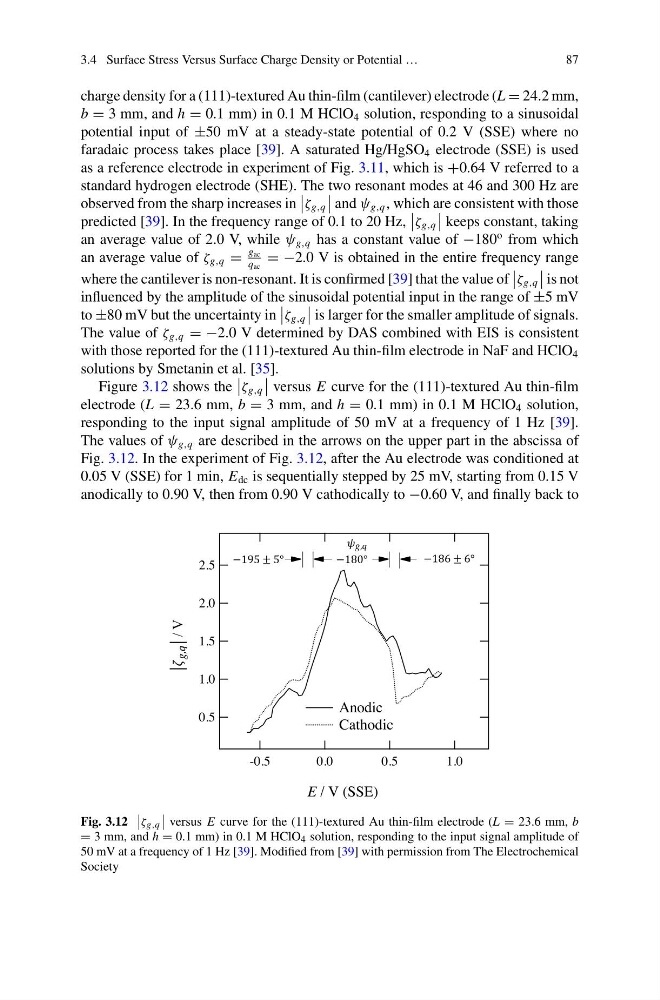
Figure 3.12 shows the
ζ g,q
versus E curve for the (111)-textured Au thin-film
electrode (L = 23.6 mm, b = 3 mm, and h = 0.1 mm) in 0.1 M HClO 4 solution,
responding to the input signal amplitude of 50 mV at a frequency of 1 Hz [39].
The values of ψ g,q are described in the arrows on the upper part in the abscissa of
Fig. 3.12. In the experiment of Fig. 3.12, after the Au electrode was conditioned at
0.05 V (SSE) for 1 min, E dc is sequentially stepped by 25 mV, starting from 0.15 V
anodically to 0.90 V, then from 0.90 V cathodically to −0.60 V, and finally back to
g
Fig. 3.12
ζ g,q
versus E curve for the (111)-textured Au thin-film electrode (L = 23.6 mm, b
= 3 mm, and h = 0.1 mm) in 0.1 M HClO 4 solution, responding to the input signal amplitude of
50 mV at a frequency of 1 Hz [39]. Modified from [39] with permission from The Electrochemical
Society
87
charge density for a (111)-textured Au thin-film (cantilever) electrode (L = 24.2 mm,
b = 3 mm, and h = 0.1 mm) in 0.1 M HClO 4 solution, responding to a sinusoidal
potential input of ±50 mV at a steady-state potential of 0.2 V (SSE) where no
faradaic process takes place [39]. A saturated Hg/HgSO 4 electrode (SSE) is used
as a reference electrode in experiment of Fig. 3.11, which is +0.64 V referred to a
standard hydrogen electrode (SHE). The two resonant modes at 46 and 300 Hz are
observed from the sharp increases in
ζ g,q
and ψ g,q , which are consistent with those
predicted [39]. In the frequency range of 0.1 to 20 Hz,
ζ g,q
keeps constant, taking
an average value of 2.0 V, while ψ g,q has a constant value of −180
o from which
an average value of ζ g,q =
g ac
q ac
= −2.0 V is obtained in the entire frequency range
where the cantilever is non-resonant. It is confirmed [39] that the value of
ζ g,q
is not
influenced by the amplitude of the sinusoidal potential input in the range of ±5 mV
to ±80 mV but the uncertainty in
ζ g,q
is larger for the smaller amplitude of signals.
The value of ζ g,q = −2.0 V determined by DAS combined with EIS is consistent
with those reported for the (111)-textured Au thin-film electrode in NaF and HClO 4
solutions by Smetanin et al. [35].
Figure 3.12 shows the
ζ g,q
versus E curve for the (111)-textured Au thin-film
electrode (L = 23.6 mm, b = 3 mm, and h = 0.1 mm) in 0.1 M HClO 4 solution,
responding to the input signal amplitude of 50 mV at a frequency of 1 Hz [39].
The values of ψ g,q are described in the arrows on the upper part in the abscissa of
Fig. 3.12. In the experiment of Fig. 3.12, after the Au electrode was conditioned at
0.05 V (SSE) for 1 min, E dc is sequentially stepped by 25 mV, starting from 0.15 V
anodically to 0.90 V, then from 0.90 V cathodically to −0.60 V, and finally back to
g
Fig. 3.12
ζ g,q
versus E curve for the (111)-textured Au thin-film electrode (L = 23.6 mm, b
= 3 mm, and h = 0.1 mm) in 0.1 M HClO 4 solution, responding to the input signal amplitude of
50 mV at a frequency of 1 Hz [39]. Modified from [39] with permission from The Electrochemical
Society