

3.2 Surface Reconstruction
75
1.26
1.24
1.22
1.20
1.18
/ J m
-2
0.8
0.4
0.0
-0.4
E / V (SCE)
Au (111)-(1x1)
Au (111)-(rec)
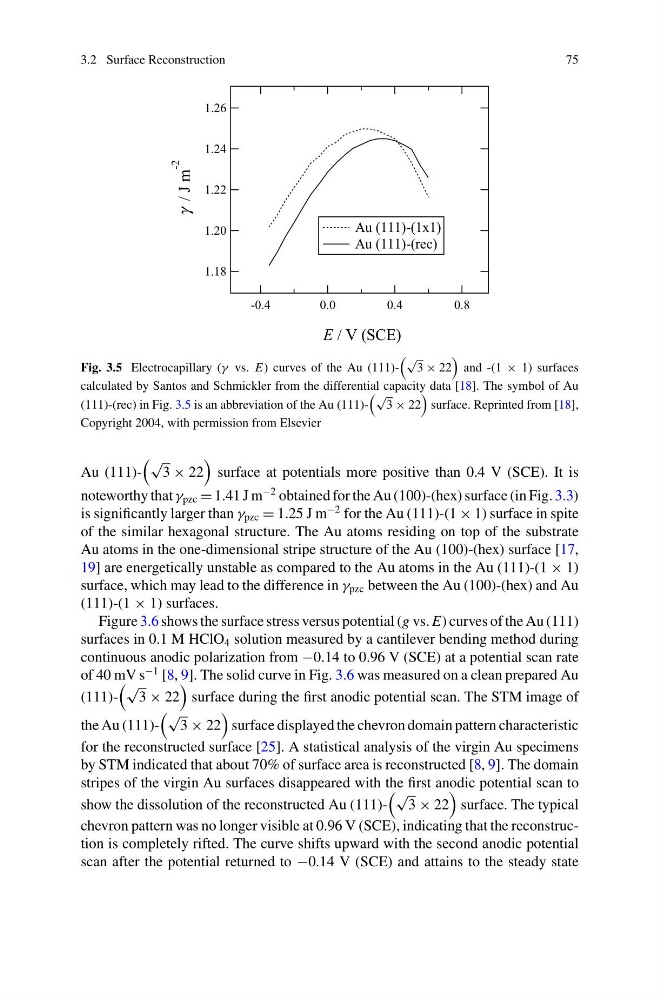
Fig. 3.5 Electrocapillary (γ vs. E) curves of the Au (111)3 × 22
and -(1 × 1) surfaces
calculated by Santos and Schmickler from the differential capacity data [18]. The symbol of Au
(111)-(rec) in Fig. 3.5 is an abbreviation of the Au (111)3 × 22
surface. Reprinted from [18],
Copyright 2004, with permission from Elsevier
Au (111)3 × 22
surface at potentials more positive than 0.4 V (SCE). It is
noteworthy that γ pzc = 1.41 J m
−2 obtained for the Au (100)-(hex) surface (in Fig. 3.3)
is significantly larger than γ pzc = 1.25 J m
−2 for the Au (111)-(1 × 1) surface in spite
of the similar hexagonal structure. The Au atoms residing on top of the substrate
Au atoms in the one-dimensional stripe structure of the Au (100)-(hex) surface [17,
19] are energetically unstable as compared to the Au atoms in the Au (111)-(1 × 1)
surface, which may lead to the difference in γ pzc between the Au (100)-(hex) and Au
(111)-(1 × 1) surfaces.
Figure 3.6 shows the surface stress versus potential (g vs. E) curves of the Au (111)
surfaces in 0.1 M HClO 4 solution measured by a cantilever bending method during
continuous anodic polarization from −0.14 to 0.96 V (SCE) at a potential scan rate
of 40 mV s
−1 [8, 9]. The solid curve in Fig. 3.6 was measured on a clean prepared Au
(111)3 × 22
surface during the first anodic potential scan. The STM image of
the Au (111)3 × 22
surface displayed the chevron domain pattern characteristic
for the reconstructed surface [25]. A statistical analysis of the virgin Au specimens
by STM indicated that about 70% of surface area is reconstructed [8, 9]. The domain
stripes of the virgin Au surfaces disappeared with the first anodic potential scan to
show the dissolution of the reconstructed Au (111)3 × 22
surface. The typical
chevron pattern was no longer visible at 0.96 V (SCE), indicating that the reconstruction is completely rifted. The curve shifts upward with the second anodic potential
scan after the potential returned to −0.14 V (SCE) and attains to the steady state
75
1.26
1.24
1.22
1.20
1.18
/ J m
-2
0.8
0.4
0.0
-0.4
E / V (SCE)
Au (111)-(1x1)
Au (111)-(rec)
Fig. 3.5 Electrocapillary (γ vs. E) curves of the Au (111)3 × 22
and -(1 × 1) surfaces
calculated by Santos and Schmickler from the differential capacity data [18]. The symbol of Au
(111)-(rec) in Fig. 3.5 is an abbreviation of the Au (111)3 × 22
surface. Reprinted from [18],
Copyright 2004, with permission from Elsevier
Au (111)3 × 22
surface at potentials more positive than 0.4 V (SCE). It is
noteworthy that γ pzc = 1.41 J m
−2 obtained for the Au (100)-(hex) surface (in Fig. 3.3)
is significantly larger than γ pzc = 1.25 J m
−2 for the Au (111)-(1 × 1) surface in spite
of the similar hexagonal structure. The Au atoms residing on top of the substrate
Au atoms in the one-dimensional stripe structure of the Au (100)-(hex) surface [17,
19] are energetically unstable as compared to the Au atoms in the Au (111)-(1 × 1)
surface, which may lead to the difference in γ pzc between the Au (100)-(hex) and Au
(111)-(1 × 1) surfaces.
Figure 3.6 shows the surface stress versus potential (g vs. E) curves of the Au (111)
surfaces in 0.1 M HClO 4 solution measured by a cantilever bending method during
continuous anodic polarization from −0.14 to 0.96 V (SCE) at a potential scan rate
of 40 mV s
−1 [8, 9]. The solid curve in Fig. 3.6 was measured on a clean prepared Au
(111)3 × 22
surface during the first anodic potential scan. The STM image of
the Au (111)3 × 22
surface displayed the chevron domain pattern characteristic
for the reconstructed surface [25]. A statistical analysis of the virgin Au specimens
by STM indicated that about 70% of surface area is reconstructed [8, 9]. The domain
stripes of the virgin Au surfaces disappeared with the first anodic potential scan to
show the dissolution of the reconstructed Au (111)3 × 22
surface. The typical
chevron pattern was no longer visible at 0.96 V (SCE), indicating that the reconstruction is completely rifted. The curve shifts upward with the second anodic potential
scan after the potential returned to −0.14 V (SCE) and attains to the steady state