

50
2 Methods for Investigating Electro-Chemo-Mechanical …
subjected to compressive or tensile surface stress due to charging, adsorption, surface
reconstruction, etc.
In his original derivation [20], Stoney considered only a uniaxial stress in the
direction of bending, a situation of which is normally not encountered. Ibach [21–23]
modified the Stoney’s original equation by taking into account the biaxial nature of
the stress and the geometry of the specimen under different boundary conditions. The
modified Stoney’s equation can be derived from the balancing of bending moments
or torques along the principal axes in the solid, i.e., the vanishing of net bending
moment [1, 22] (see Eq. (2.11)). Alternatively, the modified Stoney’s equation can
be also derived from a minimum of the total elastic energy per unit area in the sample
plate at a particular curvature [21, 23]. Ibach [21] derived the modified equation from
the minimization of the total elastic energy (including surface and bulk) based on
elasticity theory under two boundary conditions: one is that the bending is allowed
only in one direction (i.e., uniaxial bending), and the other one is that the bending is
free in both principal directions (i.e., biaxial bending).
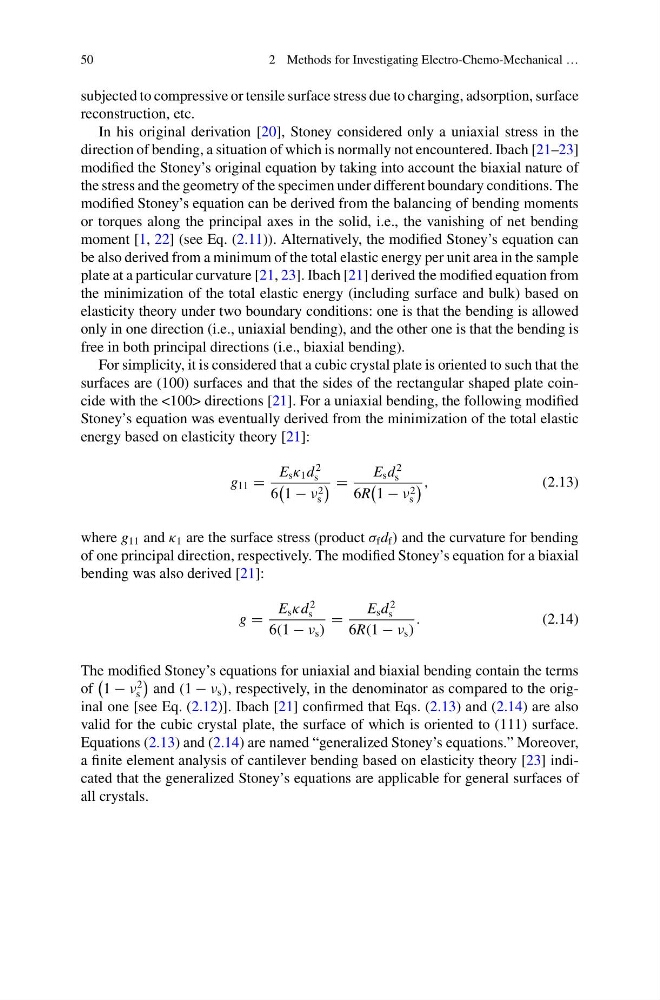
For simplicity, it is considered that a cubic crystal plate is oriented to such that the
surfaces are (100) surfaces and that the sides of the rectangular shaped plate coincide with the <100> directions [21]. For a uniaxial bending, the following modified
Stoney’s equation was eventually derived from the minimization of the total elastic
energy based on elasticity theory [21]:
g 11 =
E s κ 1 d
2
s
6
1 − ν 2
s
=
E s d
2
s
6R
1 − ν 2
s
,
(2.13)
where g 11 and κ 1 are the surface stress (product σ f d f ) and the curvature for bending
of one principal direction, respectively. The modified Stoney’s equation for a biaxial
bending was also derived [21]:
g =
E s κd
2
s
6(1 − ν s )
=
E s d
2
s
6R(1 − ν s )
.
(2.14)
The modified Stoney’s equations for uniaxial and biaxial bending contain the terms
of
1 − ν
2
s
and (1 − ν s ), respectively, in the denominator as compared to the original one [see Eq. (2.12)]. Ibach [21] confirmed that Eqs. (2.13) and (2.14) are also
valid for the cubic crystal plate, the surface of which is oriented to (111) surface.
Equations (2.13) and (2.14) are named “generalized Stoney’s equations.” Moreover,
a finite element analysis of cantilever bending based on elasticity theory [23] indicated that the generalized Stoney’s equations are applicable for general surfaces of
all crystals.
2 Methods for Investigating Electro-Chemo-Mechanical …
subjected to compressive or tensile surface stress due to charging, adsorption, surface
reconstruction, etc.
In his original derivation [20], Stoney considered only a uniaxial stress in the
direction of bending, a situation of which is normally not encountered. Ibach [21–23]
modified the Stoney’s original equation by taking into account the biaxial nature of
the stress and the geometry of the specimen under different boundary conditions. The
modified Stoney’s equation can be derived from the balancing of bending moments
or torques along the principal axes in the solid, i.e., the vanishing of net bending
moment [1, 22] (see Eq. (2.11)). Alternatively, the modified Stoney’s equation can
be also derived from a minimum of the total elastic energy per unit area in the sample
plate at a particular curvature [21, 23]. Ibach [21] derived the modified equation from
the minimization of the total elastic energy (including surface and bulk) based on
elasticity theory under two boundary conditions: one is that the bending is allowed
only in one direction (i.e., uniaxial bending), and the other one is that the bending is
free in both principal directions (i.e., biaxial bending).
For simplicity, it is considered that a cubic crystal plate is oriented to such that the
surfaces are (100) surfaces and that the sides of the rectangular shaped plate coincide with the <100> directions [21]. For a uniaxial bending, the following modified
Stoney’s equation was eventually derived from the minimization of the total elastic
energy based on elasticity theory [21]:
g 11 =
E s κ 1 d
2
s
6
1 − ν 2
s
=
E s d
2
s
6R
1 − ν 2
s
,
(2.13)
where g 11 and κ 1 are the surface stress (product σ f d f ) and the curvature for bending
of one principal direction, respectively. The modified Stoney’s equation for a biaxial
bending was also derived [21]:
g =
E s κd
2
s
6(1 − ν s )
=
E s d
2
s
6R(1 − ν s )
.
(2.14)
The modified Stoney’s equations for uniaxial and biaxial bending contain the terms
of
1 − ν
2
s
and (1 − ν s ), respectively, in the denominator as compared to the original one [see Eq. (2.12)]. Ibach [21] confirmed that Eqs. (2.13) and (2.14) are also
valid for the cubic crystal plate, the surface of which is oriented to (111) surface.
Equations (2.13) and (2.14) are named “generalized Stoney’s equations.” Moreover,
a finite element analysis of cantilever bending based on elasticity theory [23] indicated that the generalized Stoney’s equations are applicable for general surfaces of
all crystals.