

2.2 Piezoelectric Detection of Differential Surface Stress
47
of concentration; i.e.,
∂q 2
∂ε
−
∂q 1
∂ε
is equal to
∂q 4
∂ε
−
∂q 3
∂ε
[5]. Consequently, K is
eventually given by:
K =
(q 2 − q 1 ) − (q 4 − q 3 )
(|A 2 | − |A 1 |) − (|A 4 | − |A 3 |)
.
(2.9)
The value of K can be directly obtained from the respective values of |A| and q in
the measured a, a
, b, and b
curves (Fig. 2.6).
One of the important results obtained by the piezoelectric detection of differential
surface stress is that another minimum of |A| with a change of ϕ by 180
o (i.e.,
sign-reversal of differential surface stress) emerges often in the high potential region
where a monolayer of surface oxide such as PtO and PdO [2, 9, 14–16] is formed. It
is presumed from the Gokhshtein equation that the sign-reversal of the differential
surface stress takes place when the sign of
∂q
∂ε
changes from plus to minus so as
to satisfy the inequality of −q >
∂q
∂ε
after passing through −q =
∂q
∂ε
in the course
of the monolayer formation of surface oxide. The piezoelectric electrode has been
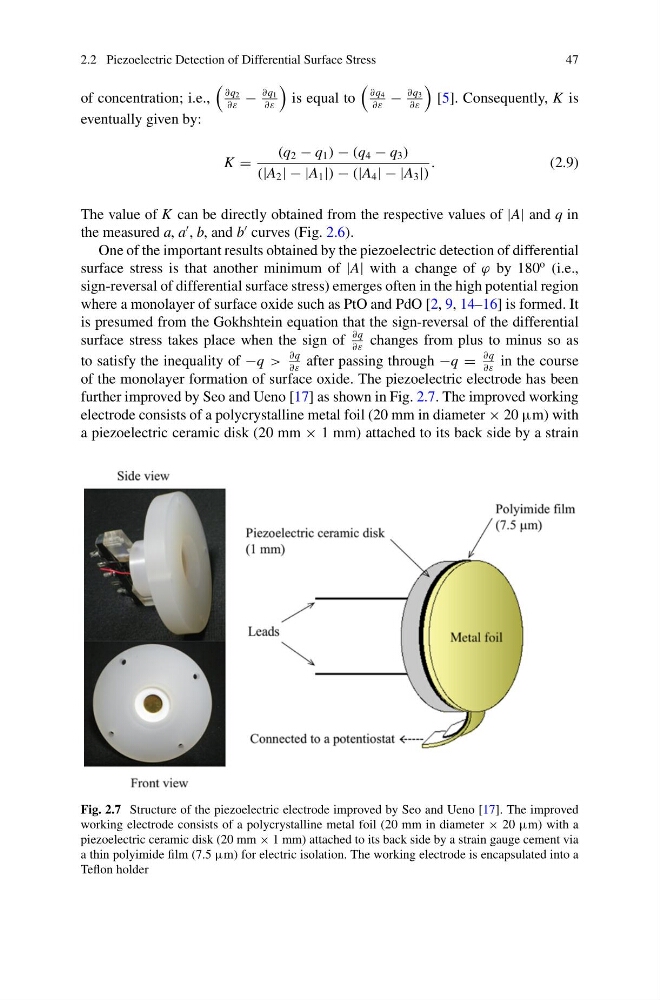
further improved by Seo and Ueno [17] as shown in Fig. 2.7. The improved working
electrode consists of a polycrystalline metal foil (20 mm in diameter × 20 µm) with
a piezoelectric ceramic disk (20 mm × 1 mm) attached to its back side by a strain
Fig. 2.7 Structure of the piezoelectric electrode improved by Seo and Ueno [17]. The improved
working electrode consists of a polycrystalline metal foil (20 mm in diameter × 20 µm) with a
piezoelectric ceramic disk (20 mm × 1 mm) attached to its back side by a strain gauge cement via
a thin polyimide film (7.5 µm) for electric isolation. The working electrode is encapsulated into a
Teflon holder
47
of concentration; i.e.,
∂q 2
∂ε
−
∂q 1
∂ε
is equal to
∂q 4
∂ε
−
∂q 3
∂ε
[5]. Consequently, K is
eventually given by:
K =
(q 2 − q 1 ) − (q 4 − q 3 )
(|A 2 | − |A 1 |) − (|A 4 | − |A 3 |)
.
(2.9)
The value of K can be directly obtained from the respective values of |A| and q in
the measured a, a
, b, and b
curves (Fig. 2.6).
One of the important results obtained by the piezoelectric detection of differential
surface stress is that another minimum of |A| with a change of ϕ by 180
o (i.e.,
sign-reversal of differential surface stress) emerges often in the high potential region
where a monolayer of surface oxide such as PtO and PdO [2, 9, 14–16] is formed. It
is presumed from the Gokhshtein equation that the sign-reversal of the differential
surface stress takes place when the sign of
∂q
∂ε
changes from plus to minus so as
to satisfy the inequality of −q >
∂q
∂ε
after passing through −q =
∂q
∂ε
in the course
of the monolayer formation of surface oxide. The piezoelectric electrode has been
further improved by Seo and Ueno [17] as shown in Fig. 2.7. The improved working
electrode consists of a polycrystalline metal foil (20 mm in diameter × 20 µm) with
a piezoelectric ceramic disk (20 mm × 1 mm) attached to its back side by a strain
Fig. 2.7 Structure of the piezoelectric electrode improved by Seo and Ueno [17]. The improved
working electrode consists of a polycrystalline metal foil (20 mm in diameter × 20 µm) with a
piezoelectric ceramic disk (20 mm × 1 mm) attached to its back side by a strain gauge cement via
a thin polyimide film (7.5 µm) for electric isolation. The working electrode is encapsulated into a
Teflon holder