

42
2 Methods for Investigating Electro-Chemo-Mechanical …
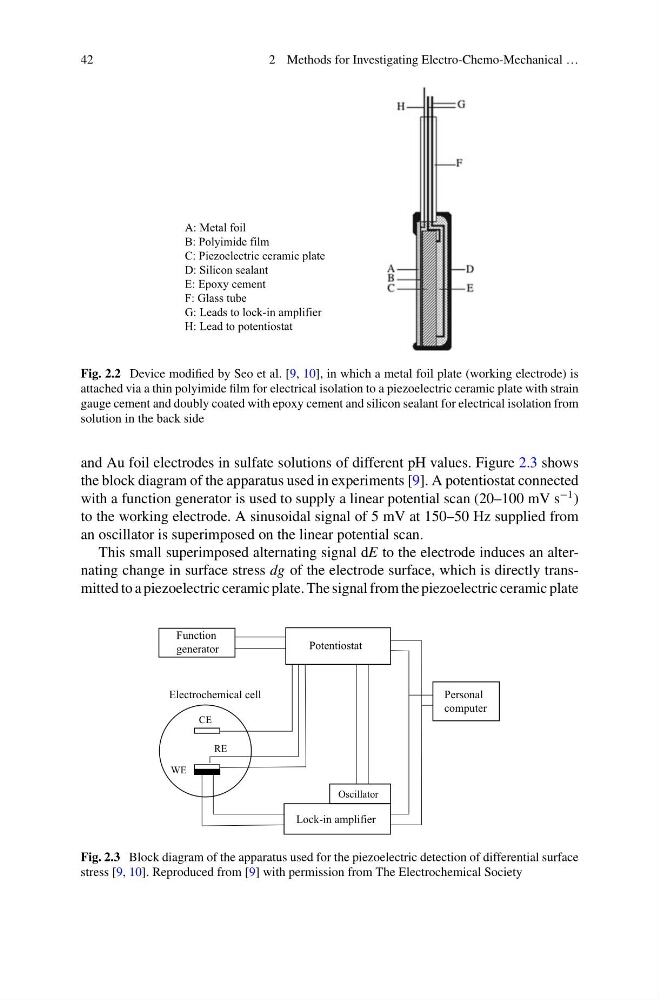
A: Metal foil
B: Polyimide film
C: Piezoelectric ceramic plate
D: Silicon sealant
E: Epoxy cement
F: Glass tube
G: Leads to lock-in amplifier
H: Lead to potentiostat
Fig. 2.2 Device modified by Seo et al. [9, 10], in which a metal foil plate (working electrode) is
attached via a thin polyimide film for electrical isolation to a piezoelectric ceramic plate with strain
gauge cement and doubly coated with epoxy cement and silicon sealant for electrical isolation from
solution in the back side
and Au foil electrodes in sulfate solutions of different pH values. Figure 2.3 shows
the block diagram of the apparatus used in experiments [9]. A potentiostat connected
with a function generator is used to supply a linear potential scan (20–100 mV s
−1 )
to the working electrode. A sinusoidal signal of 5 mV at 150–50 Hz supplied from
an oscillator is superimposed on the linear potential scan.
This small superimposed alternating signal dE to the electrode induces an alternating change in surface stress dg of the electrode surface, which is directly transmitted to a piezoelectric ceramic plate. The signal from the piezoelectric ceramic plate
Electrochemical cell
Function
generator
Potentiostat
Personal
computer
Oscillator
Lock-in amplifier
CE
RE
WE
Fig. 2.3 Block diagram of the apparatus used for the piezoelectric detection of differential surface
stress [9, 10]. Reproduced from [9] with permission from The Electrochemical Society
2 Methods for Investigating Electro-Chemo-Mechanical …
A: Metal foil
B: Polyimide film
C: Piezoelectric ceramic plate
D: Silicon sealant
E: Epoxy cement
F: Glass tube
G: Leads to lock-in amplifier
H: Lead to potentiostat
Fig. 2.2 Device modified by Seo et al. [9, 10], in which a metal foil plate (working electrode) is
attached via a thin polyimide film for electrical isolation to a piezoelectric ceramic plate with strain
gauge cement and doubly coated with epoxy cement and silicon sealant for electrical isolation from
solution in the back side
and Au foil electrodes in sulfate solutions of different pH values. Figure 2.3 shows
the block diagram of the apparatus used in experiments [9]. A potentiostat connected
with a function generator is used to supply a linear potential scan (20–100 mV s
−1 )
to the working electrode. A sinusoidal signal of 5 mV at 150–50 Hz supplied from
an oscillator is superimposed on the linear potential scan.
This small superimposed alternating signal dE to the electrode induces an alternating change in surface stress dg of the electrode surface, which is directly transmitted to a piezoelectric ceramic plate. The signal from the piezoelectric ceramic plate
Electrochemical cell
Function
generator
Potentiostat
Personal
computer
Oscillator
Lock-in amplifier
CE
RE
WE
Fig. 2.3 Block diagram of the apparatus used for the piezoelectric detection of differential surface
stress [9, 10]. Reproduced from [9] with permission from The Electrochemical Society